
What is a Pension and Why Does it Matter?
[2026] 2 FRJ 128. In the absence of a definition accepted by all in the family law sphere, do we fall into error in a strict categorisation of this complex asset category?
Ask any individual who sat on the Pension Advisory Group (PAG) to define a pension, and you are likely to be met with a different answer from each.
| PAG Report | Does not explicitly define a pension. |
| Cambridge Dictionary | ‘An amount of money paid regularly by the government or a private company to a person who does not work anymore because they are too old or have become ill.’ |
| Oxford Dictionary | ‘An amount of money paid regularly by a government or company to somebody who has retired from work.’ |
| Martin Dye v Martin Dye [2006] EWCA Civ 681, [2006] 2 FLR 901 | Thorpe LJ: ‘[Pensions] are to be characterised as “other financial resources” within the section 25(2) (a) classification. For they do not sit comfortably in the category of “property”, since they are unrealisable and non-transferable. Nor do they sit comfortably in the category of “income” because, although purely an income stream, the income does not derive from future endeavour but from past employment or contribution which will generally have been effected during the years of marriage’. |
| SJ v RA [2014] EWHC 4054 (Fam) | Nicholas Francis QC (then, and sitting as a deputy High Court Judge) said: ‘the recent well published changes to pension regulations will mean that pension investments are virtually to be treated as bank accounts to people over 55’. |
| W v H [2020] EWFC 810 | HHJ Hess recognised the different nuances arising: ‘There is no one size fits all’ with this being in recognition of the differences that arise depending upon DB and DC schemes and ages of parties/proximity to retirement age. |
Perhaps though it is more useful to define a pension as a form of deferred pay, such that a pension scheme is a mechanism by which one can defer gratification from earnings today in favour of enjoying these in some form when one is unable to work. This point was recognised in the European Court of Justice ruling of Case C-262/88 Barber v Guardian Royal Exchange Assurance Group (1990). This definition is most explicitly true with the security that comes from having a salary-related defined benefit (DB) pension but is also true with a defined contribution (DC) pension where no formal benefit promise exists.
Our proposition is that a pension is a unique asset (as we seek to demonstrate below) that cannot and should not be ascribed the categorisation of ‘capital’ or ‘income’ because that is an oversimplification. There must be a recognition that it is erroneous to ascribe an oversimplified approach or categorisation with to an asset that takes so many different forms – even DC and DB arrangements (being the two main types of pensions recognised by PAG) can mask the complexities surrounding this asset. There are, to name but a few, DB schemes based on career average revalued earnings (CARE), public sector DB schemes (not funded), schemes from an employer paying a proportion of the final pensionable salary, small self-administered pension schemes (SSAS), unapproved retirement benefit schemes (FURBS and UURBS), retirement annuity contracts (RAC), etc. This asset class is heavily regulated and subject to change depending upon legislation; one only has to consider the impact of the lifetime allowance, introduced and abolished all within 20 years. From April 2027, the government plans to bring pension funds into a person’s estate for inheritance tax purposes. This is a complex asset.
To support our proposition, we highlight the unique qualities of such an asset category, including the difficulties associated with providing accurate valuations. However, we propose to return to valuation issues in article three in this series, to highlight the complexities in the valuation process). We do, however, touch on valuation terminology below to highlight the uniqueness of the pension asset category.
The valuation exercise and terminology used for the exercise
When we consider offsetting alone, a considerable number of terms are used by pension providers, pension on divorce experts (PODEs) and others to describe the value of the pension. This vast array of terminology includes:
- best estimate market consistent capital value;
- DC fund equivalent;
- fair actuarial value;
- full value;
- money purchase equivalent value;
- open market value;
- pension share declined;
- pension share denied; and
- cash equivalent transfer value (CETV) (and variations on a theme on this).
The terminology and the description used and the analysis of the CETV is alone a confusing and complex issue. There is more widespread knowledge that the CETVs of DB pension schemes will not necessarily reflect the fair value of the underlying pension rights.
Offsetting has its own complexities and is fraught with problems from a professional negligence risk point of view. The accumulation rates pre-retirement are hard to predict. What allowance is made for inflationary pension increases in the future? What are you predicting will be the position at retirement? Do you use annuity rates, or do you assume some form of drawdown? Do you allow for a contingent spouse pension? Significant help has been given by the Galbraith Tables, which were revised in early 2024 to reflect changes in market conditions.
The oversimplification aspect of categorisation of pensions might be illustrated from the worked example below.
- The parties had a 30-year marriage.
- All pensions were accrued during the marriage.
- H 64 and W 55 (no underlying health issues).
- Total pensions were valued at £3.6m, of which:
- H CETV of £1m in DB scheme with very favourable underlying benefits/annual inflationary increases/dependants’ benefits of substance/normal retirement date 65/no funding issues.
- H and W hold £2.6m of value in their company’s SSAS.
- SSAS holds commercial properties – property X and property Y.
- Property X subject to a long rent paying £120k per annum (above market rate and no break clauses/further 15 years to run).
- Property Y has been empty for several years/so no rental income derived but has the potential for both development opportunity but also an enhanced value given recent interest showed by an adjoining landowner who would be a special purchaser.
The above example highlights:
(1) H will not want to sacrifice his DB scheme entitlement – no investment risk/no investment cost/guaranteed income for life/inflation proofed income stream.
(2) The SSAS presents risk to both H and W.
(3) Liquidity issues with property X if there is no break clause/impact selling with existing tenant might have on value/extraction of funds would be limited to rental income net of expenditure, etc.
(4) Uncertainty over value of property Y/sale delayed/sale not achieved/no rental income received.
(5) Property Y has maintenance costs with no rental income from which to meet the costs creating possible liquidity issues over maintaining the asset until sold/rented.
(6) If the parties remain in the SSAS together, potential for disagreement as to decisions to sell.
(7) Lack of sale creates problems with accessing tax-free cash lump sums.
(8) If the parties remain in the SSAS, potential for disagreement about accessing income from it.
The straitjacket of capital versus income, in the categorisation of a pension, can lead to unfair results.
Returning to HHJ Hess, W v H (Divorce Financial Remedies) [2020] EWFC B10:
‘60. (i) There is no “one size fits all” answer to this question. [Q: Is it right for the court, in dividing pensions with a view to promoting equality, to target capital equality or to target the promotion of equal incomes?] There are undoubted scenarios where the fair solution is probably to divide pensions by CE value. For example, where the CEs are relatively small in themselves or as a portion of the assets overall. For example, where the parties are relatively young and any projections about the future income producing qualities of the pensions are likely to be speculative or unreliable. For example, where all the pensions are simply defined contribution funds so that the CE values can be regarded as reasonably reliable and simple predictor of future income streams. For example, where the sole pension is involved is a non-uniformed public sector defined benefits scheme offering internal transfers only. There are, however, scenarios where a simple division of CEs may well not represent a fair solution. For example, where the pensions are medium or large, both in themselves and as a portion of the assets overall, but needs issues still arise. This is particularly the case where one or more of the pensions involved is a defined benefit scheme (an income from within the scheme per £1 of CE is likely to be higher than an annuity income outside the scheme per £1 of CE on an external transfer). This is particularly the case where the parties are no longer young and retirement issues are on the horizon.’
Fast forward to 2024, when the same judge, in SP v AL [2024] EWFC 72 (B), addressed the issue of income versus capital and said:
‘I have noticed that it is not uncommon for PODEs to be asked to provide an answer not only based on equal incomes but alternatively based on an equal capital approach.’
He concluded that it was an issue to be raised and determined at the first appointment because in most cases the only question which needs to be asked is what level of pension sharing order will produce an equal level of income on retirement, and asking more questions than are necessary will add to the costs of the case and cause confusion. Too often the first appointment does not resolve this issue and the parties exit the process with an order which sanctions the instruction of a PODE but which does not address in sufficient detail the remit of such instruction.
In a much-overlooked case called Burrow v Burrow [1999] 1 FLR 508, Cazalet J considered, with care, the different features which presented themselves in respect of the annuity that the husband had the benefit of and held:
- There were difficulties in treating an annuity provided under a pension scheme in the same way as a capital sum available under that scheme might be treated.
- As regards the capital element of a pension, different considerations applied; ‘I start by considering separately the two different elements which constitute the pension fund, namely the annuity or income fund and the capital fund’.
Other key features of pensions as an asset class
Pensions require (almost) mandatory participation
The 2012 auto-enrolment reforms require that employees earning all but the lowest of wages are admitted to a pension scheme by default, with minimum pension contribution levels being specified. A target of getting some 10.6m people into a workplace pension with such mandatory contribution requirements was set as part of these reforms. Opting out is permitted but barriers to this exist, the effect being to encourage all workers to make provision for their retirement beyond the State Pension entitlement.
Employers must contribute too
Another feature of the auto-enrolment rules is that employers must contribute at least 3% of employee salaries to their pension arrangements (alongside 5% of salaries from employees). However, it is noted that this only applies to ‘qualifying earnings’ and those on higher salaries may receive less than 3% of the total.
The taxation treatment is unique
Pension benefits in general follow the ‘EET’ rule when it comes to tax: contributions are exempt from income tax, the returns on the monies are likewise exempt from taxation and only the benefits are taxed when they are taken (with this being something of a simplification here). This is in contrast, say, to a stocks and shares ISA, where only post-tax income can be deposited but the proceeds are then untaxed.
The limits to the tax reliefs are also unique to pensions
Tax-free contributions are subject to the ‘Annual Allowance’ of £40,000, with this being reduced for very high earners albeit with there being scope to carry forward some prior years’ allowances. The former ‘Lifetime Allowance’, which placed a cap on the level of tax-advantaged pension benefits an individual could have, was abolished in April 2024.
Tax-free benefits exist at retirement
HMRC rules allow a tax-free cash lump sum of 25% of the value of a pension to be taken at retirement, with this being capped at c. £268k. Some DB pensions – especially those in the public sector – come with an automatic lump sum alongside the lifetime pension that is payable.
Tax benefits extend on unto death
In general, DC pension funds that remain upon an individual’s death are not counted for inheritance tax purposes, in contrast to other assets that form an individual’s estate. However, this position is to change in April 2027, when pension rights are to be counted for inheritance tax purposes.
There are age restrictions on when pension benefits can be accessed
Absent the pension schemes of the uniformed services (police, Armed Forces, firefighters) and some unfortunate circumstances around serious ill-health, the minimum age at which one can access pension benefits is 55. Moreover, anyone born after 5 April 1973 will have to wait a further 2 years as the ‘minimum pension age’ increases to 57, again with a few limited exceptions existing.
There are fewer restrictions on how benefits may be taken than before
The 2015 pension freedoms removed the requirement for DC funds to be used to purchase an annuity after the tax-free cash lump sum was taken. Individuals may continue to do so, but can also pursue various drawdown options instead where no explicit product is purchased. The Financial Conduct Authority suggests that since the advent of the 2015 changes, most people have cashed in smaller pension pots while larger pensions have been put into drawdown (wherein funds remain invested, but with amounts being accessed at regular intervals). Former pensions minister Sir Steve Webb also notes that the number of annuities purchased fell by 80% from 2013 to 2015.[[1]]
Some pensions come with explicit guarantees …
DB pensions (including the very large public sector schemes that exist) provide an explicit benefit promise at retirement and inflation-proofing of pension entitlements. Moreover, the State Pension enjoys the benefit of the ‘triple lock guarantee’ (such that each year it increases with the better of prices or wages, subject to a 2.5% minimum increase). It is estimated that there are 6.8m public sector workers (including MPs) who have DB pensions that pay a guaranteed inflation-proofed income for life.[[2]] This comes at enormous expense to the taxpayer, not least as these schemes are in general unfunded, i.e. assets have not been set aside to cover the benefits as these fall due.
… but some other pensions do not
Some older personal pensions might provide guaranteed annuity rates or minimum fund amounts, but these are increasingly rare. By comparison, most DC schemes do not offer any kind of benefit promise and contributions are invested in unit-linked holdings whose value is subject to move in either direction over time.
Rights to a take a transfer of benefits exist
Barring the unfunded public sector DB pension schemes, pension arrangements must in general give their members the right to transfer-out to another arrangement. This is usually a straight transfer of funds in DC schemes, but can also take the form of effecting a ‘DB to DC transfer’ with private sector DB schemes. Extreme caution must be exercised here though, and the law requires that such a transfer may only proceed where advice has been taken.
Various protections for pension rights exist if things go wrong
Public sector DB schemes enjoy the protection of HM Treasury – although there are no explicit funds set aside to cover the liabilities – and private sector DB schemes are covered at least in part by the Pension Protection Fund, which is a ‘lifeboat’ arrangement for schemes whose employers have failed. DC pension funds typically enjoy the £85k protection of the Financial Services Compensation Scheme, but this varies.
Pension rights can be shared by court order
With a view to bringing this back to family law, we note that pension rights can be made the subject of a sharing order or attachment order. The pension sharing order regime was introduced in 1999 and is a unique remedy, insofar as it allows pension benefits to be shared between parties today, even where they cannot be accessed until much later.
Further thoughts
For those still unconvinced, it is far too simplistic an approach that is adopted, sometimes, by the courts in considering what a pension is. We know of no other ‘asset category’ in financial remedy proceedings in which there is a guide – the authors both sat on the Pension Advisory Group 2023, and its report A Guide to the Treatment of Pensions on Divorce (2nd edn, 2024) is recommended reading!
Financial remedy reported decisions are dominated by asset computation running in the millions. The vast majority of court users have insufficient wealth to meet need, let alone consider the principles of sharing and/or compensation. The features of a pension require detailed consideration when assessing the needs of the parties’ post separation and the transition to retirement where every pound of pension needs to be shared to make inroads into the provision of post-retirement income to meet need. Valuable and often overlooked underlying benefits – death in service/dependents’ pensions – can usefully provide security whether or not periodical payments orders are being made.
The analysis of wealth in investigating the construct of matrimonialisation of assets is unlikely to change. The Court of Appeal in Standish v Standish [2024] EWCA Civ 567 considered carefully this construct and the ongoing acknowledgment that ‘the underlying principle is that fairness may require or justify treating property, which was not purely the product of the parties’ joint endeavours, as matrimonial property, and, therefore, within the scope of the sharing principle’. The Court of Appeal answered in the affirmative that the concept of matrimonialisation should continue to be applied.
Nothing in this article should be construed as the authors giving financial advice.
[[1]]: ‘The pension freedoms worked wonders – but not everyone was a winner’, Daily Telegraph, 11 May 2024.


Latest
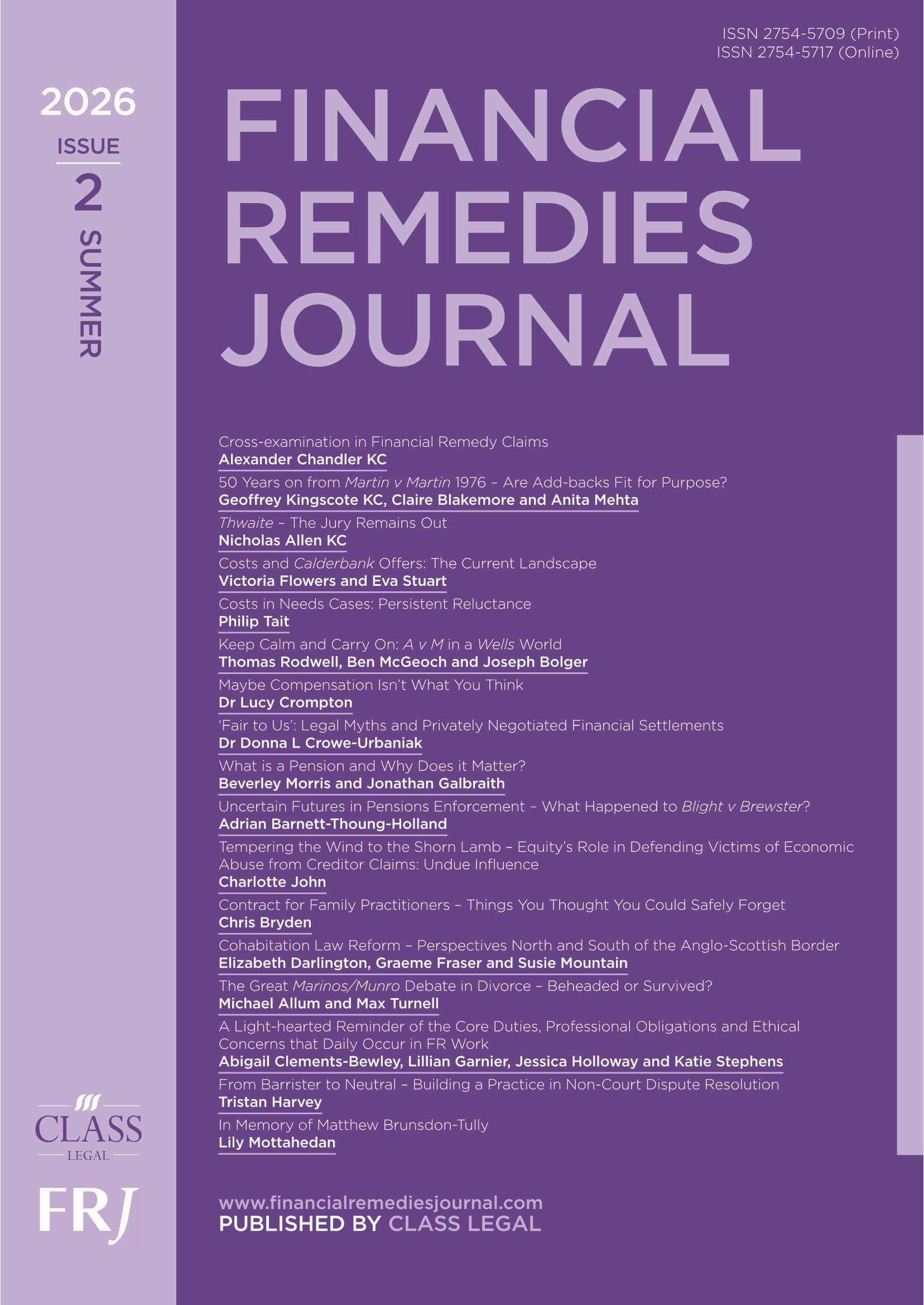
Now out: Financial Remedies Journal 2026 Issue 2 (Summer 2026)

The Right Side of History: Protection Against Domestic Abuse as a Key Theme of the Government Consultation into Financial Remedies