
MH v FD [2025] EWFC 390
Mr Justin Warshaw KC, sitting as a deputy High Court judge. Application for interim relief within proceedings brought under Schedule 1 to the Children Act 1989. The father took the 'millionaire's defence'.
Judgment date: 22 October 2025
https://caselaw.nationalarchives.gov.uk/ewfc/2025/390
Mr Justin Warshaw KC, sitting as a deputy High Court judge. Application for interim relief within proceedings brought under Schedule 1 to the Children Act 1989. The father took the ‘millionaire’s defence’.
Background
M (self-employed) and F (a high-profile entrepreneur and philanthropist) had a child under four years’ old, who lived with M and M’s parents; [1]–[3]. The parties’ relationship was over before the child’s birth; [4].
F adopted the ‘millionaire’s defence’, i.e. a concession that he can meet any reasonable order of the court; [3]. This position cannot defend against the disclosure of resources but does defend against the discovery of documents and the interrogation of assertions made in disclosure; [3].
F had not paid anything toward the child’s expenses apart from £650; [4]. F said that M’s father had told him that he would support M and the child, and that there had been issues surrounding contact; [4].
The parties had attempted mediation unsuccessfully, and F had issued an application for substantive child arrangements; [6]. M had raised allegations of coercive and controlling behaviour against F; [6]. The judge anticipated that the adjourned FHDRA might resolve the outstanding child arrangements issues; [6].
The parties’ resources
F accepted that he was very wealthy and could afford any reasonable provision that the court may order; [14].
Considering M’s capital position, the judge concluded that her resources were ‘wholly insignificant’ in contrast to F’s resources; [15]–[19]. The judge found no evidence that M had entitlement to draw on her family’s resources; [19]. He did not deem it necessary to have complete documentation of her figures for the interim hearing; [19].
The parties seriously disputed M’s self-employed income since April 2025, with M setting the total gross receipt at £86,000 and F setting it at upwards of £267,000; [21]. The judge concluded that accepting either parties’ figure made little difference to his appraisal of her capital position, given its paucity in comparison to F’s capital position; [21]. He therefore set M’s total net income per annum at £50,000, noting that it could be corrected at final hearing; [21].
Regarding M’s liability to her parents (undocumented loans, which she alleged totalled £164,000 including £92,000 relating to the child), F submitted that the sums were actually payments made by them to M representing an ongoing resource; [22]. The judge left the issue of determining if they were loans to the trial but found F’s suggestion an ‘unattractive submission’; [22]. The judge noted that the child was not the responsibility of M’s parents, and that ‘F should be making proper provision for X as a matter of principle’; [22].
M’s heads of relief
The judge dealt with interim provision for ailment and for legal fees funding until the post-FDR directions hearing in February 2026 (the parties had agreed to a pFDR); [9].
The judge rejected F’s suggestion that the application was not urgent and noted F’s previous failure to engage with the application; [23].
M sought:
- (A) a lump sum for non-legal expenditure already incurred;
- (B) a lump sum for legal costs already incurred and paid;
- (C) a lump sum for as yet unpaid legal costs;
- (D) a costs allowance for Schedule 1 proceedings;
- (E) a costs allowance for section 8 proceedings;
- (F) interim maintenance; and
- (G) F to pay the child’s nursery fees; [10].
The judge observed that he had jurisdiction under Schedule 1 to make all of the orders excluding (F) interim maintenance because M had not obtained a maximum assessment from the CMS (per s 8(6) of the Child Support Act 1991 and Dickinson v Rennie [2014] EWHC 4306 (Fam)); [11]. However, both parties sought adjudication on the issue, and F agreed to honour what the judge suggested was a reasonable figure; [11]. The precise wording for this agreement can be found at [12].
The judge’s decision regarding M’s heads of relief
The judge decided that heads (A) and (B) were not urgent and would be dealt with at trial; [24].
Regarding head (D) (a costs allowance for Schedule 1 proceedings), the judge considered the core principles from Currey v Currey (No 2) [2006] EWCA Civ 1338 and Rubin v Rubin [2014] EWHC 611 (Fam) that:
- The subject matter of the dispute and the reasonableness of the applicant’s stance are centrally relevant;
- The parties should have equality of arms and appropriate representation;
- The applicant would not reasonably be able to obtain funding for legal services through borrowing or via a Sears Tooth agreement; and
- It is unlikely that the court will expect an applicant to sell or charge a home or reduce modest savings; [27].
The judge concluded that there was nothing unreasonable in M’s stance, that M could not borrow from commercial lenders nor secure a Sears Tooth charge, that M should not have to deplete her resources, and that her parents could not reasonably be expected to fund her litigation; [28], [29].
Regarding head (C) (costs as yet unpaid), the judge rejected F’s suggestion that the liability should be met by M or her parents; [30]. The judge considered BC v DE [2016] EWHC 1806, which narrowed ‘historic costs’ to costs predating ongoing proceedings; [31]. The judge declined to make provision for costs to M’s previous solicitors in this hearing, whilst noting that this approach was not a ‘hard and fast rule’; [33]. The judge agreed with F that W’s arrears to her current solicitors were disproportionate and noted that he had broad discretion to deal with the issue (per Peel J in KV v KV [2024] 2 FLR 951); [34]. He therefore dealt with it in a ‘rough and ready way’, ordering F to pay £90,000 of the £148,834 and concluding that if M’s solicitors would not reconsider acting for her, then M would have to use her personal resources to fulfil the difference; [34].
Regarding head (E) (costs for section 8 proceedings), the judge deemed it reasonable for F to pay c.85% of M’s anticipated costs up to the conclusion of the FHDRA; [37].
Similarly, regarding head D (costs for Schedule 1 proceedings), the judge deemed it reasonable for F to pay c.85% of M’s anticipated costs to pFDR; [39].
Regarding heads (F) (interim maintenance) and (G) (nursery fees), M submitted that her interim expenses would rise from January 2026 because she would need to rent her parents’ house from them; [42]. The judge declined to order F to pay any such rent on an interim basis because he did not expect M’s parents to make her meet such costs; [43]. The judge noted that M’s budget was ‘overblown’, and that she should contribute to the running costs of the property but also accepted that F had a lavish lifestyle; [44]. He settled the interim budget at £125,000 per annum; [44]. Accounting for M’s income at £50,000 net per annum, the judge ordered that F pay the shortfall of £75,000 per annum, to be backdated from 1 September 2025; [44].
Overall, F would contribute towards incurred and unpaid legal costs, section 8 legal costs; Schedule 1 costs and interim maintenance including immediate payment of arrears; [45].
Regarding M’s application for indemnity costs, the judge declined to make an order for costs; [47].


Latest

Beyond Thing 1 and Thing 2: Cryptoassets and the New Property Landscape
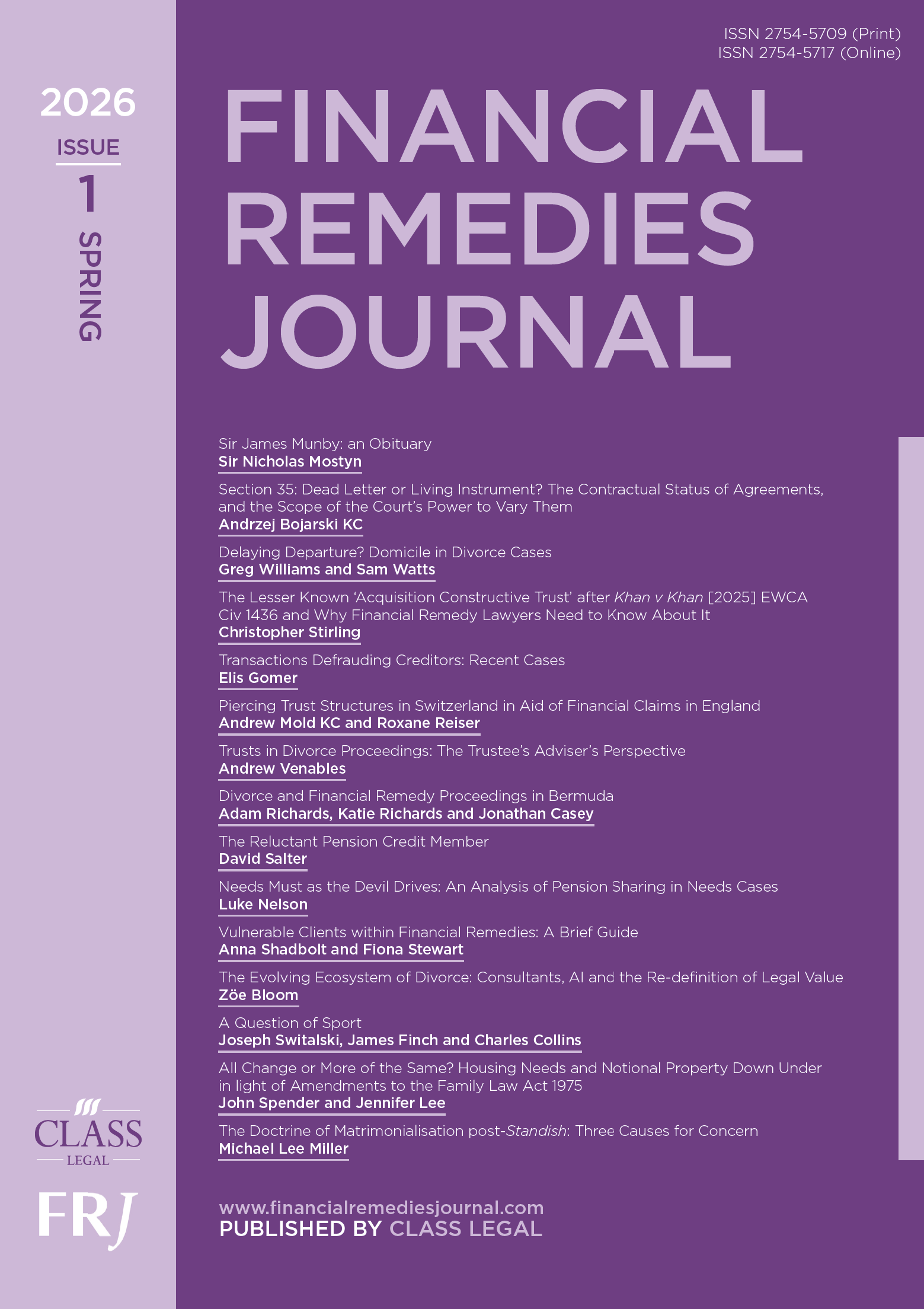
Now out: Financial Remedies Journal 2026 Issue 1 (Spring 2026)