
DR Corner: Why Private FDRs Work and How they Can Further Improve
[2026] 3 FRJ 264. The Private FDR process may not be perfect, but it provides significant advantages for couples seeking to resolve a dispute regarding their financial settlement.
A decade ago, private financial dispute resolution appointments (Private FDRs) were a niche option, largely reserved for the wealthiest separating couples. Today, owing to increasing Family Court listing delays, plus the encouragement given to non-court dispute resolution by the 2024 amendments to the FPR, and a growing body of anecdotal evidence pointing to higher settlement rates than court proceedings, it is being increasingly used by couples wanting to resolve contested financial remedy claims that do not settle through negotiation or mediation.
As a Private FDR evaluator, I read the recent article, ‘Private FDRs Under the Spotlight’,[[1]] which outlined the results of a survey of practitioners and their experience with FDRs, with great interest, especially the point that clients sometimes had negative experiences of Private FDRs, using words such as ‘stressful,’ ‘exhausting’ and ‘rushed’ to describe them.
In particular, I noticed that the survey identified the following factors that led to clients feeling let down by the Private FDR process.
Lack of preparation
Family law consultants believe that many clients arrive at a Private FDR with little idea of what to expect. They believe clients can also feel overwhelmed with the amount of information they have to process and the speed of proceedings. Add a lack of sleep from nerves and meeting the evaluator for the first time, and clients naturally feel anxious and stressed on the day.
In my experience, much of the success of Private FDRs rests on how prepared the participants are, not only regarding the process, but also the possible outcomes. If clients are going to enter into an FDR, whether in court or a Private FDR, they must be prepared to settle. This often means compromising on certain issues, and you and your client should be alert to what could be compromised and what is a deal-breaker. As solicitors, we need to prepare our clients for a range of possible outcomes while negotiating for what matters to them. This gives clients a sense of control over their future. Statistics show that where people buy into an agreement, they are much more likely to stick with it. This is known as the IKEA effect: people value outcomes more highly if they put effort into creating them.
Family law solicitors also have to be clear about the emotional and financial cost of not reaching a decision in a Private FDR, and some of these are not initially obvious. For example, even if a case ends up in court, the longer that matters remain unresolved, the more likely fresh issues are to arise, leading to more phone calls, meetings and negotiations, all of which increase a client’s overall costs. As far as the emotional cost, the uncertainty caused by unresolved disputes can affect the whole family, especially children. Sometimes we underestimate the impact that not knowing whether they can stay with their friends at their current school or come home to the house they feel safe in, or see grandparents who live close by, can have on young people, especially those who are neurodiverse. Once uncertainty is removed, plans can start being made. I also find that the relationship between children and an absent parent often improves once a financial resolution has been reached, because everyone knows where they are and things can move forward. The focus then often turns to the future rather than the past.
Private FDRs morphing into mini trials
The most persistent criticism levelled at the Private FDR process among practitioners is that it has, in some cases, drifted from a summary evaluation exercise towards something closer to a mini final hearing. Position statements for Private FDRs have lengthened well beyond the limits set out in paragraph 89 of the Financial Remedies Guide 2026,[[2]] which caps them at 12 pages. Oral submissions, similarly, have expanded to fill whatever time is available, since a private evaluator, unlike a judge, has no other case waiting and may be less likely to impose a strict time limit on any arguments.
I would argue, however, that although Private FDRs can mimic court hearings, especially in complex, high-net-worth cases, attending court is always going to be far more stressful for clients. The fact that an evaluator can provide parties an entire day of their time is most often an advantage, as each person has the time to put their points across, hear the other party’s point of view, and then hear what the evaluator thinks.
Another advantage of Private FDRs is that the evaluator will have had sufficient time to read the papers in advance of the hearing, which is unfortunately an increasingly rare occurrence for judges operating in our overstretched and under-resourced Family Court system.
Lack of safeguarding
Practitioners responding to the survey pointed out that the Private FDR model contains few formal safeguards. They expressed concern that the process could be ‘weaponised’ in relationships where coercive control is present. I would argue that if one party to a family law dispute is controlling, they will act accordingly in whatever resolution method they engage with, be it mediation, Private FDR or formal court proceedings. It is the role of family law barristers and solicitors to protect their client in these types of situations by preparing them properly, insisting that certain safeguards are in place, and managing proceedings to ensure a controlling or narcissistic party is kept in check.
In my experience, parties rarely talk to each other in Private FDRs. In addition, the process can be conducted in barristers’ chambers with both parties sitting in separate rooms or even online. Unlike the Family Court, the parties and their legal advisers decide how the process is conducted, and they can put in whatever safeguards they agree to ensure both parties feel safe. If one party does not feel safe, the Private FDR cannot take place.
Concluding comments
Private FDRs give parties the choice of an evaluator, who can spend an entire day on their case in a place that suits them, including less formal locations where possible. No dispute resolution method is perfect, but given the pressure on the family courts at present, Private FDRs provide a genuinely positive alternative.
One change that could increase access to Private FDRs is appointing less experienced barristers and solicitors as evaluators. At present, most evaluators tend to be more experienced and thus more costly, which is suitable for complex matters. However, there are plenty of excellent junior solicitors and barristers who could act as evaluators at a lower rate for many clients, thereby reducing one of the main barriers for less wealthy couples who would like to engage in the resolution method. These barristers and solicitors regularly act for such clients and have experience of the issues they are facing, so are ideally placed to be the evaluator at a Private FDR.
[[1]]: https://financialremediesjournal.com/private-fdrs-under-the-spotlight/
[[2]]: The Financial Remedies Court of England & Wales: Financial Remedies Guide (March 2026), www.judiciary.uk/guidance-and-resources/financial-remedies-guide-2026/


Latest
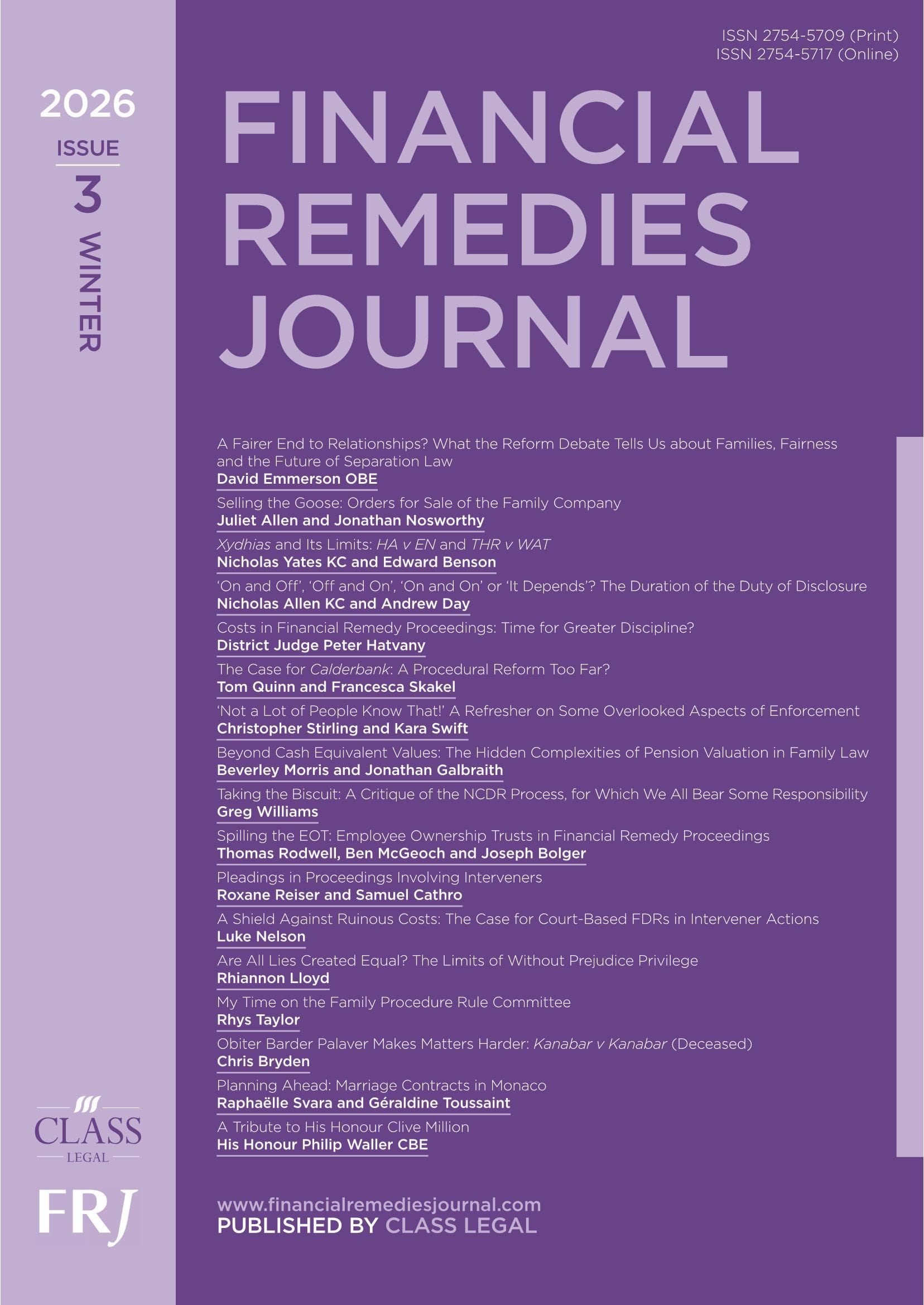
Now out: Financial Remedies Journal 2026 Issue 3 (Winter 2026)
The Case for Calderbank: A Procedural Reform Too Far?