
Beyond Cash Equivalent Values: The Hidden Complexities of Pension Valuation in Family Law
[2026] 3 FRJ 216. Valuing a private limited company can be fraught with difficulty. An expert report may produce such a wide range of figures that a court treats its conclusions as unreliable. Ultimately, it is for the court and not the expert to determine the value.
It is well-known to all those conducting financial remedy work that valuing assets can prove problematic. Valuing a private limited company can be fraught with difficulty. An expert report may produce such a wide range of figures that a court treats its conclusions as ‘fragile’ and unreliable.
Ultimately, as Peel J observed in HO v TL [2023] EWFC 215, [2024] 2 FLR 175 at [21], when setting out the legal principles that apply to business valuations, it is for the court and not the expert to determine the value.
In Neil v Neil [2019] EWHC 3330 (Fam), [2020] 1 FLR 1095, Moor J confirmed at [53] ‘[t]he expert advises but the judge decides’.
Some pensions have the same potential for dispute and debate as to value, and this article seeks to explore that fragility of a pension valuation or the need to examine in greater depth the underlying assets held within a scheme.
Form E/first appointment difficulties
The authors have long advocated for Form E to be amended to contain a dropdown box or expandable box which requires the pension holder to signpost and detail the assets held within the pension scheme and/or to give greater detail as to the nature of the assets, changes that might arise, underfunding issues they may be privy to, unassigned benefits, etc.
Worked example
H discloses membership of a self-invested personal pension (SIPP) with a fund value stated to be £1.3m. A drop-down box would explain:
- A commercial property, Brook House, 10 High Street, Henley in Arden, is held last valued on 2 January 2026 at £850k. The tenants are x, y and z and the rental agreements in place are a, b and c.
- A portfolio of equities with an up-to-date value of £320k.
- The balance in cash.
The procedure before the first appointment:
- the parties are required to file a concise statement of issues and to pursue what expert evidence is required/complete a Part 25 FPR-compliant application;
- FPR 9.15(1) states that ‘[t]he first appointment must be conducted with the objective of defining the issues and saving costs’.
However, how is one meant to comply with the overriding objective and the requirements of the Financial Remedies Guide 2026 if one prepares for a first appointment with no knowledge of the assets which make up a potentially complex pension scheme?
Aspects of pension valuation fragility
We are going to focus on:
(a) the fragility of the cash equivalent value (CEV);
(b) the unreliability of actuarial valuations, including issues pertaining to The Lord Chancellor v McCloud & Ors [2018] EWCA Civ 2844 as affect public sector schemes; and
(c) specifics around the actual assets used to provide a pension credit.
Fragility of the CEV
As a general rule of thumb, CEVs of active contributing members grow over time, whether on account of further accrual of rights or the making of contributions from salary. Conversely, CEVs of pensions in drawdown or in payment generally decline over time, as rights are discharged to the individual. The CEVs of deferred or ‘paid up’ pensions will be more stable, on the ground that no explicit changes are being made to rights thereafter.
Moreover, CEVs will continue to change over time, depending on the type of scheme in which the rights are held:
- Defined contribution (DC) CEVs reflect the underlying fund values, akin to a stocks and shares ISA. Therefore, the CEVs will fluctuate in line with market movements of the funds in which the individual has invested.
- Private sector defined benefit (DB) schemes pay out CEVs that we might liken to the surrender value of the rights in the scheme, i.e. what it will pay out to discharge the member’s liability upon request. Such CEVs are not necessarily reflective of the underlying fair value of the accrued benefits, and the CEVs will change over time in line with both market movements (yields on HM Treasury bonds, and market-derived expectations of inflation chief amongst them) and explicit changes made by the scheme actuary to the ‘basis’ (being the collective term for the actuarial assumptions made to generate the CEV).
- Public sector DB schemes tend to have more stable CEVs: these are not explicitly market-related, but instead depend on actuarial factors set by the Government Actuary’s Department which are revised wholesale every few years, and to this extent CEVs of rights only change when the member passes a birthday or in respect of other changes to benefits, for example, increases being applied each April.
However, there may be several further factors to consider thereafter.
Unreliability of actuarial valuations
First, some private sector DB schemes produce reduced CEVs because the scheme is significantly underfunded, i.e. the scheme actuary has determined that the assets fall short of covering the cost of paying out all the accrued pension rights to the scheme members. Pensions legislation allows the scheme trustees to pay out a reduced CEV, on the ground of balancing the needs of those who want to leave the scheme against its remaining members.
This has implications for pension sharing, as the CEV is used to determine the pension credit payable to the ex-spouse, and it follows that such a reduced CEV produces a loss in overall rights upon sharing. However, this might be mitigated by the fact that schemes are required to provide an internal transfer option for ex-spouses where reduced CEVs are being paid – with any pension credit payable to the ex-spouse being based upon the reduced CEV rather than the full amount – even where this is not the scheme’s general policy.
Even where private sector DB pension CEVs are not being explicitly reduced by the scheme, such CEVs might still not necessarily reflect fair value. By contrast, public sector DB schemes require the internal transfer of pension rights to the ex-spouse – in effect, granting the ex-spouse shadow membership of the scheme – such that this takes place on fair value terms, with no loss of rights being incurred, regardless of the generosity or otherwise of the CEV.
Second, it is important to consider what is being valued when it comes to the computation of a CEV.
It is usually ‘plain sailing’ for DC plans with no guarantees or other attaching benefit promises but, as always, things are more complicated with DB pensions. The CEV is, by definition, the valuation of the per annum income payable in retirement to the member, but it will also include an allowance for any automatic tax-free cash lump sum that attaches to the pension. The calculation of the CEV will assume that the pension benefits are unreduced at the earliest possible age (usually the Normal Retirement Age) and no allowance will be made for the commutation of pension, i.e. the member’s right to take a reduced pension in exchange for a one-off lump sum at retirement.
DB pensions almost always come with a reversionary spouse’s pension, typically 50% of the member’s pension, and the CEV will contain an allowance for this (notwithstanding that, upon the finalisation of the divorce, there becomes no legal spouse to whom such a pension may be payable). Some pensions accrued before April 1997 increase in payment only at the scheme trustees’ discretion, and the CEVs of such pensions will usually only take account of such increases where there has been an established practice of paying these each year.
The long running litigation in McCloud gave rise to changes in the way that public sector CEVs were computed. This typically affects DB CEVs where accrual has taken place during the 2015–22 McCloud ‘window’, and the compliant CEVs now being produced by the schemes are computed based on the member being assumed to invoke the choice (new scheme vs old scheme for the 2015–22 period) that gives the better outcome. There did exist a period between the identification of the McCloud issue and the issue of such compliant CEVs, but this is now of historic interest only. Experienced pension on divorce experts were able to determine workaround solutions in the interim period that were intended to remain robust, regardless of what happened thereafter.
Third, given that DB CEVs are valuations of retirement incomes payable, they are a function of actuarial estimates of life expectancy. The modelling involved here tends to be rather sophisticated, drawing on actual pension scheme experience but making allowance for expected improvements in longevity, i.e. the assumption that someone born in, say, 1982 would be expected to live longer in retirement from age 65 onwards than someone born in 1962. However, scheme members are assumed to enjoy ‘typical’ life expectancy, and no attempt will usually be made to reflect the specifics of an individual’s health or lifestyle (in contrast to the purchase of life insurance products, etc). Where an individual has retired on grounds of ill health, the scheme may compute a lower CEV to reflect the individual’s reduced life expectancy, and again this can have an impact on what can be shared with the ex-spouse.
The public sector DB schemes are known to make such adjustments, but the practice in private sector schemes is less clear. Practitioners might not be thanked for drawing to a DB scheme’s attention the much-reduced life expectancy of their client if this will in turn lead to the trustees’ seeking to reduce the CEV accordingly, in recognition that the transfer of rights to the ex-spouse will reflect selection against the scheme, i.e. the scheme trustees have ‘got wise’ to the fact that the pension is going to be in payment for a much shorter period than would be typical.
The assets that underpin such valuations
We note that all such considerations are actuarial in nature, in that they consider the valuation of the accrued rights in the pension scheme. It is also important to look at how a CEV is comprised and the assets that underpin it.
In most cases, such valuation issues do not arise. In particular:
- DC plans tend to be invested in listed/unitised arrangements, i.e. managed funds or perhaps specific stocks and shares, if the member holds a SIPP. Such amounts are easily realisable for the purposes of providing the ex-spouse with a pension credit.
- Private sector DB schemes may invest in a multitude of assets but, overall, it is the responsibility of the scheme trustees/administrators to manage cashflow, and the pension credit payable to an ex-spouse via external transfer is unlikely to present any such liquidity challenges for the scheme.
- Again, public sector DB schemes require the internal transfer of the pension credit, and thus liquidity issues do not exist as no attempt is being made to realise a capital amount in lieu of pension rights payable in retirement. (Indeed, it is noted that these schemes – barring the Local Government Pension Scheme – are all unfunded, with HM Treasury not explicitly holding assets to meet the public sector workforce’s accrued rights.)
Valuation issues may arise with more bespoke arrangements, such as small self administered schemes (SSASs), which may hold one main but illiquid asset such as a property, in particular, the premises of a business operated by one or more of the member trustees. It can be difficult to assess the present ‘market value’ of a property which is not going to be sold for the foreseeable future.
Moreover, great diversity exists in how SSASs are structured. Some may have assets explicitly ring-fenced for the beneficiaries; some may have a common pool of unassigned benefits of which members hold a percentage share, and others may reflect a mix of the two. Arrangements where there exist such unassigned benefits may create further implementation issues, as it follows that the rights of other SSAS members – being those not party to the divorce – should not be fettered or compromised by the need to effect a pension sharing solution for one (or two) SSAS participants.
Worked example
- SSAS contains commercial property worth £6.5m.
- The property is the subject of a potential compulsory purchase order in respect of a road widening scheme being explored by local government.
- The property is subject to planning permission applications to convert into eight self-contained apartments (impermissible asset to be held in the SSAS but would, if granted, have significant impact on the value).
- A commercial loan is secured against the property in the sum of £2m.
- The property is rented by the company the spouse is a director and shareholder of.
- There are five other members of the SSAS.
- The company is in rent arrears having not paid for 12 months/the company is suffering cash flow difficulties.
- The rent historically paid has been utilised to service the borrowing and to pay insurance premiums and some essential maintenance costs.
- The SSAS contains only £40k in cash.
The above creates real challenges when it comes to the divorce settlement and advising the other spouse. For example:
- How any pension credit may be discharged to the ex-spouse.
- The timing of implementation of a pension share in the light of the potential for increased value.
- Non-payment of rent, which is ultimately a further point around the fair value of the assets in the SSAS.
- Other members’ objections to the scheme’s borrowing against the asset, in specie transfers of some assets to the ex-spouse, or the use of an internal transfer option within an SSAS which preserves the overall arrangement’s asset holdings and at least defers the issue raised until a later date. All such solutions do, however, have various drawbacks and need to be considered carefully by all parties as these arise.
Issues can also occur where investments are held in exotic asset classes, such as cryptocurrency and unlisted shares. Specialist advice from investment advisers, forensic accountants and others might be required, in addition to more conventional pensions on divorce support.
It follows therefore that the actual arithmetic associated with such pension sharing orders may well be trivial (e.g. 50% each), but the challenge is presented by both such valuation and implementation issues.
Conclusion
Pension valuation in family law financial remedy proceedings remains inherently challenging. As we have sought to demonstrate in this article, the fragility of CEVs, the unreliability of actuarial assumptions, and the complexities of valuing underlying assets create significant difficulties for practitioners and courts alike.
As always, practitioners should not hesitate to seek specialist support. Actuarial experts, forensic accountants and investment advisers play a critical role in identifying valuation risks and implementation solutions. Early engagement with such specialists during case preparation can prevent costly disputes and ensure that pension sharing orders accurately reflect the parties’ true financial circumstances. The arithmetic of pension sharing may appear straightforward, but delivering substantive fairness requires expert guidance tailored to each scheme’s unique characteristics.


Latest
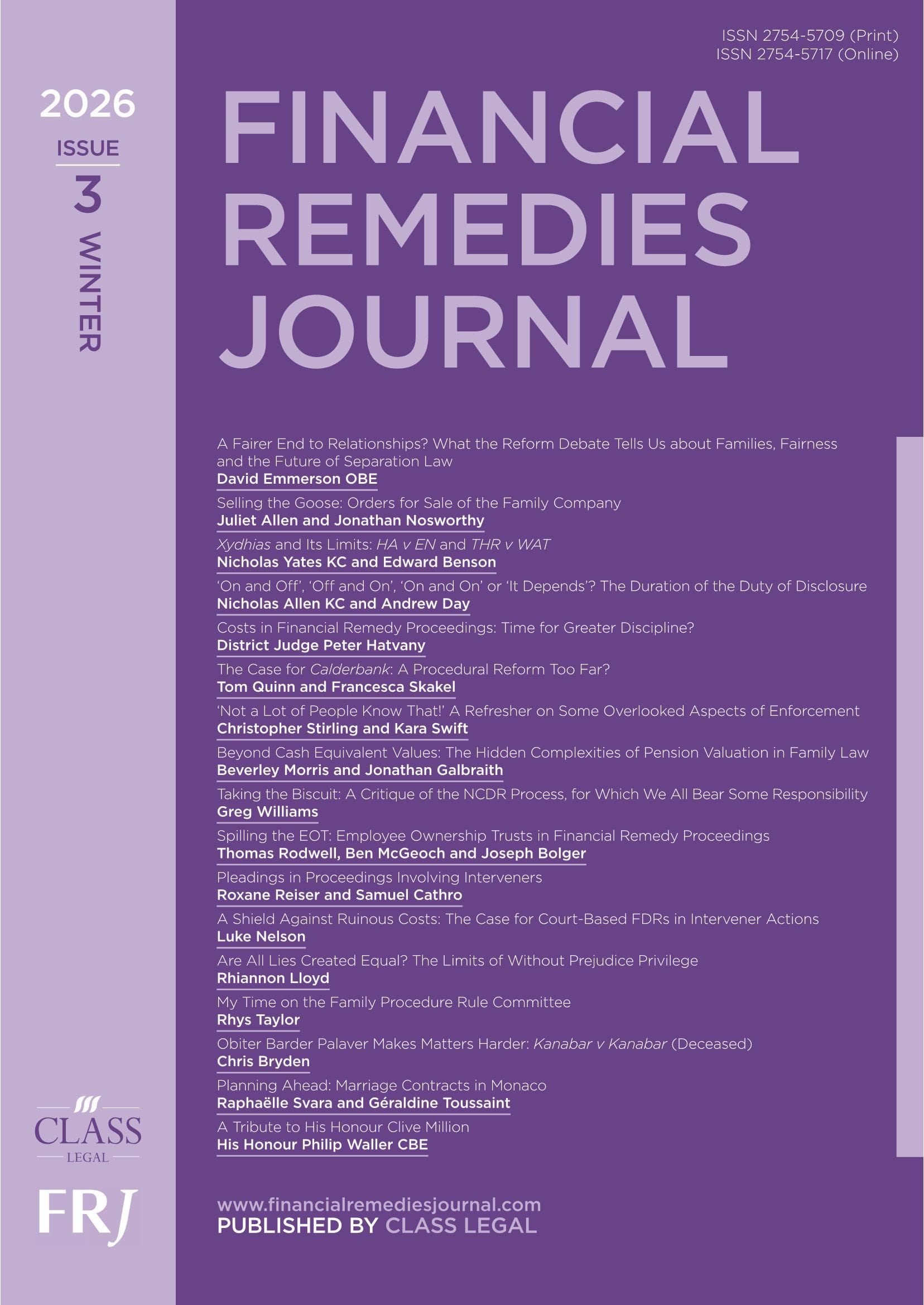
Now out: Financial Remedies Journal 2026 Issue 3 (Winter 2026)
The Case for Calderbank: A Procedural Reform Too Far?