
Taking the Biscuit: A Critique of the NCDR Process, for Which We All Bear Some Responsibility
[2026] 3 FRJ 219. The purpose of this article is to examine whether our profession’s march towards NCDR has gone too far, too quickly. Litigants in person are now appearing every working day before real judges.
The purpose of this article is to examine whether our profession’s march towards non-court dispute resolution (NCDR) has gone too far, or too quickly.
Before I begin, I must declare several interests. The permeation of NCDR into my daily practice means that, in the calendar years 2025 and 2026 to date, I have personally been into actual court buildings less frequently than once every 2 months (not including remote hearings). I do not miss the early morning train ride to visit Oxford, for example, where I will wait hours to be called on. Neither do I miss sitting on an uncomfortable Thameslink train seat for long round trips to Cambridge or Bedford. I much prefer a quick 15-minute hop on the Elizabeth line into Chambers or another London set. Not arriving already tired to start the work day has now become the norm and not the exception.
I also enjoy, as I’m confident we all do, the benefits of NCDR facilities hosted in modern offices. During the summer heatwaves, it was significantly more pleasant to be in Coram Chambers’ air conditioned conference rooms with chilled mineral water and refreshments on demand. I am partial to Coram’s good coffee, chocolate biscuits and excellent service. I doubt I am alone in that. For balance, other good Chambers are also available.
None of us in private practice can faithfully say that we prefer the broken water cooler at the Central Family Court; or the oppressively hot (or cold) courtrooms, depending on the season. Yes, the Bar Pass has made entering the court estate easier, but do we really need to have to show it every time we go to the toilet (Luton), or when re-entering the court building after running out for lunch (everywhere else)? Chairs in Chambers are not broken, lavatories are clean and hot water dispenses from taps. Conference rooms are guaranteed. If we require something printing, it appears, as if by magic. Did I also mention the biscuits?
I must further declare that I am, too, a barrister who offers my services as a Private FDR (pFDR) tribunal – with decent market traction and forward bookings in the diary. Providing neutral evaluations is enjoyable work. However, I am not yet a trained mediator and I am not an arbitrator, though I appear as an advocate at both. I wonder, if I were to search my soul deep down, whether my lack of appetite to qualify further has anything to do with my concerns raised in this article.
Having now provided all reasonable ammunition to those who wish to accuse me of being part of the problem, let me now try to ventilate some of my concerns which our collective enthusiasm appears to have looked past.
The obvious place to start is the two-tier justice argument. I am not making a party political point. It is a statement of fact that those with deeper pockets can pay to jump the queue. Business models are being built on it. If I had twenty pounds for every explicit comparison I have seen in internal client correspondence comparing a pFDR (‘BUPA’) to a court-based FDR (the ‘NHS’), I would be significantly closer to my retirement pot target. The trend towards NCDR has been strongly encouraged by the profession. It has also been encouraged by the judiciary. Well-meaning, over-worked judges encouraged our enthusiasm, because it helped make their lists shorter. Has it succeeded? I suggest that one cannot noticeably tell, save perhaps in very carefully managed courts. Ah, I hear you cry, but you can save costs by going to NCDR! A pFDR means an upfront cost, but there are much larger savings to be made in the long run. I can also hear you say: parties who pay for a service are more likely to settle. They are more invested, mentally and financially. Perhaps this is (or was) true, but I will examine it below. But before we get to that we must all remember that some parties live hand to mouth and can’t afford any extra cost. To every NCDR proponent who says ‘there are plentiful cheap, junior evaluators’, I say ‘look at the litigants who cannot afford even their own lawyer’. Litigants in person are appearing every working day before real judges. This is two-tier justice, and we must face that fact.
The second difficulty I have with NCDR is the nature of full-day evaluative hearings. Plainly, everyone wants a judge who has read the papers properly and who is capable of giving a thoughtful indication. But do all barristers and solicitors seeking repeat work as an evaluator make for a suitably robust tribunal? I have seen an opponent make submissions for 1 hour and 25 minutes at a relatively straightforward FDR. True, they were asked questions by the evaluator, which did not help to speed them up, but the evaluator was equally at fault for failing to stop them. Who wants an indication at 2 pm? No one. Yet it happens, all too frequently. Who also thinks it is helpful to get a written follow up at 4 pm, when the parties have already been there for 7 hours? Good evaluators manage time effectively. The best set submission time limits. Yes I want to be heard, but I also want my indication before lunchtime. In the real world, judges have time constraints and other cases to get to. The only real utility to a written indication is to file it away for reference, if the matter fails to settle.
My third point is that as pFDRs become the norm, have they lost some of their lustre? Are our clients truly getting a special service? Or are some parties (and their advocates) choosing to leave at 3 pm because they did not like the indication? Where is the real judge to stop them? I have seen parties politely decline to see an evaluator a second time because they didn’t like what they said. I have seen them depart before receipt of the written follow up. I am yet to see a party refused permission to leave a Chambers. I have frequently seen a party refused permission to leave the court, at least until they come back in to explain their sticking point to the judge. NCDR (and pFDRs in particular) are advertised as being a panacea to ineffective court-based FDRs. The judges will have had time to read the papers, our clients are told. The quality of the tribunal will be excellent. This is all true. But is there any actual evidence (other than anecdotal) that pFDRs have a higher settlement rate? Didn’t we used to settle FDRs at court as well? Is not one potential answer that when pFDRs really took off, it also coincided with the COVID-19 pandemic, when all pFDRs were almost entirely online anyway? Perhaps we should investigate whether online FDRs have an equally high settlement rates? Perhaps parties sitting in comfort at home with counsel on standby make for capable decision makers. Advocates being able to have a breather from lay clients during lulls in the negotiation? Yes, please. Years ago, when the court closed at 5 pm, so did the case for the day. One would drag one’s trolley bag back to the train station, decompress on the ride home, and then think about the next day. Is it possible that the so-called ‘higher’ pFDR settlement rate is nothing more than the fact that we are settling more cases late in the day, after 5 pm, or in the days that immediately follow the pFDR? Where do we draw the line about when a pFDR should end? Is settling late really a sensible strategy? Is there not a well-being concern for the parties and the advocates? I recall a mediator telling me (with pride) that he had helped to settle a case close to midnight. I was horrified. As a better alternative to the late finish, are we not just doing more business electronically, by checking in with our opponents by phone or email in the days after the hearing to see if anyone has budged? Is this really because of NCDR, or just because we can all use WhatsApp?
Fourth, there is the potential for subconscious bias. This one has been nagging at me for a while. I had a case where a firm recommended three counsel to be the pFDR evaluator. We picked one. When the hearing came around, one of the other two on that list was now my opponent. If professional people are so clearly capable of picking their favourites, can tribunals guarantee absolute objectivity? How long will it be before a party complains that their ex-spouse’s solicitor recommended a particular evaluator or arbitrator (to whom their own solicitor did not object), only to find later that that same advocate is now instructed in a different case by that same firm? The world is full of tech savvy litigants who scour the internet. Would they be justified to feel aggrieved if the tribunal who they felt found or indicated against them is later instructed by the firm who recommended that person for their case? If that sounds far-fetched, how many times have our lay clients refused a tribunal from the same chambers as that of their spouse’s counsel? Frequently, is the answer. Advocates are generally relaxed about it. We believe such suspicion is ill-founded. We maintain that we and our colleagues are not going to sacrifice our professional reputations by giving loaded indications to a colleague or a potential instructing solicitor. But are we all naïve enough to think that it will never happen, somewhere, at least subconsciously? The real issue here is the perception of the potential for bias. The litigant is the most important person in the system. Appearances matter. Justice must be seen to be done. Mark my words: one day, there will be a complaint brought by a dissatisfied litigant. There may have been absolutely no bias whatsoever. But the optics are not good. It looks grubby. If you are not with me on that point, then what about the potential for bias or subconscious bias in favour of the gender of a spouse? How often have we heard colleagues say ‘oh [that arbitrator] is pro-husband’ or ‘[that evaluator] is quite generous on maintenance?’ How many of us have read, to our horror, a shortlist of potential tribunals picked by the other party’s lawyer who we know will likely suit the gender of that particular party. I can assure you this does happen. I have been a part of WhatsApp groups, both in and out of Chambers, where professionals swap gossip about who allegedly has ‘pro-husband’ or ‘pro-wife’ sympathies. I have heard members of Chambers consoled at the water fountain with words like ‘oh, don’t worry, that [person] is notoriously pro-husband’. Would I admit to being cynical enough to putting forward such tribunals to my own client’s advantage? Not in this article. Does such potential bias also feature in the public court sector? Almost certainly. Water cooler conversations have happened for eons. The point is that before NCDR took root one couldn’t pick one’s own tribunal. One arrived at a real court building to play a judicial lottery in which we all had the same ticket.
Fifth, as a result of cases going private, is evaluative experience being lost from the resident Bench? As time goes on, will the newer intake of judges become less skilful at providing indications? Speaking personally, I had a recent judge at a court-based FDR in the South East of England, who produced a shocker of an FDR ‘indication’. It was no indication at all. It consisted of berating the parties for spending so much in costs before putting them to the back of the list. Not even a wide settlement bracket was indicated. Both parties had counsel. Did the judge think they had not already been advised? They came to court for judicial help to settle. Had it been 4 pm on a Friday, one might have been more sympathetic to the judge’s position. But this FDR was first in the list on a Monday morning. Everything was lodged in perfect time. I had a suspicion the judge did not know what the answer was. It was not a very hard case.
Sixth, there is the matter of self-regulation. To my noble friends who decide policy at Resolution, I am sorry to report that not all self-regulation is welcome. Some members of the Bar, at least, do not want a Code of Practice mandated by any particular organisation, of which one presumably has to then become a paid member to participate in the existing legal marketplace. If we eventually reach a position where all pFDRs can only be conducted by those of us who have agree to subscribe to a particular Code of Practice, or some other requirement dictated by a representative body, that would be a barrier to entry into the market. It would hurt the more junior barristers harder than most because some such organisations charge significant annual membership fees. It seems to me that the market is not perfect (as already ventilated above), but isn’t a free legal market the best guardian of quality? Those members of the Bar or solicitors who already sit as fee paid judges should get more private work as a result of their judicial credentials. Even those who are not (like me) gaining a reputation for giving quality indications – quickly – will likely get repeat business.
Seventh, how does the stealth privatisation of financial remedies applications protect against litigants who abuse the process? NCDR tribunals have blunt teeth. It is said that early neutral evaluation promotes efficient settlement. So it does. But what when cases can’t settle? When my arbitrator tells the witness I am examining under ‘oath’ not to speak to anyone during the lunchbreak, what sanction is there when they fail to abide by that direction? If the witness under examination cheerily walks out into the car park and starts chatting on their mobile phone, what is the arbitrator to do? And what happens when someone lies during their evidence during arbitration? Are they potentially guilty of perjury? To be precise, is an arbitration a ‘judicial proceeding’ within the meaning of s 1 Perjury Act 1911? While undoubtedly an arbitrator can draw adverse inferences against a non-disclosing party in accordance with case law principles, what real and immediate deterrent is there against a suitably minded party who is considering lying when there are no obvious or immediate repercussions before an arbitrator? A judge has committal powers or the power hold a party in contempt. An arbitrator has neither.
Eighth, both the process of NCDR and the humans within it are not infallible. While we all laud the expertise of our NCDR tribunals, are there not potential limits to their powers? I had a Schedule 1 case where the Form ARB1FS explicitly provided that the arbitrator was to determine not only the Schedule 1 aspect, but other financial matters as well (a family shareholders dispute). One side had deliberately wished to arbitrate both matters together to avoid ruinously expensive separate family and civil proceedings. The other side, despite signing the ARB1FS, later served a skeleton argument claiming that the IFLA arbitrator had no power to deal with company law issues, despite their lay client having signed up to a determination of those company law issues. They argued that an arbitrator’s powers mirror only the jurisdiction of the Family Court, which cannot hear company law issues. I will not tell you the actual answer in this article. What I want to make clear is that arbitration is not always plain sailing in smooth waters. There can be some chop. Furthermore, NCDR tribunals are no less human, and therefore no less fallible, than judges. True, you can pick an expert in your designated area. That is small comfort to those clients who got an unhelpful or unexpected indication. When judges fall into error, there is a well-trodden route of complaint. Do we think that those of us in private practice are incapable of making mistakes? I am not saying our tribunals are of poor quality. Indeed, they are generally of the highest quality. I am saying mistakes can happen in any human system and in arbitration the remedies to those errors can be as or even more troublesome to rectify, as anyone who has ever had cause to read s 57 Arbitration Act 1996 can attest to.
Ninth and lastly, there is the admittedly niche question of career progression. Those who regularly appear in, or sit as NCDR tribunals, are insulating themselves away from cases which might make or break a silk application. Ironically, the better we are at settling, the less able we are to demonstrate that we can meet the core competencies of excellence, which revolve around court-based advocacy, because specimen cases must be tendered. Yes, an arbitrator can be a judicial assessor for a silk application, but unless something changes, presently a pFDR tribunal cannot be. If one spends 80% of one’s time advocating at pFDRs, then it becomes a vicious circle. I can think of several friends who, in my humble view, should have taken silk long ago, but who spend their time settling or sitting. Hardly anything litigates to trial now. It is hard to get a reported case, even for specialists. The annual silk list contains painfully few family barristers compared to civil and crime, and financial remedy barristers are arguably the most underrepresented category of all.
So there it is. Have we created a superhero system or are we gradually creating Frankenstein’s monster? You decide. Meanwhile, I shall continue to eat excellent biscuits while noting the irony of the sweet taste. But when I stop to reflect occasionally, I shall continue to worry that we are perhaps all somewhat guilty of taking the proverbial biscuit, which may not always be a good thing.


Latest
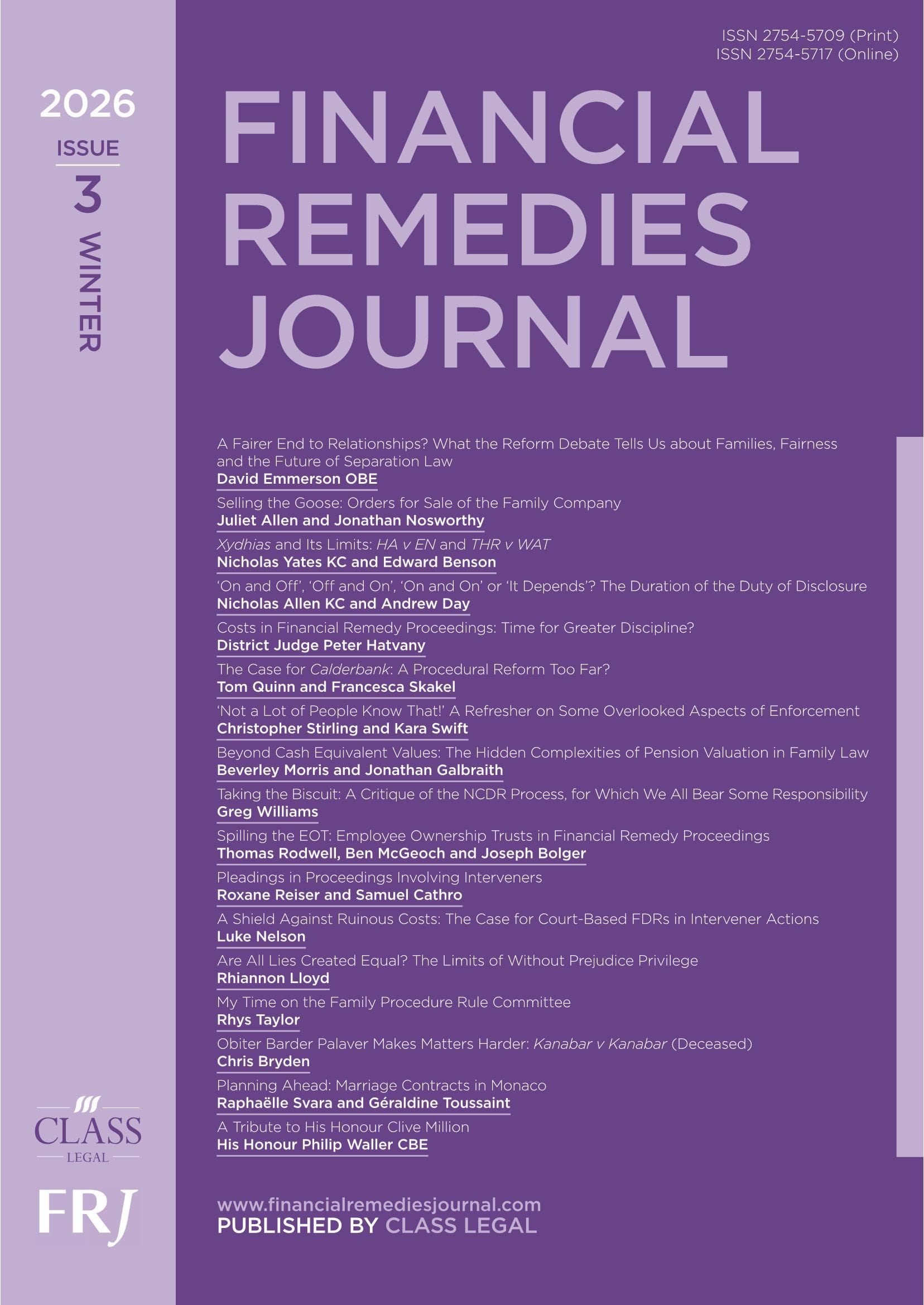
Now out: Financial Remedies Journal 2026 Issue 3 (Winter 2026)
The Case for Calderbank: A Procedural Reform Too Far?