
WS v HS [2018] EWFC 11
Judgment date: 28 February 2018
Related
BY v GC (No 2) [2025] EWFC 397
In this seven-day final hearing of a long marriage with adult children, the computation and distribution of a variety of assets were determined by a robust analysis and application of the case law by Mr Nicholas Allen KC.

Interested Third Parties Opposing an Order for Sale
A v N [2025] EWFC 371 (B) sets out non-exhaustive factors to consider when a third party with a beneficial interest in the family home opposes an order for sale, and considers how the court will balance the needs of the third party and the spouses.

The Financial Remedies Court: A New Horizon?
It is approaching 10 years since HHJ Edward Hess and Joanna Miles published their seminal article which fired the starting gun for the creation of the Financial Remedies Court. The purpose of this article is to reflect upon the possible ways in which the FRC might evolve and develop in the future.


Related
BY v GC (No 2) [2025] EWFC 397
In this seven-day final hearing of a long marriage with adult children, the computation and distribution of a variety of assets were determined by a robust analysis and application of the case law by Mr Nicholas Allen KC.
Interested Third Parties Opposing an Order for Sale
A v N [2025] EWFC 371 (B) sets out non-exhaustive factors to consider when a third party with a beneficial interest in the family home opposes an order for sale, and considers how the court will balance the needs of the third party and the spouses.
The Financial Remedies Court: A New Horizon?
It is approaching 10 years since HHJ Edward Hess and Joanna Miles published their seminal article which fired the starting gun for the creation of the Financial Remedies Court. The purpose of this article is to reflect upon the possible ways in which the FRC might evolve and develop in the future.
Latest

The Reluctant Pension Credit Member
[2026] 1 FRJ 39. In the case of AP v TP [2025] EWFC 190 (B) a financial remedy order was made by consent, following an FDR, which included a pension sharing order in W’s favour. Difficulties began when W failed to provide the necessary information to permit the pension share to be implemented.

Housing Particulars: Mind The Gap
What can the court do when there's a significant gap between the bottom of the applicant’s range and the top of the respondent’s range? Can the court take up the invitation made by counsel to ‘conduct its own research on Rightmove if it wishes’?
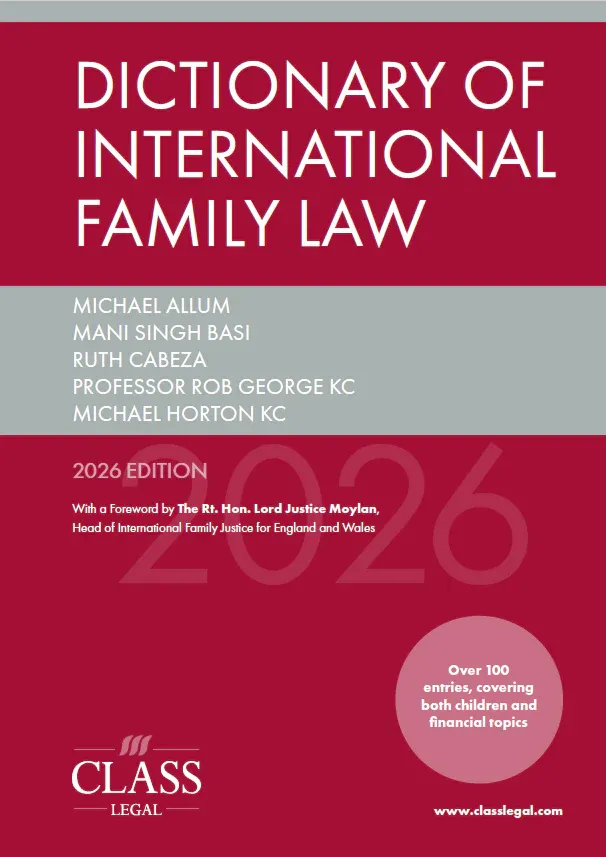
Book Review: Dictionary of International Family Law
The Dictionary of International Family Law is the latest addition to the series of Class Legal Dictionaries. It joins this distinguished family with confidence and purpose.