Tempering the Wind to the Shorn Lamb – Equity’s Role in Defending Victims of Economic Abuse from Creditor Claims: Part 1 - Undue Influence
[2026] 2 FRJ 137. This article is the first of a two-part series highlighting equitable doctrines that present options for defending the victim and the family home against the claims of commercial mortgage lenders and trustees in bankruptcy – or at least mitigating the damage.
Spouses and cohabitees face an acutely difficult predicament when persuaded, particularly in coercive relationships, to mortgage the family home as security for borrowing raised for the benefit of their partner.
Perpetrators compel their partners through pressure, emotional manipulation or deceit to jointly borrow or guarantee borrowing, which is raised for the perpetrator’s own ends but secured against the family home. The victim then stands in the position of joint borrower or surety, assuming liability without receiving any corresponding financial advantage. When the business fails or the perpetrator absconds, the victim is left exposed to the claims of banks and other creditors.
Whilst there may be ways of framing claims against the perpetrator, in unjust enrichment or undue influence, such claims may be of little assistance if the creditor is already circling or if, as is commonly the case, the perpetrator is insolvent or has organised their assets in a manner calculated to thwart enforcement. In such scenarios, the victim suffers the double hit of finding themselves and the family home to be the primary target of creditor claims, as well as loss of recourse against the perpetrator.
This article is the first of a two-part series highlighting equitable doctrines that present options for defending the victim and the family home against the claims of commercial mortgage lenders and trustees in bankruptcy – or at least mitigating the damage.
In Part 1 of this series, I will look at the doctrine of undue influence, with a particular focus on mortgages procured by the exercise of undue influence. Part 2 of this series will look at the ‘equity of exoneration’, which in certain cases permits the burden of borrowing secured against a jointly owned property to be discharged so far as possible out of the equitable interest of the debtor, preserving the non-debtor’s share of the equity.
The Supreme Court has recently examined the obligations of lenders in the context of mortgages procured by undue influence in Waller-Edwards v One Savings Bank Plc [2025] UKSC 22, in a victory against the bank for the surety cohabitee which has extended the circumstances in which undue influence can be relied upon against a bank.
In what follows, I will use female pronouns to refer to the vulnerable party in the relationship and male pronouns to refer to the influencing party. Whilst economic abuse is experienced by men and is also prevalent in other categories of relationship (it is also a depressingly common form of elder abuse), the fact pattern in the reported cases concerning mortgage borrowing overwhelmingly involves male partners influencing female partners to assume liability for debts. Any references to husbands and wives should also be read as including unmarried cohabitees and same-sex couples.
Coerced debt as economic abuse
Women’s participation in the labour market and their financial independence have markedly increased since the House of Lords considered undue influence in the context of mortgage transactions in Barclays Bank Plc v O’Brien [1994] 1 AC 180. However, as Lady Simler observed in Waller-Edwards, any expectation that such developments would reduce the prevalence of domestic financial abuse has proven unfounded.
The Financial Conduct Authority in its 2024 report, The hidden cost of domestic financial abuse: working together to improve outcomes, cited in the judgment, suggests that as many as one in six women in the United Kingdom has experienced financial abuse by a current or former intimate partner. According to statistics published by the charity Surviving Economic Abuse, one in seven UK women (equivalent to 4.1m women) experienced economic abuse from a partner or ex-partner in the past year. Furthermore, of those women who reported experiencing any other form of domestic abuse, 71% had also experienced economic abuse; 34% of victim-survivors experienced financial difficulty as a direct result of the perpetrator’s economic abuse, with 17% being left with unmanageable debt; 1 in 25 women had credit taken out in their name without their consent, or because they were scared to refuse the abuser.[[1]]
Before exploring how the doctrine of undue influence might assist in such scenarios, let’s first consider the basic facts of Waller-Edwards, which provide a textbook example of the trajectory of this sort of economic abuse.
In late 2011, at what is described in the judgment (without further explanation) as a vulnerable time in her life, Catherine Waller-Edwards entered a relationship with Nicholas Bishop, who worked as a property developer. At the beginning of the relationship, Ms Waller-Edwards was financially comfortable – she owned a mortgage-free property, referred to as ‘Pilford’, valued at £600,000 and had savings of £150,000.
Sadly, Ms Waller-Edwards was persuaded by Mr Bishop to enter into a series of disastrous transactions. She agreed to exchange Pilford and £150,000 for a partially built property, known as Spectrum, which was encumbered by a charge in favour of a Mr Higgins, which Mr Bishop lacked the means to pay off. Thereafter, she entered into a series of further charges to secure escalating sums against Spectrum, initially in favour of Mr Higgins or his company and culminating in a buy-to-let remortgage loan of £348,000 with One Savings Bank (OSB).
The OSB remortgage was used in part to pay off the existing charge secured against Spectrum. Around £39,500 was used to pay off Mr Bishop’s car finance and credit card debts (at the insistence of OSB as a condition of the loan). The sum of £142,000 was used to pay off Mr Bishop’s divorce settlement.
By the time the relationship ended, in late 2014, Ms Waller-Edwards was left in a highly precarious position. Her home was heavily burdened by mortgage borrowing, much of which had been raised for Mr Bishop’s benefit. Because the loan was on buy-to-let terms, she was occupying the property in breach of the terms of the mortgage. Her savings had been entirely depleted, and, since she lacked the means to maintain the loan repayments, she fell into arrears on the mortgage. Inevitably, OSB initiated possession proceedings. Ms Waller-Edwards defended the possession claim by seeking to set aside the mortgage on the grounds that her consent to the OSB remortgage was vitiated by Mr Bishop’s undue influence.
The trial judge accepted that the circumstances gave rise to a presumption of undue influence on the part of Mr Bishop, which OSB could not rebut. However, the trial judge (with whom the High Court and the Court of Appeal agreed), held that OSB was neither fixed with constructive notice, nor put on inquiry in respect of that influence, and granted OSB possession of Spectrum.
I will pick up these threads, and the Supreme Court’s decision upholding Ms Waller-Edwards’ appeal, after dealing with the essential requirements for establishing undue influence.
Establishing undue influence
The doctrine of undue influence renders a transaction voidable if a person’s consent is procured by improper pressure, coercion or an abuse of a relationship of trust and confidence.
The leading case on lifetime undue influence is Royal Bank of Scotland v Etridge [2001] UKHL 44, [2002] 2 AC 773. There are two alternative evidential routes to establishing undue influence – via direct evidence of coercion or, more commonly, where the facts give rise to a presumption of undue influence.
In summary, the presumption of undue influence will arise in the context of lifetime transactions in circumstances where two elements are established:[[2]]
- A relationship of influence: a relationship of influence will be irrebuttably presumed in certain confined categories of relationship – solicitor/client, trustee/beneficiary, parent/child (but not child upon parent). In all other cases, a relationship of influence will need to be established on the facts. It is well settled that there is no presumption of influence as between spouses and cohabitees, although it is recognised that the high degree of emotional interdependence and trust that typically characterises such relationships provides scope for abuse.[[3]] Outside the defined cases where influence will be presumed, it will need to be shown that the person making the gift or entering into the transaction (‘the donor’) reposed trust and confidence in the other party (‘the donee’). The cosy sounding descriptor of a relationship of ‘trust and confidence’ may be at odds with the nature of some coercive relationships and is not a definitive ‘touchstone’. Other ways of describing the essence of the dynamic include ‘reliance, dependence or vulnerability’ on the one part coupled with ‘ascendency, domination or control’ on the other.
- A transaction that calls for an explanation: the transaction is not readily explicable by the relationship between the parties, i.e. it must be one which cannot be explained by reference to friendship, the parties’ relationship, charity or other ordinary motives on which people act.
Once the evidential presumption of undue influence is triggered, the donee must neutralise the inference that the transaction was procured by abuse of influence. He does so only by proving that the donor entered the transaction after ‘full, free and informed thought about it’.[[4]]
The courts have long regarded the provision of independent and competent advice as the clearest way of displacing the presumption. Such advice must be ‘that of some independent and qualified person’ but not necessarily a lawyer,[[5]] and must be ‘relevant and effective to free the donor from the impairment of the influence’.[[6]]
However, the fact that a solicitor has participated in the transaction and given advice to the donor does not guarantee that the donee will be able to displace the presumption of undue influence.
For an example of a case where the court has found a transaction to be tainted by undue influence despite the involvement of a solicitor, see Paull v Paull [2018] EWHC 2520 (Ch). In Paull, the solicitor had read out a note prepared on the legal effect of the transfer – despite this document discussing various issues in detail, the Master concluded that it was a ‘lawyer’s document’ and ‘not an easy read’ and it failed to bring home the central point that the father was irrevocably transferring his property to his son. Second, the Master concluded that it was insufficient to ask the son to step out of the room whilst the advice was given – the father would be aware of that fact and conscious of his son’s expectation that the transfer would be concluded at the end of the interview. In these circumstances, it was unlikely that the father would have been able to disengage himself from his son’s influence.
Influencing factors and the duty of candour in the domestic context
It must be borne in mind that there are sometimes difficult choices to be made in relationships, where the fortunes of the couple are bound together, and that self-interest or affection, rather than undue influence, may often incline a partner to agree to charge the family home in order to obtain finance to support a business upon which the family depends.
As Lord Nicholls put it in Etridge at [30]:
‘Wives frequently enter into such transactions. There are good and sufficient reasons why they are willing to do so, despite the risks involved for them and their families. They may be enthusiastic. They may not. They may be less optimistic than their husbands about the prospects of the husbands’ businesses. They may be anxious, perhaps exceedingly so. But this is a far cry from saying that such transactions as a class are to be regarded as prima facie evidence of the exercise of undue influence by husbands.’
However, when a husband’s optimism tips over into misrepresentation, this may amount to an abuse of influence capable of vitiating consent to a transaction – the distinction may sometimes be a fine one. In Etridge, Lord Nicholls explained the position as follows at [32]–[34]:
‘32. … Undue influence has a connotation of impropriety. In the eye of the law, undue influence means that influence has been misused. Statements or conduct by a husband which do not pass beyond the bounds of what may be expected of a reasonable husband in the circumstances should not, without more, be castigated as undue influence. Similarly, when a husband is forecasting the future of his business, and expressing his hopes or fears, a degree of hyperbole may be only natural. Courts should not too readily treat such exaggerations as misstatements.
33. Inaccurate explanations of a proposed transaction are a different matter. So are cases where a husband, in whom a wife has reposed trust and confidence for the management of their financial affairs, prefers his interests to hers and makes a choice for both of them on that footing. Such a husband abuses the influence he has. He fails to discharge the obligation of candour and fairness he owes a wife who is looking to him to make the major financial decisions.’
The boundary between natural, albeit misplaced, optimism and actionable misrepresentation was explored by the Court of Appeal in Royal Bank of Scotland Plc v Chandra [2011] EWCA Civ 192. In Chandra, a wife sought to set aside a personal guarantee, secured against the family home, on the basis that her husband had misrepresented that an additional £700,000 loan would be sufficient to complete a highly risky hotel development project which ultimately ran substantially over budget.
The court ultimately rejected her claim of undue influence. Patten LJ highlighted that the husband’s statement was an honest forecast based on his genuine belief at the time and, importantly, the wife understood it as an estimate rather than an absolute certainty. Relying on Lord Nicholls’ cautionary note in Etridge, above, the Court of Appeal emphasised that an over-optimistic assessment – or even an inadvertent, negligent failure to outline every objective risk – does not equate to a breach of fiduciary duty or an abuse of confidence. For a statement to vitiate consent, it must cross the line from a genuinely held expectation into the realm of an inaccurate explanation or the deliberate suppression of material facts.
This obligation of candour and fairness in relationships of trust and confidence can extend to an obligation to disclose matters external to the borrowing transaction, if they are nonetheless material to the decision to be taken.
This requirement is illustrated by the Court of Appeal’s decision in Hewett v First Plus Financial Group Plc [2010] EWCA Civ 312. At the time that Mr Hewett persuaded his wife to remortgage the family home to consolidate his credit card debts, he was having an extramarital affair. His deliberate concealment of the affair was a fundamental breach of this duty of candour, resulting in the setting aside of the mortgage. The court recognised that the wife’s consent was heavily predicated on the assumption that Mr Hewett was as committed as she was to the marriage, the family, and the preservation of their home life. In that context, the affair was a highly material fact that ‘cried out for disclosure’.
It is not necessary for the victim to establish ‘but for’ causation by proving that they would not have entered into the transaction, but for the relevant abuse of trust. Instead, the focus is on objectively assessing the materiality of the undisclosed facts. Briggs J in Hewett put the test as follows at [35]:
‘35. In my judgment the question whether Mr Hewett’s affair was a material fact calling for disclosure is to be decided by an objective test, rather than by asking the hypothetical question whether disclosure would have made all the difference to his wife’s process of decision making. The issue may be best addressed by asking whether a solicitor, consulted by Mrs Hewett for advice about the wisdom of the transaction, would have thought it relevant to know that her husband was, while asking for her unqualified trust, at the same time conducting a clandestine affair. There can in my view only be an affirmative answer to that question.’
The obligations on lenders post-Etridge
In the context of mortgages procured by undue influence, the victim is not just seeking to set aside a contract with the influencer, they are seeking to avoid a contract with a third party. The bank is almost invariably an innocent participant in the transaction, without any involvement in any abuse or undue influence occurring behind closed doors. The courts have had to grapple with the competing policy demands of safeguarding victims and maintaining confidence in commercial lending.
In an effort to resolve this tension, the House of Lords established a framework in O’Brien and subsequently refined it in Etridge, with the objective of providing a measure of protection for vulnerable individuals and enabling the bank to have confidence in the strength of its security.
A bank is bound by the undue influence of a borrower (and the bank’s security charge is consequently liable to be set aside) only if the bank had actual or constructive notice of the risk of wrongdoing and failed to take reasonable steps to mitigate that risk. A bank will have constructive notice if it is ‘put on inquiry’ that there is a risk of undue influence. In considering when a bank will be put on inquiry, Lord Nicholls in Etridge drew a distinction between the following categories of cases – the character of which is to be assessed from the position of the bank:
- Surety transactions: a bank is automatically put on inquiry in every case involving a non-commercial relationship (i.e. such as a romantic or familial relationship), where security is being given by one party (the surety) for the debt of the other. In this scenario, the transaction, on its face, offers no financial advantage to the surety. The bare fact that a person is guaranteeing a partner’s debt for nothing in return is a red flag that triggers the bank’s obligation.
- Joint borrowing: conversely, in a joint borrowing scenario where the money is ostensibly being advanced to both parties jointly (e.g. to purchase a second home or for renovations), the bank is generally not put on inquiry unless there is some indicator of concern that ought to put the bank on alert.
If a bank is put on inquiry, it must take reasonable steps to ensure the surety’s consent is properly obtained and fully informed. The steps that must be taken by a bank in these circumstances have been described as ‘the Etridge protocol’. In summary, the protocol requires the bank to communicate directly with the wife, explaining it will need written confirmation from a solicitor that the nature and implications of the transaction have been explained to her and that this is required both for her protection and to ensure that she is bound by the transaction.
The bank should provide information to the wife about the husband’s financial affairs, and if consent from the husband to do so is not forthcoming, the transaction cannot proceed. In an exceptional case where the bank suspects the wife has been misled (or is not acting of her own free will), the bank must inform the wife’s solicitor of the facts giving rise to the suspicion.
The bank must then obtain written certification from the wife’s solicitor that the necessary information and advice have been provided.
The effect of the certificate is that it will usually prevent the lender from being fixed with constructive notice of any undue influence. In the normal course of events, any deficiencies in the advice given will not affect the position of the bank – although, as we have seen, the husband himself might be unable to displace the presumption of undue influence if the advice was inadequate.
It is quite common for the same solicitor to act for all parties in the transaction, including the bank. It may be wondered if information acquired by the solicitor in the course of advising the wife can then be imputed to the bank, if the solicitor then acts as the bank’s agent in the transaction. However, if the solicitor has been properly constituted as the agent of the wife, then any information that the solicitor receives whilst wearing that hat is not imputed to the bank, because the solicitor’s professional duties in giving that advice are owed exclusively to the wife and any information received by the solicitor during those consultations remains confidential to her.
Whilst a lender is usually protected by such a certificate, this protection may be lost if the bank knows facts from which it ought to have realised that the surety has not received the appropriate advice, or where the solicitor has not in fact been retained by the wife and acts only as the bank’s agent.
In Midland Bank Plc v Wallace (one of the eight cases considered by the House of Lords in Etridge), a solicitor instructed by the bank to oversee execution formalities had endorsed a legal charge to confirm that he had explained the document to the wife. The wife’s evidence (yet to be tested at trial, as the appeal was against an order for summary judgment) was that this was untrue. If her evidence was correct, then, since the solicitor was acting exclusively on the bank’s instructions and had never been retained by the wife, the bank would be unable to rely upon the solicitor’s endorsement in order to shed constructive notice of any undue influence by the husband.
Similarly, in HSBC Bank Plc v Brown [2015] EWHC 359 (Ch), the bank received a certificate of execution from a solicitor who had entirely failed to meet with – let alone provide advice to – a mother who had entered into a charge to secure her son’s debts over a farm owned by the mother but occupied by the son. As the bank had failed to comply with the Etridge protocol, the solicitor was not acting as the agent of the mother and the bank proceeded at its own risk.
Waller-Edwards and ‘hybrid’ transactions
Waller-Edwards concerned, from the perspective of the bank, a transaction of a hybrid character comprising in part what appeared to be joint borrowing and in part borrowing for Mr Bishop’s purposes.
By the date of the OSB remortgage, Spectrum was registered in the joint names of Mr Bishop and Ms Waller-Edwards, although subject to a declaration of trust providing that the property was held 99% for Ms Waller-Edwards and 1% for Mr Bishop. OBS believed that the remortgage was to pay off the existing charges secured against Spectrum and that £100,000 was to be used for purchasing another property.
Ms Waller-Edwards did not receive independent legal advice and OSB did not comply with the Etridge protocol. The same solicitor acted in the various transactions involving Mr Bishop and Ms Waller-Edwards – initially, he was instructed for Mr Bishop in the exchange of Pilford for Spectrum, then for Mr Bishop and Ms Waller-Edwards jointly in the dealings with the charges in favour of Mr Higgins and his company, and finally for Mr Bishop and Ms Waller-Edwards and OBS in relation to the OSB remortgage.
OSB was not aware that money was being borrowed for the purposes of Mr Bishop’s divorce settlement – whilst the solicitor acting in the transaction was aware of this, his knowledge was acquired pursuant to his retainer with Mr Bishop and Ms Waller-Edwards and could not be imputed to the bank. However, the bank was aware that £39,500 was being used to clear Mr Bishop’s debts and had insisted on this as a condition of the loan.
The lower courts had held that determining whether the bank was put on inquiry required an assessment of ‘fact and degree’, looking at the non-commercial hybrid transaction as a whole to ascertain whether the loan was being made for the purposes of one spouse, as distinct from their joint purposes. The trial judge held that the fact that OBS knew that just over 10% of the total borrowing was to go to Mr Bishop’s credit debts did not tip the matter into a surety case – a decision which the High Court and the Court of Appeal upheld.
The Supreme Court rejected this approach, observing that it introduced uncertainty and was impracticable for lenders to operate.
Instead, the Supreme Court endorsed a ‘bright line’ rule: a creditor will be put on inquiry in any non-commercial hybrid transaction where, viewed from the lender’s perspective, there is a greater than de minimis element of the borrowing which serves to discharge the debts of one borrower. Where such an element exists, the entire transaction must be treated as a surety transaction rather than a joint loan and the lender must take the protective steps set out in the Etridge protocol.
Applying this newly coined bright line test, the Supreme Court held that £39,500 easily surpassed the de minimis threshold.
The matter was to be remitted to the county court for consideration of remedy. However, it must follow that because OSB failed to ensure Ms Waller-Edwards received independent legal advice, it was fixed with constructive notice of the undue influence and the mortgage is liable to be set aside.
Implications for practitioners advising victims of economic abuse
The Supreme Court’s decision in Waller-Edwards brings clarity to the law surrounding hybrid transactions. In discarding the ambiguous ‘fact and degree’ test, the Supreme Court has lowered the hurdle for identifying transactions that put lenders on inquiry. By establishing the bright line rule that any non-commercial loan with a greater than de minimis surety element triggers the Etridge protocol, the court has expanded the protective umbrella of the protocol to a wider category of transactions. This at least ensures that more women in Ms Waller-Edwards’ position will be required to receive independent legal advice before encumbering their homes. To this extent, the decision in Waller-Edwards is a welcome one.
However, there is an argument that the judgment represents a missed opportunity to address the substantive realities of coerced debt. Whilst the Supreme Court has expanded the application of the Etridge protocol, it has done nothing to improve its quality.
I have already set out above some concerning cases, such as Midland Bank Plc v Wallace and HSBC Bank Plc v Brown, where solicitors have grossly failed in their duties towards sureties. In both of those cases, the surety was able to able to deploy the solicitor’s failings against the bank in question. However, where the bank complies with the Etridge protocol, even in a case like Brown where the solicitor wholly failed to meet with Mrs Brown, the bank does not have to look behind the certificate unless independently the bank has knowledge of facts suggesting that adequate advice has not been given.
Eleanor Rowan, an academic at Cardiff University, conducted research consisting of interviews with 22 solicitors involved in the delivery of independent legal advice in mortgage transactions.[[7]] Rowan’s research reveals that the delivery of independent legal advice is frequently treated by solicitors as a mere ‘tick-box’ exercise, structured around a checklist provided by the lender. Some of the survey responses make troubling reading, revealing a striking reluctance amongst solicitors to pass evaluative judgment or to advise a client against a ruinous transaction. Despite the expectation in Etridge that a solicitor should consider the client’s best interests, 15 interviewees rejected any duty to advise against proceeding. Only two interviewees had ever advised a client against entering into a transaction.
The most alarming insight arose when participants were presented with a hypothetical scenario in which a client, having just signed the documents securing her husband’s borrowing, was seen leaving the building with her husband, visibly upset and crying. Of the 12 interviewees asked to respond to this scenario, seven stated they would proceed with sending the certificate of independent legal advice to the bank without making any attempt to contact the client. They justified this stance with observations such as ‘none of my business I think’, ‘it could be that their dog has died’, ‘they could be crying over anything. They could have hay fever!’. Another, revealing a ‘wise monkey’ aversion to the revelation of any evidence of the emotional reality of the situation, joked: ‘I’d possibly give my colleague a smack round the face for telling me’.
Furthermore, the Etridge framework itself is arguably flawed in the context of domestic abuse. The courts recognise in cases such as Paull v Paull, considered above, that the participation of a solicitor does not always have an emancipating effect, yet it is treated, at least so far as a bank is concerned, as a magical cure in surety transactions. As Ellen Gordon-Bouvier puts it, this approach:[[8]]
‘… demonstrate[s] a distinct absence of understanding of the nature of coercive control and economic abuse, as well as ignoring the wider relational context in which choices are made. While the doctrine of undue influence claims not to be premised on the victim’s lack of understanding … the remedying effect of independent legal advice presumes that once the advice is received, the victim is able to make a rational and self-interested choice. This assumption does not fit with the narratives of sureties who signed under pressure …’
The sting in the tail and a potential lifeline
It is also to be noted that even where the doctrine of undue influence can be leveraged to have a mortgage set aside, the war is rarely over. The availability of other remedies to the lender will often mean that the family home remains at risk:
- Equitable charges and Trusts of Land and Appointment of Trustees Act 1996 (TLATA) claims: a successful undue influence claim avoids the legal mortgage. However, the agreement with the bank typically remains effective as an equitable charge over the influencer’s beneficial interest, if the property is jointly owned. It may seem unjust that the bank can achieve by the back door, what it has been denied by the front, however this is a well-established consequence of the application of s 63 Law of Property Act 1925, which provides, in effect, that a conveyance is effectual to pass all the estate or interest which the conveying parties have in the property. Since the influencer has no basis for setting aside the charge, the bank receives all that the influencer has the power to grant – a charge over their beneficial share. As with other sorts of equitable charges, such as charges created by way of charging order, the lender can seek an order for sale of the property under s 14 TLATA. This will require the court to consider the discretionary considerations under s 15 TLATA, including the interests of any minor children in occupation of the property; however, in most cases this will not fend off the bank forever and a deferred sale will often be the best that can be achieved.
- The doctrine of subrogation: if any portion of the voidable loan was used to redeem a prior, valid mortgage or to pay off a vendor’s lien, the lender can claim to be subrogated to the rights of the previous creditor. This allows the lender to step into the shoes of the prior chargee – or even be ‘sub-subrogated’ to an earlier charge – thereby preserving its security over the property to the extent of the prior valid charge.
Where the defence of undue influence fails entirely – perhaps because the lender successfully complied with the Etridge protocol or because the borrowing, from the bank’s perspective, was ostensibly for joint purposes – the legal mortgage remains valid and binding against the victim. In this scenario, the ‘equity of exoneration’ may nonetheless come into play in disputes with other creditors of the husband or his trustee in bankruptcy. As will be explored in Part 2 of this series, where jointly owned property is charged to secure the debts of only one owner, equity presumes that the non-debtor co-owner acts as a surety. Whilst this principle does not avoid the mortgage, by invoking this doctrine, practitioners can seek to ensure that the burden of the secured borrowing is discharged, as far as possible, exclusively out of the other partner’s equitable interest. For the victim, the equity of exoneration may represent the final safeguard to maximise their share of the equity.
[[1]]: R Wilson-Garwood, Counting the Cost: The Scale and Impact of Economic Abuse in the UK (Surviving Economic Abuse and Ipsos UK, 2025).
[[2]]: Etridge at [11]–[14].
[[3]]: Historically, the courts have treated engaged couples as falling within the established classes of relationship where influence is irrebuttably presumed. In Re Lloyds Bank [1931] 1 Ch 289, the justification for this presumption was put in the following terms: a young woman engaged to be married ‘reposes the greatest confidence in her future husband; otherwise she would not marry him. In many, if not most, cases she would sign almost anything he put before her’. In Leeder v Stevens [2005] EWCA Civ 50, that passage was described as having a ‘splendid 1930s redolence about it’ but not otherwise demurred from. To date, no English court has expressly departed from this position, despite its inconsistency with the exclusion of married and cohabiting couples from the presumptive categories of relationships of influence. Whilst domestic case law has yet to resolve this contradiction, the High Court of Australia in Thorne v Kennedy [2017] HCA 49 has now rejected the continued application of the presumption of a relationship of influence to engaged couples. That is not to say that such relationships cannot be relationships of influence – but the existence of such a dynamic will have to be proven on the facts.
[[4]]: Zamet v Hyman [1961] 1 WLR 1442 at 1446.
[[5]]: Inche Noriah v Shaik Allie [1929] AC 127 at 135.
[[6]]: Niersmans v Pesticcio [2004] EWCA Civ 372 at [23].
[[7]]: E Rowan, Commerce Over Care: Exploring Legal Advice Given in Potential Economic Abuse Cases (Legal Ethics, 2025).
[[8]]: Ellen Gordon-Bouvier, ‘Analysing legal responses to coerced debt’, (2024) 44(3) Legal Studies 537.


Latest
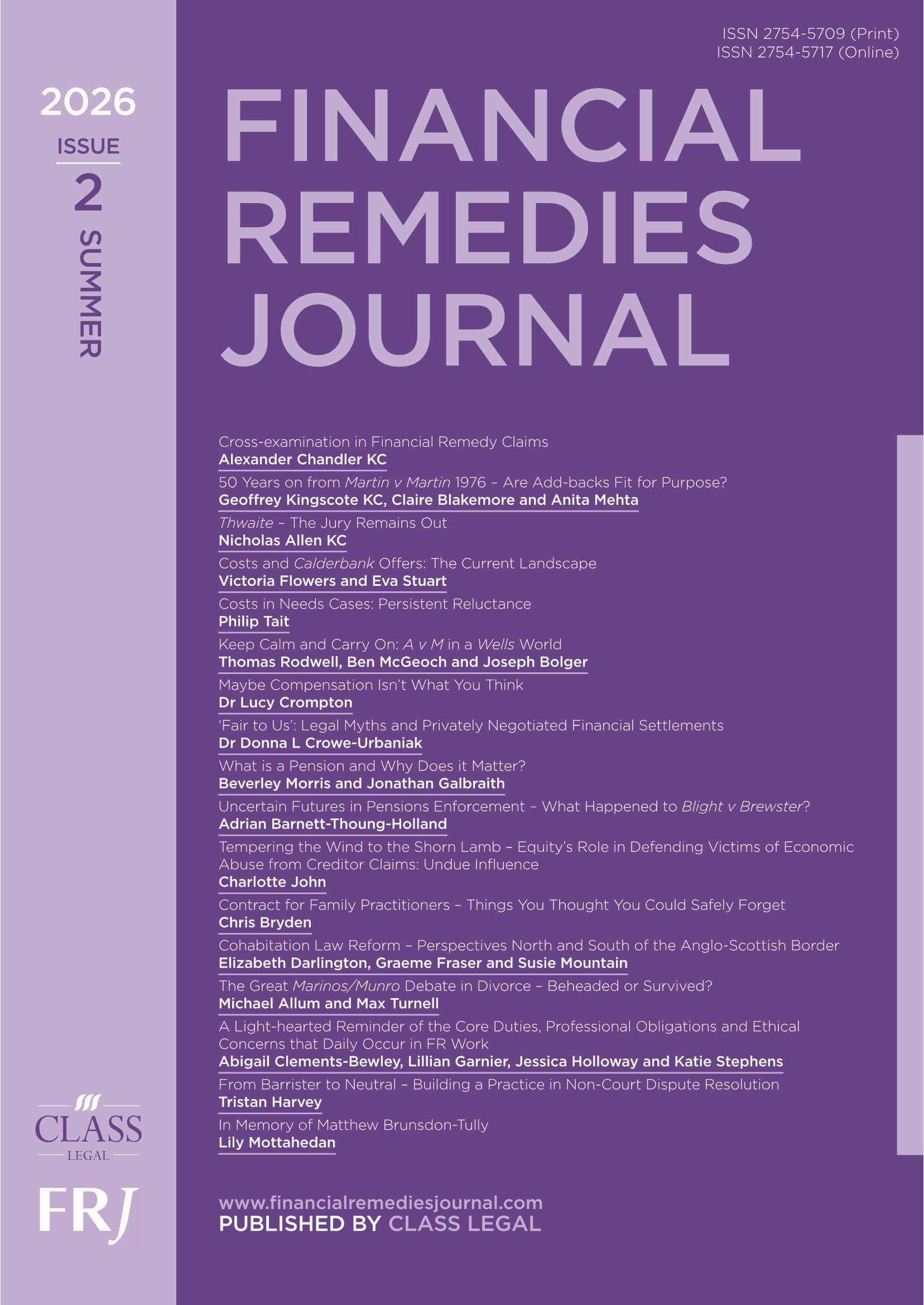
Now out: Financial Remedies Journal 2026 Issue 2 (Summer 2026)

The Right Side of History: Protection Against Domestic Abuse as a Key Theme of the Government Consultation into Financial Remedies