
Seagrove v Sullivan [2014] EWHC 4110 (Fam)
Judgment date: 03 December 2014
Related
Rt. Hon. The Countess Karen Anne Spencer v Rt. Hon. Ninth Earl Spencer, Charles Edward Maurice Spencer [2025] EWFC 431
Peel J. Appeal by W for further details of an arbitration award to be disclosed to the associated KBD proceedings and to ‘any persons’. Peel J permitted minimal further disclosure in order to provide the King’s Bench court with full context but emphasised the confidential nature of arbitration.
DR Corner: Arbitration, Litigation and Biscuits
[2026] 1 FRJ 70. A member of the author's chambers once described the private FDR as a court FDR, with biscuits. But arbitration and litigation are also different in other important ways, and arbitration is not just another form of consensual non-court dispute resolution (NCDR).

When Might an Arbitration Not Be Entirely Private and Confidential?
One of the great virtues of family law arbitration is its ability to provide the parties with confidentiality and privacy for their dispute. Unlike court proceedings, the parties will not face the risk of the hearing taking place in open court with curious members of the public present.


Related
Rt. Hon. The Countess Karen Anne Spencer v Rt. Hon. Ninth Earl Spencer, Charles Edward Maurice Spencer [2025] EWFC 431
Peel J. Appeal by W for further details of an arbitration award to be disclosed to the associated KBD proceedings and to ‘any persons’. Peel J permitted minimal further disclosure in order to provide the King’s Bench court with full context but emphasised the confidential nature of arbitration.
DR Corner: Arbitration, Litigation and Biscuits
[2026] 1 FRJ 70. A member of the author's chambers once described the private FDR as a court FDR, with biscuits. But arbitration and litigation are also different in other important ways, and arbitration is not just another form of consensual non-court dispute resolution (NCDR).
When Might an Arbitration Not Be Entirely Private and Confidential?
One of the great virtues of family law arbitration is its ability to provide the parties with confidentiality and privacy for their dispute. Unlike court proceedings, the parties will not face the risk of the hearing taking place in open court with curious members of the public present.
Latest

The Reluctant Pension Credit Member
[2026] 1 FRJ 39. In the case of AP v TP [2025] EWFC 190 (B) a financial remedy order was made by consent, following an FDR, which included a pension sharing order in W’s favour. Difficulties began when W failed to provide the necessary information to permit the pension share to be implemented.

Housing Particulars: Mind The Gap
What can the court do when there's a significant gap between the bottom of the applicant’s range and the top of the respondent’s range? Can the court take up the invitation made by counsel to ‘conduct its own research on Rightmove if it wishes’?
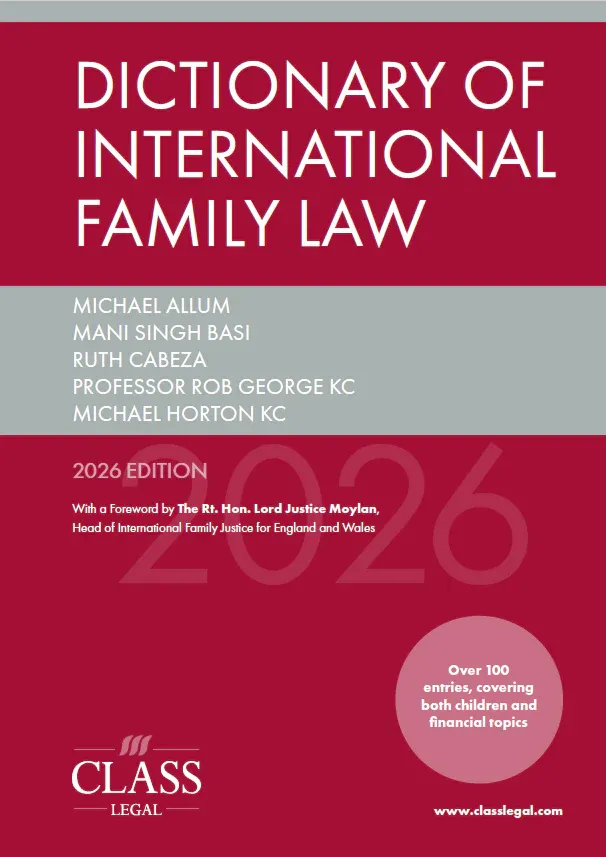
Book Review: Dictionary of International Family Law
The Dictionary of International Family Law is the latest addition to the series of Class Legal Dictionaries. It joins this distinguished family with confidence and purpose.