
Money Corner: Share Options – What Are They and How Do You Value Them?
[2026] 3 FRJ 255. Employee share options are increasingly encountered in financial remedy proceedings, particularly where a party works in a senior role. While they may receive less immediate attention than other assets, share options can represent a substantial component of an individual’s wealth.
Why share options matter in financial remedy proceedings
Employee share options are increasingly encountered in financial remedy proceedings, particularly where one party works in a senior managerial, professional or executive role. While they may receive less immediate attention than a family home, pension or investment portfolio, share options can represent a substantial component of an individual’s wealth.
The first challenge for practitioners is that the value of employee share options is rarely obvious. Unlike cash balances or quoted shareholdings, options derive their value from the possibility of future gains rather than ownership of an asset today. An option that appears worthless on an employee’s most recent Equity Compensation Statement because its exercise price exceeds the current share price may nevertheless have significant economic value, as there remains time for the share price to appreciate before expiry.
The position can be further complicated by vesting conditions, performance targets, restrictions on transferability and uncertainty as to whether the employee will ultimately be able to realise the benefit of the award. As a result, the face value of an option grant, or even its current intrinsic value, may bear little resemblance to its true economic worth. An example of the challenges of valuing options can be seen in GW v RW [2003] EWHC 611 (Fam) where the accountants instructed by the wife made what Mostyn J called an ‘unfortunate’ and ‘elementary’ error in their calculation of the husband’s options:
‘They calculated them without taking into the account the option price which H would have to pay to acquire the assets. They attributed over £6m to these options when the correct figure, net of tax, would have been only about £640,000.’
Furthermore, the treatment of employee share options in financial remedy proceedings can raise difficult questions that extend beyond valuation. The court is often faced with arguments about the extent to which share options granted during the marriage but vesting (sometimes long) after separation should be treated to reflect post-separation endeavour.
Going further still, in C v C (Post-Separation Accrual) [2018] EWHC 3186 (Fam), Roberts J was persuaded that part of the value of restricted stock units (an employee incentive similar to options) both awarded and vested during the marriage could properly be characterised as non-matrimonial, because the awards were subject to a ‘performance-based cancellation’ provision and thus required ongoing endeavour to realise their full value. However, rather than characterising part of the asset as non-matrimonial, the more usual judicial response to this issue is to reflect post-separation endeavour through a reverse contingent lump-sum mechanism.
The authorities demonstrate that the court’s focus is not merely on the existence of the award but on the reason it was granted and the extent to which its eventual value derives from efforts made during, as opposed to after, the relationship. In Lawrence v Gallagher [2012] EWCA Civ 394, the Court of Appeal was cautious about treating unvested and contingent elements of deferred remuneration as present capital available for immediate sharing, recognising that no clear entitlement had yet crystallised. Lawrence v Gallagher treated said remuneration as future income rather than capital. Interestingly, this approach has not been followed in the reported authorities at High Court level, which have invariably treated granted (but unvested) tranches of deferred compensation as capital assets, despite their deferred receipt and contingency (which may warrant departure from equal sharing and/or Wells sharing).
For family practitioners, understanding the principles behind option valuation and their treatment by the courts is important. A proper assessment can materially affect both the identification of matrimonial assets and the fairness of any eventual settlement. Before considering how such valuations are performed, it is useful to understand what share options are and why they exist in the first place.
The agency problem
The story of share options begins with the agency problem. In a company, particularly a large company, the people who own the company, i.e. the shareholders, are not usually the people running it.
Shareholders desire returns on their investment via an increase in the company’s value and long-term profits. However, the managers they have hired to achieve those goals may sometimes make decisions that benefit themselves rather than the company’s owners.
For example, shareholders might want management to focus on profitable projects, while a CEO or Managing Director might approve an expensive new headquarters or an uncommercial expansion because it increases their status and influence. In this case the shareholders bear the cost, while the CEO enjoys the prestige.
There are various methods of attempting to reconcile this apparent conflict of interests. One solution to this problem that companies use is to grant options to their employees to buy the company’s shares in the future in order to align the incentives of their employees with those of shareholders. These are known as employee stock options, or ‘ESOs’.
Naturally, shareholders benefit when the share price rises. Granting options to employees means that they too benefit from share price rises and are therefore motivated to work hard and to make smart decisions to achieve a sustainable appreciation in share price.
In addition to aligning employees’ motivations with that of their shareholders, stock options enable companies to compensate employees without paying out cash, which is good news for companies’ cashflows.
From a financial remedy perspective, this means that a significant part of an employee’s remuneration package may not appear in the form of salary, bonuses, pension contributions or other employment benefits, even though it may represent substantial value. Furthermore, ESOs can be awarded so that they cannot be exercised for several years, helping to encourage longer-term decision-making. This built-in delay is known as the ‘vesting period’. Only once an ESO has vested can any benefit be gained by the holder.
Questions surrounding vesting often arise in divorce proceedings because the court may need to consider whether unvested options represent a resource that should be taken into account when assessing the parties’ financial positions.
What is an option?
An option contract gives the holder the right, but not the obligation, to buy or sell an underlying asset. In my explanation below, the asset will be a shareholding (also known as a ‘stockholding’ in the US), but it could equally apply to assets as varied as oil, Vietnamese dong or tulips.
The contract will specify:
- whether the holder has the right to buy, or sell, the underlying asset;
- the date by which the option may be exercised; and
- the price at which the option may be exercised, which is known as the ‘Exercise Price’ or ‘strike Price’.
A call option gives the holder the right to buy an asset, while a put option gives the holder the right to sell an asset. Employee share options are naturally therefore call options. Company management would be foolish to issue put options to their employees as this would incentivise employees to decrease the company’s share price.
Typically, ESOs have several features that distinguish them from publicly traded options, such as exchange-traded commodity options:
(1) First, ESOs cannot be sold or transferred by the employee like an exchange-traded option can.
(2) Second, employee stock options have a long period, typically 10 years, over which they can be exercised, as opposed to the shorter terms of publicly traded options.
(3) Third, most ESOs have vesting restrictions requiring employees to wait for a specified period before being able to exercise their options. This encourages the employee to remain with the company and supports longer-term alignment with shareholders, because the options may be forfeited for no value if the employee leaves before they vest or before the share price has adequately appreciated.
There are two main types of option contract:
- European-style options, which can only be exercised on the option’s maturity date.
- American-style options, which allow option holders to exercise the option at any time prior to and including its maturity. This can increase the value of the option relative to a European-style option, particularly where early exercise may be optimal.
Most ESOs are best thought of as American-style options once vested, because they can usually be exercised before expiry, although they are subject to vesting and other contractual restrictions.
One important feature of options is that they have a minimum value of zero, because they are only a right, not an obligation, for the option holder. If the prevailing market price of the shares is less than the exercise price, any rational option holder will simply decline to exercise their right to purchase the shares as they could buy them for less on the open market.
The current market value of an option contract is known as the option premium. This premium comprises two elements:
- intrinsic value; and
- time value.
The intrinsic value of an option represents the value that would accrue if the option were to be exercised now, while time value represents the possibility that the option could be exercised for a greater profit in the future.
Consider a holder of an option on shares in a hypothetical company, Widget plc, with an exercise price of £1.00 that will expire in 3 months’ time. Suppose that the current price of Widget plc shares is £0.90. The holder will not exercise the option currently since buying the stock at £1.00 is more expensive than the market price. The intrinsic value of the option is therefore £nil.
However, there is a probability that the spot price (i.e. the current price) of the underlying Widget plc shares will rise during the life of the option. If the share price rises above the strike price of £1.00 before it expires, the option holder can exercise the option and make a profit. The probability of this happening gives the option time value.
This distinction between intrinsic value and time value is particularly important in financial remedy cases, as an option that appears to be worth nothing today may nevertheless have substantial economic value:
- When the price of an asset is less than the exercise or strike price of a call option written on it, then the intrinsic value is £nil and the option is said to be out-of-the-money.
- When the asset price equals the exercise price, the option has zero intrinsic value, and the option is said to be at-the-money.
- When the price of an asset is higher than the exercise price then it has an intrinsic value equal to the asset price less the exercise price, and the option is said to be in-the-money.
Options with longer terms to maturity are more valuable. This is because the longer a share is given the chance to rise in price, the higher the probability that the share price will rise above the strike price. This probability is reflected in the option’s time value.
The duration to maturity of the option is one aspect that affects its value. Another significant factor is the volatility of the spot price of the underlying asset, in this case Widget plc shares. Volatility is a measure of how much and how quickly the share price fluctuates over time. If the share price is very volatile, then there is a higher probability that the option will be very deeply in-the-money by the time it expires, or indeed at some point before its expiry. Somewhat counterintuitively, the potential profit for an option holder over a volatile share is therefore greater than for a less volatile share. So, the time value of the option over a volatile asset will be higher, and therefore its overall value will also be higher.
Consequently, a cursory review of an employee’s option awards may significantly understate their true worth where the underlying shares exhibit high volatility.
Investors value stability in asset prices as it reduces risk and uncertainty. However, option holders like volatility because the payoff is asymmetric: they don’t care if the share price drops dramatically as it would not result in a significant loss like it would to a shareholder. In fact, their loss would be the same if the share price was just below the exercise price: £nil. However, if the share price rises dramatically the option holder stands to profit significantly. Due to this asymmetric payoff, option holders will happily risk a higher likelihood of the share price collapsing if it means there is a higher likelihood of it soaring.
When interest rates rise, the value of call options also rises. If interest rates rise, the cost of borrowing money to buy an investment rises, or alternatively the return on existing capital rises, making it more attractive to hold call options, which require little or no investment, compared with buying the underlying stock itself. Hence, call options become more valuable.
So, the value of options is sensitive to:
- the current market price of the underlying asset, for example, the current market price of Widget plc shares, say £14.50;
- the strike price of the option, for example, £17.80;
- the time until the maturity of the option, for example, an exercise date in 3 months;
- the volatility of the price of the underlying asset, for example, a relatively high volatility of 35%, which means the asset’s returns can vary significantly around its expected value; and
- a change in interest rates.
How to value ESOs
Having defined what options are, the next consideration is how to value them. This can be an important issue in financial remedy proceedings, as the existence of an option award is usually apparent from disclosure, whereas its economic value is not.
One would assume that any valuation would inevitably require a prediction about the likely future share price of the underlying company.
This would create a complicated problem. While analysts can attempt with varying degrees of success to predict the future price of a share, no one can forecast it with certainty. If they could, option pricing would be trivial – and forensic accountants would be out of a job.
For example, if a stock were to trade at a price of £100 today and you knew with certainty it would be £150 in a year:
- the payoff of a call option with a strike price of £100 would definitely be £50;
- its fair value would be £50, discounted for the time value of money.
The challenge is that nobody knows whether £150 will be its future price.
Instead of a single forecast, option pricing first uses a distribution of possible outcomes. For example, let’s assume there is a 20% probability of the share price being each of £60, £80, £100, £120 or £140. The corresponding payoffs would be £nil, £nil, £nil, £20 and £40. The expected payoff would be £12, as follows:
| Future price (£) | Probability (%) | Option payoff (£) | Expected payoff |
| [A] | [B] | [A x B] | |
| 60 | 20 | – | – |
| 80 | 20 | – | – |
| 100 | 20 | – | – |
| 120 | 20 | 20 | 4 |
| 140 | 20 | 40 | 8 |
| Total | 12 |
So, the option is worth £12 if:
(1) those probabilities are correct;
(2) investors are indifferent to risk; and
(3) we ignore discounting for the time value of money (i.e. the concept whereby £12 in the future is worth less than £12 now as I could invest £12 now and earn a return).
However, this is not yet a proper option-pricing model; it is simply a way of showing why a range of possible future outcomes gives the option value today.
Furthermore, this example is a very imprecise method of calculation. Share prices do not move in leaps of £20. On the London Stock Exchange, for example, shares can move in increments (known as ‘tick size’) as small as 0.0001p, depending on the specific share.
Furthermore, there are a much wider range of possibilities of what the share price will be on the exercise date than merely five possibilities.
Therefore, we need to build a much more complicated model to consider the outcome of myriad possible future scenarios. We could do this with what is known as a ‘binomial lattice’.
A binomial lattice model is based on a probability distribution in which the underlying event has only two possible outcomes (hence ‘binary’). In the case of employee stock options, the underlying event is the change in the stock price and the resulting intrinsic value of the option.
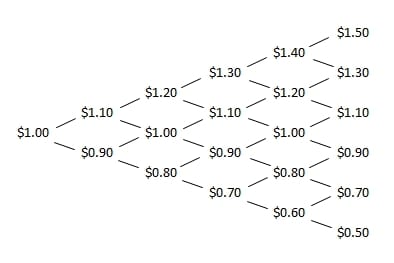
During each time period, the stock price can move either up or down. When multiple periods are considered in sequence, a distribution of possible stock prices is created. This binomial distribution is referred to as a lattice (or tree), reflecting its appearance. It models how the underlying asset price may evolve over time. An example of a binomial lattice with a current share price of $1.00, increments of $0.10, and five time steps, can be seen below:
[INSERT IMAGE 22]
As can be seen in the example, after five time periods, be it years, months, weeks or days, the number of possible prices is six, each with its own probability. Each price in the binomial lattice is called a ‘node’, from which the next price stems.
But it would only result in a crude estimate of the option’s value if we stopped at five time periods with its corresponding six price possibilities and increments as large as $0.10. To increase accuracy we need to add more steps and therefore more possibilities, each with smaller price changes.
What happens if we make the model finer and finer, like a master mason gradually hewing a rough block of stone into perfectly smooth masonry fit for use in the intricate tracery of Notre-Dame de Paris’s rose window?
Eventually, we would have an infinite number of future price possibilities. This is a concept borrowed from calculus, which literally means ‘small pebble’ in Latin, and is a far cry from the lump of rough stone in the binomial lattice example above.
But one big problem remains: nobody knows what the probability is of a share moving up or down in price. So, what probabilities should we use in the model?
Enter stage left: Fischer Black and Myron Scholes
The Black-Scholes model (pronounced ‘shoals’) was developed in 1973 in the prosaically titled article, ‘The Pricing of Options and Corporate Liabilities’.[[1]]
It is a mathematical model for the dynamics of a financial market containing derivative investment instruments, such as share options.
It gives a theoretical estimate of the price of European-style options and shows that the option has a unique price depending on the risk of the underlying security when replacing its expected return with the risk-free or risk-neutral rate, such as the rate of return on government bonds.
As explained earlier, European-style options can only be exercised on the option’s maturity date, or expiry date.
Calculus had been used before to value share options, but the genius of Black and Scholes, and what ultimately led to the Nobel Memorial Prize in Economic Sciences being awarded to Myron Scholes in 1997 (Black having died in 1995), was not letting the number of possible future prices become infinite but showing that you did not need to know the true probabilities of future prices at all. By continuously hedging an option with its underlying share, they transformed a problem of forecasting into one of arbitrage, allowing a unique fair value to be derived.
Hedging involves investors adjusting their portfolios to eliminate or reduce risk. For example, suppose you own a house worth £500,000 and are worried that prices might fall before you sell it. If there were a market where you could sell a contract that gains value when house prices fall, you could use that contract to offset your risk. If the house loses £20,000 in value, the hedge might gain £20,000, leaving you largely protected.
On the other hand, arbitrage is the opportunity to make a profit with no investment, no risk and no uncertainty about the outcome. For example, if gold were trading at £2,500 per ounce in London and £2,510 per ounce in New York, an investor could buy in London, sell in New York and lock in £10 per ounce without taking price risk.
In other words, instead of asking, ‘What will happen?’, Black and Scholes asked, ‘Can I build the option from other traded assets?’.
To see why this matters, imagine a share worth £100 and a call option that gives the right to buy that share for £100 in one year’s time. If, in one year’s time, the share is worth £120, the option will be worth £20, its intrinsic value. If the share is worth £80, the option will be worth nothing.
Black and Scholes showed that it is possible to construct a portfolio consisting of shares and borrowing or lending that produces exactly the same future payoffs as the option. Such a portfolio is known as a ‘replicating portfolio’. If the option and the replicating portfolio have identical future cashflows, they must have the same value today. If they did not, an arbitrage opportunity would exist that would quickly be eliminated by an efficient market.
For example, if the option traded for more than the cost of creating the replicating portfolio, an investor could sell the expensive option, buy the cheaper portfolio, and lock in a risk-free profit. If the option traded for less, the reverse trade would generate the same result. Competitive trading would quickly eliminate such opportunities, forcing both to have the same price.
The remarkable consequence is that the option’s value can be determined without knowing the actual probability that the share price will rise or fall. The market’s collective hopes, fears and forecasts become irrelevant. All that matters is the cost of constructing the portfolio that replicates the option’s payoff.
This leads to one of the most counterintuitive ideas in finance: options can be priced as if investors are risk-neutral, i.e. indifferent to risk. The resulting probabilities are not forecasts of what will actually happen. Rather, they are the probabilities that make all assets earn the risk-free rate after accounting for risk. Under these risk-neutral probabilities, the value of an option is simply the discounted expected value of its future payoff.
This counterintuitive but genius leap led to Black and Scholes creating their famous equation. Nowhere in the equation is there a variable for the probability of the share price rising or falling. Instead, only five inputs are required:
(1) the share’s current value;
(2) the option’s exercise price;
(3) the option’s time to expiry;
(4) the risk-free interest-rate, which is typically based on government bond yields; and
(5) the expected variability of the share price, known as its volatility.
The Black-Scholes model was designed to value options that can be exercised only at maturity. It was also designed to value options on underlying assets that do not pay dividends. But many shareholdings pay dividends. An adjustment was needed to the mathematics.
More problems require more mathematicians – enter stage right: Robert Merton
Although the original Black-Scholes model assumed that the underlying share paid no dividends, Robert Merton quickly extended the framework developed by Black and Scholes to accommodate dividend-paying securities and, more importantly, provided a more general and rigorous treatment of the arbitrage and continuous hedging arguments underpinning the model. As a result, the version used in practice today is more accurately known as the Black-Scholes-Merton model and led to Robert Merton sharing the Nobel Memorial Prize in Economic Sciences.
However, by extending the framework to assets paying dividends another problem arose. For options over non-dividend-paying shares, due to the possibility of the share price rising further than it might have already done, and because the downside risk remains limited, options should never be exercised early. For that reason, American-style call options over non-dividend-paying shares are no more valuable than European-style call options.
But this is not true for options over dividend-paying shares. While a shareholder is entitled to receive dividends, option holders are not. Therefore, it may be more profitable to exercise the option early and become a shareholder in order to receive the dividend an option holder would not have received. This creates an optimisation problem: is it better to exercise today or keep the option alive?
The standard Black-Scholes-Merton formula has no simple way to answer that problem; once early exercise becomes relevant, binomial lattices are usually more practical.
There are also other differences between the market-traded, theoretical options for which the Black-Scholes-Merton model is designed and the non-transferable, real-world options awarded to employees that may need to be valued in financial remedy proceedings.
These contractual, behavioural and market factors include:
- the risk of employee resignation or termination;
- how long after resignation or termination the options can be exercised;
- non-transferability of the options;
- blackout periods when employees may be prohibited from exercising share options to prevent trading on inside information such as the period before the company publishes its annual results; and
- the risk of sub-optimal exercise behaviour where employees exercise earlier than predicted by standard option-pricing models due to risk aversion or liquidity needs.
Many of these factors will require consideration of circumstances specific to the employee spouse and can therefore be particularly relevant when valuing options in a divorce context.
For that reason the Black-Scholes-Merton model is only relevant in certain circumstances, such as when:
- the risk of the employee exiting employment is low;
- there is a short period until the option vests – the longer the vesting period the greater the employee exit risk;
- the volatility of the share price is low meaning the impact on the time value of the option from exercising earlier than optimal due to risk aversion is mitigated;
- there are no unusual performance conditions such as price hurdles or profit targets – those features introduce path dependency for which the Black-Scholes-Merton model is not designed;
- the shares have a low dividend yield as large dividends may encourage early exercise.
For family practitioners, the significance is that the valuation methodology may materially affect the value attributed to an option award and, therefore, the overall asset schedule presented to the court.
When the off-the-shelf block does not fit
Outside those circumstances, the expert valuer will likely need to rely on our old friend the binomial lattice. While forensic accountants cannot create binomial lattices with infinite smoothness like the masonry in Notre-Dame’s rose window, modern software can get very close. Under the same assumptions as Black-Scholes-Merton, a binomial lattice with enough time steps will converge very closely to the Black-Scholes-Merton value. Think of it like a piece of masonry fit for a gothic arch in a parish church: perhaps not perfect, but still very much beautiful.
The main benefit of binomial lattices is that they are much more adaptable than the Black-Scholes-Merton model. The real-world features of an ESO, such as a high risk of an employee leaving employment or risk-averse behaviour in response to volatile share prices, can be incorporated into a bespoke model. If the gothic arch is slightly off-plumb and not quite square, a binomial lattice can create a near-perfect masonry block for that specific church window when an immaculately precise off-the-shelf block made by Black, Scholes and Merton will not fit.
Trees with multi-dimensional branches do not bear fruit
Unfortunately, the machinations of a large corporation’s remuneration committee know no bounds. While a standard ESO may incentivise most senior employees effectively, it might not suffice for certain high-ranking executives with greater decision-making powers.
Remuneration committees therefore sometimes add conditions to whether the ESOs vest, such as requiring the company’s share price to outperform its peers, for example, ‘1 million options vest only if the company’s share price exceeds the FTSE 250 median over a three-year performance period’.
This adds much greater complexity to the binomial model. Each variable introduced, such as the company’s future share price and the future level of the FTSE 250 index means another dimension needs to be added to the binomial tree. The lattice quickly expands from a simple tree into a multi-dimensional grid of possible outcomes. While it is technically possible to create one of these multi-dimensional trees, it would require some very careful splicing of the tree’s branches and the result would be very cumbersome.
Luckily, however, there is another tool in the mason’s kitbag for such a commission: Monte Carlo simulation. The term was coined by a physicist during the Manhattan Project and references the famous casino because the method relies on randomness and games of chance like roulette or craps. It can provide approximate solutions that are far too complex for mathematical analysis, even for Black, Scholes and Merton.
Monte Carlo simulation avoids this ‘curse of dimensionality’ by generating thousands of complete future scenarios for all companies at once, based on random starting conditions and price changes, and then averaging the resulting outcomes. With enough simulations, and assuming the model inputs and structure are appropriate, Monte Carlo can produce a close approximation to the modelled value. This approach is particularly useful where vesting depends on performance conditions, a feature commonly encountered in executive remuneration packages disclosed within financial remedy proceedings.
In the masonry analogy, Monte Carlo simulation is like taking a large block of stone and using an automated chisel to decide whether thousands of random points should be chipped away or not. Do it enough times and the final shape becomes increasingly smooth and accurate.
From rough stone to reasoned value
In the end, valuing employee stock options is less about finding a single perfect formula and more about choosing the right tool for the stone in front of you. Black-Scholes-Merton may provide an elegant, finely cut block where the assumptions fit; a binomial lattice can be shaped to accommodate the awkward angles and contractual quirks of real-world ESOs; and where the structure becomes too complex for even that, Monte Carlo simulation allows the valuer to chip away at the problem through thousands of possible futures.
None of these methods removes uncertainty entirely. But, in financial remedy work, mathematical perfection is rarely the objective: the task is to produce a reasoned, supportable valuation that fits the facts, the evidence and the particular window the court is being asked to look through. Where employee share options form part of the parties’ resources, valuation evidence may therefore assist the court and the parties in understanding their potential economic significance, even if that evidence is ultimately used as an analytical tool rather than as the basis for a specific asset schedule figure. On the other hand, valuation will not always be determinative. In many financial remedy cases, rather than attempt to attribute a precise present value to share options, the court may instead decide to Wells share such assets in specie, perhaps apportioned to reflect post-separation endeavour depending on the facts of the case. The fact that an asset is capable of being Wells shared does not necessarily render valuation evidence irrelevant. Rather, valuation and Wells sharing are often complementary tools directed towards the same objective: achieving a fair outcome in the face of uncertainty. Expert analysis may assist in identifying the nature of the awards, distinguishing between matrimonial and non-matrimonial elements, assessing tax implications, evaluating the range of potential outcomes and informing both settlement discussions and the design of any sharing mechanism ultimately adopted.
Why the valuation of share options should not be overlooked
For family lawyers, the key point is that employee share options should rarely be dismissed as an incidental employment benefit. Depending on the circumstances, they may represent a significant source of current or future wealth and can sometimes be worth considerably more than appears from a superficial review of the disclosure.
Equally, the complexity of the valuation process should not deter practitioners from obtaining expert assistance where appropriate. While sophisticated valuation techniques such as binomial lattice modelling and Monte Carlo simulation may sound daunting, the practical exercise of valuing many employee share option awards can often be undertaken efficiently and at a proportionate cost. The existence of a specialist valuation issue does not necessarily mean that a full-scale and prohibitively expensive expert exercise will be required.
The potential consequences of overlooking these assets are far more significant. If a valuable option holding is ignored, misunderstood or incorrectly valued, the resulting settlement may fail to achieve a fair division of the parties’ resources. In an adversarial environment where disclosure and asset identification are of central importance, practitioners who fail to investigate substantial share option awards adequately may find their approach subject to criticism.
The legal analysis does not end once a valuation has been determined. In financial remedy proceedings, the court may still need to consider what proportion of the award, if any, should properly be treated as matrimonial property. That exercise may require consideration of the purpose of the award, the vesting period, the timing of separation and whether the award was intended to reward past performance, incentivise future performance or both. While a valuation model may take account of factors such as forfeiture risk, employee departure rates and vesting conditions when determining the economic value of the award, the separate legal question of whether that value is matrimonial or non-matrimonial remains a matter for the court. The expert’s role is therefore typically to assist the court with the valuation of the award, while its ultimate treatment for sharing purposes is a question of law and judicial discretion.
The prudent course is therefore straightforward. Whenever employee share options are disclosed, practitioners should consider at an early stage whether their value can readily be established from available information or whether specialist forensic accounting input is required. The extent to which a formal valuation exercise will be necessary will often depend on how likely it is that the court will adopt a Wells-sharing approach, since Wells sharing does not generally require a precise present-day value to be attributed to the options. That said, the question is not always whether the options need to be valued, but whether they need to be understood. Even where a Wells-sharing outcome is likely, expert analysis may assist the court and the parties in understanding the nature and potential economic significance of the awards, the extent of any matrimonial and non-matrimonial components, the relevant tax consequences, and the practical implications of any proposed sharing mechanism. Share options are not always valuable, but they can be. Ensuring that they are properly understood and, where appropriate, properly valued is often a small investment compared with the risk of getting the overall financial picture wrong.
[[1]]: (1973) 81(3) Journal of Political Economy 637–654, www.journals.uchicago.edu/doi/10.1086/260062


Latest
Now out: Financial Remedies Journal 2026 Issue 3 (Winter 2026)
The Case for Calderbank: A Procedural Reform Too Far?