
Interview with District Judge Lynda Ashworth
[2026] 2 FRJ 177. As March 2026 drew to a close, the only district judge dealing purely with financial remedies in England and Wales, District Judge Lynda Ashworth, chose to retire from full-time judicial work. She was interviewed in late February about her life, practice and judicial career.
District judges are unfairly seen by some as the worker bees of the judicial system. They make decisions every day that profoundly affect the lives and rights of people and entities that come before the courts. But their judgments are usually not citable, they do not make precedent, and thus the impact of their decision-making often goes unrecognised, save by those who work in the legal system.
In the Financial Remedies Court so much of the work is carried out by district judges. The effect of their work is life-changing. They deal with people at some of the most stressful points in their lives. The district judge needs to be sensitive to those issues; to listen to, understand, and assess a litigant’s needs, motives and desires, and to reach a fair outcome.
As March 2026 drew to a close, the only district judge dealing purely with financial remedies in England and Wales, District Judge Lynda Ashworth, chose to take her well-deserved retirement, from full-time judicial work at least. Among the congratulatory messages sent when news of her retirement spread, were also messages of sorrow that her perspicacious decision-making would not be available to litigants in future.
I had the pleasure of interviewing her in late February about her life, practice and judicial career.
Tell me about you, your childhood, and your background.
I come from a very average background. My parents probably saw themselves as middle class. My dad was certainly middle class; my mum was not, she had quite a hard life. She’s very bright, my mum. She came from a not well-off family. She passed her 11+ to go to grammar school, which she loved. In another era, she would have gone on to further education, she might have been me. She probably would have been a history teacher, I think, but there wasn’t the money, so she did her O Levels and left school at 16.
My mum’s from Rugby, my dad’s a Yorkshireman from Hebden Bridge. My dad was doing an apprenticeship at Associated Electrical Industries (AEI) in Rugby. There was a grand lady called Mrs Arthur James − who was the late Queen Mother’s godmother − who had a big house, Coton House, at the end of the road where my mum lived and the apprentices from AEI used to stay there. It was a condition they had to go to church on a Sunday where Mrs Arthur James played the organ and that’s how my parents met. My mum was pregnant with me when they moved to Chippenham, which is near Bath, for my dad’s work.
From 13 I went to the state grammar school for a year. It became a comprehensive and merged with the secondary modern.
Did you always want a career as a lawyer?
I can’t tell you why I wanted to be a lawyer, but I knew from the age of 11. I was unshakable about it. We have no lawyers in our family, so I have no idea where that came from. I can’t remember seeing anything on the telly that made me think that that was what I want to do, I just knew.
My parents didn’t have a clue, bless them, and the careers advice that’s available today just wasn’t available. I remember we applied for the prospectus of every university in the country to see what they said we needed to do. My school said I needed to show I could think logically so I did maths, English literature and chemistry at A-level.
These weren’t my best subjects. The result was that I didn’t do very well. My predicted grades weren’t very good. I didn’t get any offers at university, so I went to Trent Polytechnic. In 1979, it was one of the best institutions in the country to do law. I did my degree and my Law Society finals there and I came back to Chippenham and did my articles with a local firm.
Trent Poly was more of a solicitor’s institution than a barrister’s institution. I don’t think I really thought about it, but I wouldn’t have had the confidence for the Bar.
So you did your Law Society finals and then went back to Chippenham and did articles.
I did my articles at a firm called Wood & Awdry. It was a small High Street practice – there were five partners (all men) and that was it – when I started there wasn’t anybody else. At the end of my first year at poly, I wrote to all the law firms in Chippenham and asked if I could do some work experience. They were one of only two firms that bothered to reply.
When they took me on, they discovered I could type as I had taken myself off to night school when I was in sixth form and learned how to touch type. They used me as a quasi-secretary. I also used to help in reception. At the end of the first year, they asked me back and towards the end of the second year, the second senior partner – he was a very austere man – said to me, ‘Well, I suppose you’ll be wanting articles now. We’ve never had an articled clerk and I didn’t think we’re ever going to have one, especially not a woman’. After that, I kept going back and at the end of the third year they offered me articles.
You proved yourself then!
It was a family firm and of these five partners, the senior partner had been our MP and the second and third junior partners were from well-connected families, so they knew a lot of people. The work that we did was High Street work, but it was also sometimes quite high-powered for quite influential people, which you would never have thought if you saw this little, sleepy place.
I did my articles there and then they offered me a job which, once I’d started my articles, I think had always been the intention, because they wanted somebody to assist the partner doing family law. This was fine because it was family law that had interested me the most anyway.
What did you like so much about family law?
I just liked the maths, really. As I say I wasn’t that good at it, but I just liked the analysis. Although, of course, in those days it was different, it was all about reasonable needs − don’t forget this is all way before White. I also liked the human element of it, being able to help people.
It was primarily divorce and money. We got very few disputes about arrangements for children – people either worked it out amongst themselves or they didn’t pursue it.
Of course, money was reasonable needs in those days, there was no concept of ‘sharing’. You got the house, you got some maintenance, and that was it. I know White v White is what we remember but actually I think it was Flick v Flick that really started the ball rolling. The wife was married to a chap who was part of the family that owned Mercedes. Her argument was that she was only getting needs and he got to keep all his money.
White was a very good change in the law. When I do my FDR indications, I always make sure I stress that contributions − financial and non-financial − are absolutely equal. To do otherwise is wholly discriminatory.
Where are we now then? You are a very junior solicitor at Wood & Awdry.
After a year of being a qualified solicitor, I felt I really needed to move.
I then got a job in Bath with a firm called Stuart-Brown & Worboys in 1986. I became a partner there but it didn’t work out so I left.
In 1993 I went to work as an associate solicitor with a firm called Bobbetts Mackan in Bristol, which was a large inner-city firm with a family department. The partner in charge was a very good lawyer and she did a lot of care work as a guardian solicitor. I was there between 1993 and 1997 and then went back to Wood & Awdry.
I was at Wood & Awdry for another 10 years until I got appointed in 2008. I came in as an associate solicitor, not a partner − my one foray into partnership was not entirely successful and it didn’t really interest me, it wasn’t something that I wanted to do.
What made you want to become a judge?
I was appointed a part-time district judge in 2002. At 42, I had been working as a lawyer since 1983, when I started my articles, so for nearly 20 years. I wanted two things: to expand my horizons and do something different; and to give something back to my profession − that’s important to me.
I also did quite a lot of extracurricular work: I set up a young solicitors group in Bath; I was on the National Committee for Young Solicitors with the Law Society for several years; I was a committee member of the Legal Aid Practitioners Group; I was a council member for Bristol Law Society; I also did a year lecturing on the ILEX course for South Bristol College.
I got it the second time. If you got through the paper sift you were invited for interview. They gave you a scenario and you had to deliver a judgment based on it. There was no role-play, I just had about 20 minutes to write a judgment on a road traffic accident, then you deliver it and then the interviewers asked questions. And you squirm in your seat, it was very uncomfortable, because they really grill you! I remember it even now.
I had an informal mentor, a district judge called Gillian Stuart-Brown − the Stuart-Brown of Stuart-Brown & Worboys. She was so supportive, not only of me but of other local solicitors who wanted to become judges. There were four or five of us at the time, and I can’t tell you what an inspiration she was. I always thought she was a very good judge, she was so kind and supportive and really took an interest in me.
I was in the west country, I was born there and had no intention of moving. Gillian told me that as there were so few vacancies on the Western Circuit, I needed to widen my remit, so I applied for the London group and I got it. Actually, for me, that was the best thing that could have happened because I suffer terribly from nerves and imposter syndrome, like many of us. What helped me was it was so refreshing to be able to come up to London and make my mistakes in front of people who didn’t know me. I think that helped me in terms of developing a style and then I thought about becoming full-time.
Where did you sit when sitting in London as a DDJ?
I went all over. Willesden was my favourite court − they were so welcoming and supportive there of deputies. There was a circuit judge there called Peter Copley. He had his chambers set up like a dining room and all the deputies were always invited to have lunch up there, it was a three-line whip, you had to go. At that time the district judges were Morris, Steel, Dabezies and Cohen. It was a very welcoming place.
In 2007, after 6 years sitting part-time, I applied to become full-time. I was 48 when I was appointed. The application process took about 18 months.
I did that in the January and then in the July I got notified I had been successful. They wouldn’t then tell you where you were going for ages, even in October they hadn’t told us. I then went to do the course for my Section 8 ticket. There were about six of us that had been appointed on this course and none of us knew where we were going. Of those six, four were prepared to go anywhere and two were adamant that they were only going to the courts they wanted to go to and if they didn’t get them, they weren’t going to take up the appointment. The thing was that in those days, there were four applicants for every one position. The accepted practice was that if you turned something down, you were really at risk of not being offered anything else and everybody knew of people that that had happened to. It took an enormous amount of chutzpah to say, ‘if you don’t give me what I want, I’m not doing it’. I wasn’t in that position, I wanted to be a full-time judge, I’d had enough of private practice, so I was prepared to take anywhere.
I remember talking to my mentor about it. She asked me where I had applied to go and I said that I’ve ticked on the box anywhere in the south east and she said, ‘Oh, for God’s sake, Lynda, they’ll give you Southend!’. I think she just used it as an example, like it was the end of the universe. I had no connection with Southend at all, I had never been to Essex!
And it was Southend! It then never crossed my mind to say ‘no’. I relocated and signed up for 5 years (we all had to sign up for 5 years). I felt quite strongly, something to do with my sense of duty probably, that it was very unfair on the people in the court office if, the minute I got there, I was desperately trying to go somewhere else. I felt that having taken it, I owed it to them to make a success of it. That’s why I stayed there until I came to London.
I had to be persuaded to come to London. It came about because Lynn Roberts, who was an amazing judge, was my DFJ. She saw me one day and said there was an expression of interest for judges who were experienced in financial remedy work to sit at the Central Family Court and she suggested I do it.
My circuit arranged for me to do 2 weeks every 3 months, they didn’t want me to do a long stint.
The first case I ever did there was nearly the last − it was a long financial remedies case. Of course, when you’re new there, everybody tries to test you, to see what they can get past you. I’m fully aware that there’s something like the chambers totem, or the jungle drums, the text messages that go around, ‘Do you know this judge?’, ‘What are they like?’
I found the first case I did very intimidating, but I kept going back and obviously I was doing alright. Martin O’Dwyer was extremely supportive of me, he was very, very helpful. After I had been going a couple of years, he kept saying to me, ‘you need to come and sit here full time’. I just told him that I couldn’t afford to live in London, that I didn’t want to have to sell the flat in Southend.
I also thought it was too far to commute on a daily basis. To do it once a week, you could probably do it but not every single day. When I come in on a Monday from Southend, I get up at 5.45 and I catch a train at 6.45 and I’m here at my desk by 8.15 – so it’s about an hour and a half each way, that’s 3 hours a day.
That was why I said ‘no’ and then it all changed with COVID-19 because you couldn’t go anywhere and you couldn’t spend any money, so I managed to amass some savings. I was not entirely happy by then at Southend because I felt it was becoming very marginalised as a court. I came up to London to do some sitting and they asked me if I would consider moving here full-time. Lynn Roberts said that if I did, I could only do money. I thought about it and I thought, ‘Well, why not – I’m getting near the end of my career, I’ve been in Southend a long time, I no longer owe them anything’.
What do you mean by marginalised?
When I started in Southend, the DCJ was based there, there were two other full-time judges and a judge who sat there 3 days a week and we regularly had circuit judges, it was a thriving court. Then all the admin, all the listing and everything was moved to Chelmsford. The DCJ retired, the new DCJ became peripatetic and so would visit but wasn’t based with us and as the district judges retired, they weren’t replaced. Ultimately, by the time I left, there were two of us and the visiting CJs. You just felt it was becoming subsumed by Chelmsford and we were just a satellite court.
When did you go full-time in London?
Three years ago, January 2023 – I’ve done just over 3 years.
So you stay up when you’re in London?
Yes, I rent a flat. I jokingly say I pay to work, because I don’t have much money left by the time I’ve paid for the rent. I’m not complaining, it was my choice. I knew when I took the job that I would have to fund my living arrangements here. For me, it was more the idea that I would be able to do just money, because that is my passion.
What were you doing before you were doing just money? The full range of DJ work?
Yes, the only thing that I’ve never done in sitting, although I did it in practice, is care. When I was appointed, you didn’t automatically get a care ticket. I was offered one and I said ‘no’. It never appealed to me.
I was doing personal injury; I was doing contract; I was doing insolvency, which I quite enjoyed and then they took away a lot of that jurisdiction. I did everything that the District Bench did. Obviously, financial remedy, children and the dreaded small claims.
Why dreaded?
Have you ever tried to decide who’s fault a road traffic accident is while one person’s telling you one thing and somebody else is telling you another?!
I really enjoyed doing housing law. I liked insolvency. I was quite good at both of those, which were areas of law I’d not had any practice in before.
What saddens me today is that the District Bench is becoming a reflection of the legal profession in that it is becoming very specialised. You hear of courts where people only want to do the area of law they did in practice or where the District Bench concentrates on civil and the Circuit Bench might do family law. Now, to me, that’s not what the job is about. I can see that’s where we’re going, but one of the good things for me was that I felt that a lot of what I learned about housing and insolvency stood me in really good stead in terms of financial remedy work.
It would have been easy to try to do lists that were only family, but I used to make myself do lists I knew wouldn’t be. It was the only way I’d get the experience, to get out of my comfort zone.
I’ve just done a case where it transpired that the husband was a discharged bankrupt. I asked him if he had disclosed his interest in the family house (which wasn’t in his name, but it was accepted he was the beneficial owner) to the trustee in bankruptcy. He replied that he didn’t know, so we had to adjourn to see if the trustee in bankruptcy wanted to become involved. Even though he was discharged, it didn’t mean the trustee didn’t have an interest in it.
Things like that, just the mechanics of how things work. I think now there’s tendency for judges to be more niche. Having said that, I’m niche now, but I did my dues!
So memorable cases. Have you got a few that stand out?
As a practitioner, I took a case to the Court of Appeal. It was all to do with whether care proceedings should be adjourned pending the outcome of criminal proceedings. There had been a Court of Appeal decision where it had been decided there were certain circumstances where you might be able to do that.
We were dealing with a case where both the mother and the father were being prosecuted in relation to sexual abuse of their children. Our criminal department were adamant the parents could not give evidence in the care proceedings before they gave evidence in the criminal proceedings. I used to do my own advocacy in those days, so I appeared before the circuit judge, argued it and lost. I asked for permission to appeal and was granted it.
We took it to appeal and Caroline Wright was instructed. The Court of Appeal tore her to shreds. It was one of the most awful days of my life as a practitioner. I can remember it now. They said we shouldn’t have brought the case at all and it was outrageous. It was a legal aid case and so to be paid there needed to be ‘legal aid taxation’ as it was called in those days. It was Lady Justice Butler-Sloss and her parting words, when it came to costs, were something like ‘I don’t consider that the solicitors should get any money for this’. I walked around London for the rest of the day. I was so shocked, I really was.
We ended up having to have the bill taxed, so we sent it off and it came back with a note saying, ‘in view of the court’s comments, why should I assess your bill at all?’. I then had to come up for an appointment with the taxing master. He got very cross with me because I handed him a bundle and he said I should have sent it in advance. He then asked me why I took the case to the Court of Appeal and I told him that counsel had advised we should. He told me that I shouldn’t have blindly followed counsel’s advice. I told him that we hadn’t, that we had a detailed consideration of it and an analysis. He then said, ‘Well, I can’t read all these papers now and I’m going on holiday. I’ll call you and let you know the outcome’. I hate to say this, I was actually in tears.
Anyway, we didn’t hear anything for about 3 months when our bill was taxed and paid in full. I felt absolutely vindicated, but it taught me a powerful lesson. I would hope that I have never treated anybody like that in court. I would hope that people in my courtroom get treated with respect and courtesy. I’d like to think that’s one of my legacies.
Then another memorable case, also with Caroline. I used Caroline and Sue Jacklin KC a lot as counsel.
We acted for a man who had had his divorce done in the High Court. He hadn’t attended the final hearing and, at the time, he had one of the highest lump sum orders made against him that had ever been made and he hadn’t paid it. He had an order for costs made against him and the solicitor acting for the wife sent him the bill and invited him to come over from France, where he lived, to go through the bill with her at his offices. He accepted and when he arrived she had him arrested by the tipstaff.
Nobody batted an eyelid about that at the time. When I told this story a couple of years ago at the lunch table, there was at least one person who was appalled and thought that that was very bad conduct on behalf of the solicitor. So it just showed you how times change.
I got called out to the police station on a Saturday night by my criminal team saying this man was in the cells and could I do anything about it. The tipstaff took him up to the High Court on Monday and then they tried to find a judge who would deal with it. On the Wednesday it went back in front of Mr Justice Connell, the same judge who had dealt with the original divorce. Caroline Wright was amazing because our backs were really against the wall because this chap hadn’t paid the money, he was bang to rights, he hadn’t paid it. Caroline spotted the other side hadn’t applied for a decree absolute so the order was unenforceable and they had to let him go.
Why it’s memorable is because Mr Justice Connell said in his judgment, ‘I recall at the time of my judgment, in the husband’s absence, I made some fairly robust comments about him. I would like to say that now, having had the opportunity of seeing him and hearing the evidence, I don’t change my view.’
That was a good one to win, but that was Caroline though, not me.
Have you published many judgments?
A few. B v M is the big one because that’s the one that was reported and picked up by the newsletter. Then in the days when we were still doing the acronyms, there was RI v NG which is about the Married Women’s Property Act. I published that one because it was said to me there weren’t many cases about it.
I published one about LASPO and Schedule 1 payments, it was for costs funding under Schedule 1. Interestingly, Mr Justice Peel didn’t agree with me because he gave a decision last year which was contrary to mine. My decision was that you could hear an application for a LASPO after the proceedings have concluded if it was made before they had concluded. Mr Justice Peel said that once the financial proceedings are ended, that’s it.
I also published one on a combined preliminary issue and final hearing and one on a PNA last week.
How much hassle is it to do written judgments? Do you do those?
I find it helps to marshal my thoughts if I have it down in writing, it helps me to have a structure. Anybody who looks at my judgments will know that they’re all the same structure. It helps me to focus on the issues.
I do give extempore judgments, but if I’m dealing with a final hearing, it’s usual that I’ve written it. Sometimes I’ll read them out and sometimes I’ll send them out. For me it’s just the way I am. I think that comes from being a solicitor.
If I’ve got litigants in person I tend to read them out, because I think if they just get it sent to them, then it’s difficult for them to follow.
I did one several years ago in a very difficult case. I had three litigants in person and I actually took a leaf from the book of the care judges and I did a summary of what the written judgment said.
Aside from that, as a judge, you’ve also been a judge trainer. How long have you done that for?
About 11 years. I started off as a tutor and I tutored at the Judicial College on financial remedies and private children. And then, when I became course director, I was largely responsible for the financial remedies courses.
How much hard work is it organising those courses?
It goes again to giving something back and also it’s a change from the day job. That was one of the reasons I wanted to do tutoring, it was just something a bit different. I liked teaching and I still do, I like to impart knowledge. I am passionate about my subject and if I can explain something or give advice about how to do things, I really like doing that.
I really enjoyed the tutoring. Of course, the thing I’m really proud of is the financial remedies course, I am exceptionally proud of that.
Are you still involved in that?
No, times change and people move on and it would not be right to be involved.
I felt for a long time that financial remedies work was underrepresented at the Judicial College. When they decided that they wanted to have some kind of induction course, I was delighted and very pleased to be able to design it.
I should say that Judith Crisp helped a lot, she prepared all the syndicate questions. I couldn’t have done it without her. She’s also a really good sounding board, so I don’t want to take all the credit for it because she definitely was a big part of it. Mark Haigh and Robert Prigg were also a great support. If you needed a speaker or you needed somebody to do something, people would deliver for you. It was a real team effort.
I knew what I wanted to deliver. I wanted to do a course that took people through an FDR because that was where non-money practitioners were struggling, they couldn’t quite understand the concept of it so that’s why that course has a whole afternoon just dealing with the FDR.
I was really taken aback by the response it got the first time we ran it, I was quite amazed actually. It has stood the test of time.
FDRs have to be good. People need to hear it from a judge who needs to be robust about it but in a kind way. It’s no good telling somebody they haven’t got a hope in hell. You’ve got to persuade them that it’s the right thing to do in just one hearing. Sometimes the cases that you think are the ones that won’t settle, do. I had two a couple of weeks ago − one of them was very difficult, I didn’t think it would settle and it did; the other one, a long marriage, plenty of money, should have been straightforward 50/50 and that didn’t settle.
How can the justice system be improved? Where do you start? More money?
That’s never going to happen is it? But that’s what’s really needed − investment in judges and judicial time.
Has the cut in sitting days for the FRC affected you?
Yes. FRC work at Central London is always over-listed on the basis that cases come out. Occasionally you’d be fortunate and you’d get a bit of breathing space if enough cases come out that they couldn’t fill the gaps, which would leave you time to do the admin and the referrals, which are incessant, they don’t stop throughout the day.
I’d say two things really: first of all, the ability to carve some time in the day has gone because your lists are less likely go short; and, secondly, because of the fewer number of judges, the full-timers are getting far more referrals because they’re having to be dealt with by a smaller number of people.
Also having to manage people’s expectations in terms of them having had their cases stood down. Sometimes it is lack of judicial availability. But sometimes it is for other reasons. I got a transcript this afternoon where the parties turned up and it was quite clear that the time estimate was woeful so it had to be relisted. I can’t imagine how frustrating it must be for parties who’ve geared themselves up to have this day and then suddenly it’s taken away.
If they then can’t afford to set up an arbitration immediately, or they don’t want to arbitrate as they want a judge, they feel like the justice system has let them down.
I think that in one respect, having private FDRs and arbitration is a good thing, it does take the pressure off the system. But on the other hand, there’s a danger that you’re creating a two-tier justice system where those who can afford to opt-out and those that can’t afford to have to remain within the system.
Part of the problem now, of course, is that the reduction of sitting days means that the system is under incredible pressure, so people are having to wait long periods of time for hearings. Of course that plays into the hands of those litigants who don’t want to cooperate or to provide disclosure or documents.
And trying to get urgent dates …
Well you can’t. The number of applications you see now for enforcement in terms of where there’s an order to sell a property and somebody’s not cooperating and they’ve got an offer, or there’s a mortgage offer and they desperately want a hearing and we just can’t accommodate it. You sympathise with these people but there’s nothing that you can do about it.
However, there’s no point complaining about it because we’re not going to get any more funding, so we’ve got to find a way to deal with it. For me, that probably means more effective, proactive case management. I would say for practitioners, it means more realistic time estimates for cases.
Which means what?
Well, a realistic time estimate should always allow for judicial reading or judicial consideration at the end of the day.
I’m afraid there are still some practitioners who think it’s alright if you have 2½ days of evidence and submissions and you finish the submissions at 13.00 on the third day and at 14.00 the judge delivers their judgment.
We are now starting to try and get trial templates put into orders so that everybody can be very clear about what’s required.
The point is if there are more realistic time estimates, fewer trials will be vacated. It is things like that, making sure that there’s efficient use of judicial time.
Another area of concern is questionnaires. The amount of time we have to spend going through them. Personally, I think questionnaires are becoming wholly disproportionate to the issues in a large number of cases. You’re being asked for questionnaires and then schedules of deficiencies and then schedules of deficiencies to replies to deficiencies and further questionnaires … you just get to a point and say, ‘Stop, where is this all going?’
I think there’s a tendency to forget that it’s for a party to prove their case. If somebody says that they’re ill and they can’t work, it’s up to them to prove it and if they don’t provide the evidence, that’s their problem.
When I’m going through a questionnaire with a red pen I say to litigants ‘I’m looking at what questions are going to help me deal with this as the judge at final hearing’. Do I really want to know what somebody’s engagement ring is worth? No. If you want to know what the value of a car is, get them to give you the number plate and put it into We Buy Any Car. I’m not interested in why you spend £50 or £500 a month on going to the beauticians because, at the end of the day, it will be my decision as to what’s a reasonable level of expenditure for you. I’m also not interested in ‘Do you have any other bank accounts anywhere in the world that you haven’t disclosed?’ because the question is asked and answered by the Form E.
There comes a time when I think you just have to say, ‘I’m going to ask the court to draw adverse inferences as to what you’ve got and you might find that the court thinks you’ve got more than you actually have’.
The other thing I say is don’t complain if the answer to the question is not what you expect it to be. You get that a lot of the time. They’ve answered the question and you don’t like it, that’s not a deficiency.
When do you last sit?
Friday, 13 March. I’d already booked 2 weeks leave off for the last 2 weeks. My final day is therefore 31 March, but I’m not listed that day. On 30 March I’ll probably hand down judgment on the case I heard this morning.
And then?
I’m relocating back from Southend to the west country to be near my family. My dad is 90 and my mum is 89.
I don’t have any immediate plans. I decided I wasn’t going to book a big holiday but I’m going on a trip to Malta in May. I do like to travel, but I thought I’ll just see how things go and just get used to not working. Just some me time, really.
Are you going to do some part-time sitting?
I have applied to sit in retirement. This is the funny thing, because we didn’t hear anything for months. Eventually Edward Hess contacted them. They replied saying, ‘oh, really sorry, we found her email in our junk mail’. I haven’t heard back yet.
What are you going to do for fun?
I live in a flat so, as and when I move, I want a garden. I used to have a garden years ago when I lived in Chippenham, it was lovely garden, but I was too busy to look after it. My parents are very keen gardeners.
I want to start doing more cooking again. I like baking bread so I’m quite looking forward to doing more of that.
Reading for pleasure. My favourite books are Bleak House and To Kill a Mockingbird. I do like to read, I like classics.
Walking, enjoying life, going to cinema. I’m a big film fan. My favourite movie is Gone with the Wind. I very much like 1940s and 1950s black and white films. I’m very into the golden age of cinema − Bette Davis, Humphrey Bogart, Cary Grant − films like that.
You’ve chosen to retire now, haven’t you? It’s not that you are obliged to.
No but I think the time is right. I’m a big believer that nobody’s indispensable. Time moves on, you know.
I was going to retire last March but Edward Hess asked me if I would consider staying, and I said that I would because we’d lost Jane Evans-Gordon and it was going to leave a big hole.
It’s interesting that I didn’t have much trouble making that decision, so I knew that I wasn’t ready to go, actually, but now I am. The thing is, when you have good days, it’s the best job. When it goes right, when somebody sends you a lovely email saying thank you so much for something that you did.
Years ago, I did a telephone hearing in Southend. The husband hadn’t paid the lump sum he’d been ordered to. There had been an appeal – I had the judgment of the judge who dealt with the first hearing and the appeal decision. It was an application to enforce. He attended on the line with counsel who hadn’t been involved in the appeal who tried to run an argument that was totally contrary to what was said in the appeal. I was able to say ‘you can’t say that as you’ve argued something else in your appeal’. They went off to think about it for 5 minutes and when they came back the husband agreed to pay the money owing to the wife. Her counsel sent me a really lovely email saying that her client was just so grateful and that she felt that other judges wouldn’t have taken the time to have read into it to that extent. To me, that’s part of the job but I accept there is lot of time pressure.
I like to think that I have a reputation for having read things. I can only speak for myself but I don’t like not being sure of what I’m doing. It’s all to do with wanting to do the best you can for people. However, everybody prepares for and deals with cases in their own way.
At the end of the day, I have to go home and look in the mirror and know that I did the best I could. That’s what’s important to me, to know that I made the best decision I could in that case based on the information I had. I think if you know that you’ve done the best you can, you can’t be criticised. Nobody gets it right all the time, do they?
Martin O’Dwyer once said to me that only a judge who plays it safe will never get appealed. It was a good point. Sometimes you’ve just got to make a decision. Appeals do not concern me. I was told many years ago, and it’s good advice, that if you’re right, you’ll be upheld and if you’re wrong, you’ll know not to do it again.
Lynda, thank you. On behalf of everyone I wish you a long and happy retirement.


Latest
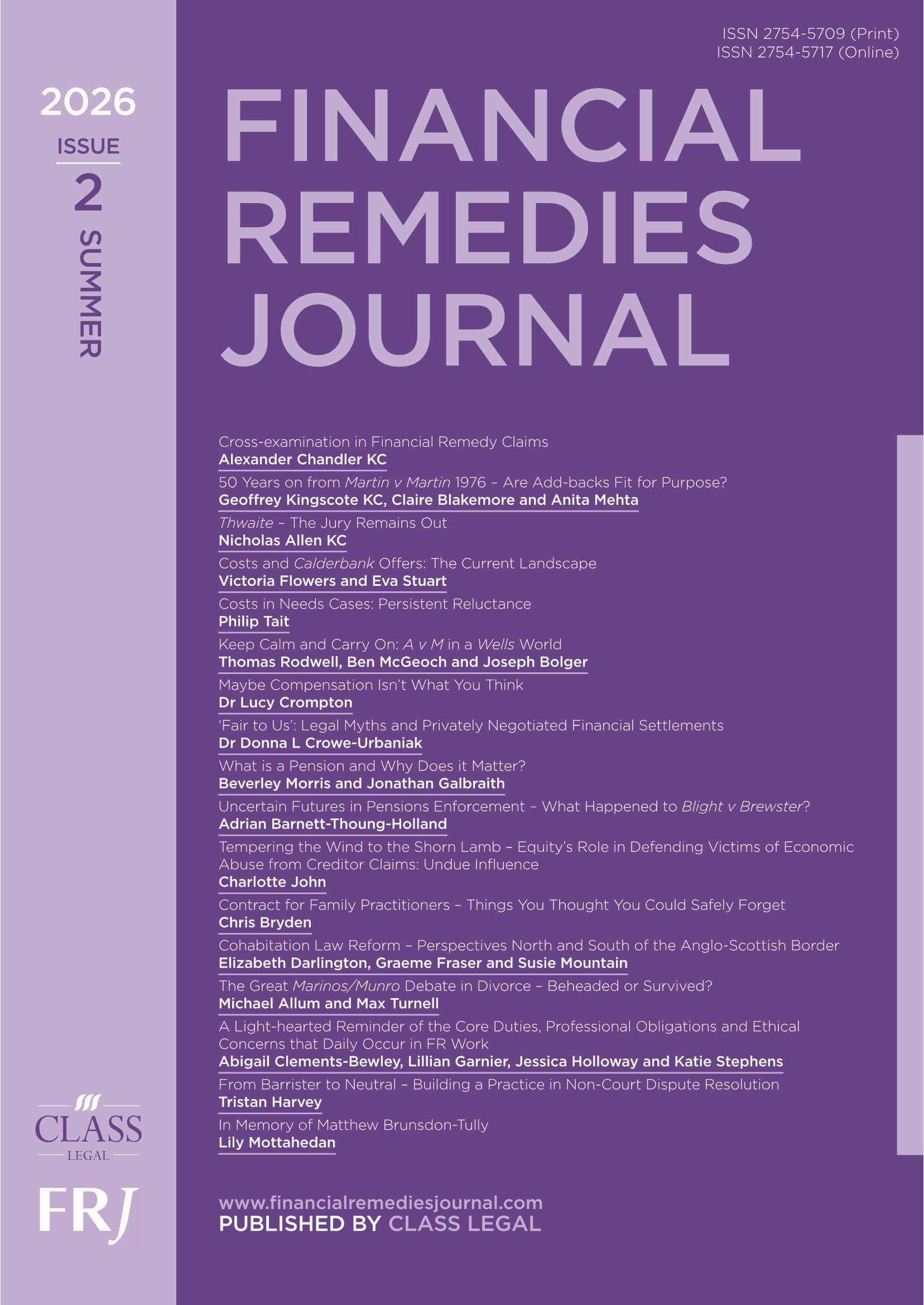
Now out: Financial Remedies Journal 2026 Issue 2 (Summer 2026)

The Right Side of History: Protection Against Domestic Abuse as a Key Theme of the Government Consultation into Financial Remedies