Contract for Family Practitioners – Things You Thought You Could Safely Forget
[2026] 2 FRJ 143. Financial remedies is one of the few areas of law in which one needs at least a working knowledge of numerous other areas of law. This article considers issues of contract law and scenarios where they have arisen, often in conflict with the court’s overarching jurisdiction.
Anyone who has taken the unwise decision to get me onto this topic knows that I say that financial remedies is not a specialised subject. It is a specialist subject – dabbling in financial remedies law is a recipe for disaster, and everyone reading this will have a story to tell of the lawyer that thought they could run a case without any experience or procedural (or legal) knowledge. But I say that it is not a specialised subject because it is one of the relatively few areas of law in which it is necessary to have at least a working knowledge of numerous other areas of law. Financial remedy practitioners are likely, depending on the case, to need at least a working knowledge of:
- Trusts – both in terms of trusts of land (particularly in intervenor-type cases) and in respect of trusts more generally, which may or may not be nuptial trusts and thus open to variation by the court.
- Company law – whether the company is solely owned by one or both parties, or where they are shareholders with others.
- Partnership law – with similar issues.
- Employment law – particularly where the parties are employees of a company in which they have an interest.
- Housing law – if there are tenanted properties.
- Property law – if there is a boundary dispute, a need to extend a lease to add value, or similar.
- Immigration law – if there are immigration issues arising out of the marriage.
- Inheritance issues – including potential claims that could be made by or against the estate of a parent.
Additionally, there is the need to have a working understanding of various international concepts such as domicile, habitual residence and the different property regimes that apply on a cross-border basis.
It should not be a surprise that there is such a cross-over. The Family Division has existed in its current form only since 1971, previously being the Probate, Admiralty and Divorce Division since the Judicature Act 1873. This miscellaneous jurisdiction of the division over, as AP Herbert once put it, ‘wills, wives and wrecks’ is generally ascribed to the fact that these three parts of the law had all been greatly influenced by the Roman law. The Administration of Justice Act 1970 established the Family Division. Contentious probate went to Chancery, wardship came from Chancery to the Family Division. There has always therefore been a significant overlap between Chancery and Family, and the issues that arise out of family relations will also often invoke the common law.
This article considers issues of contract law and scenarios where they have arisen, often in conflict with the court’s overarching jurisdiction. However, the sorts of issues that will be considered do not concern the contract of marriage itself, albeit the detailed history of the evolution of the law of marriage set out by Mostyn J in NB v MI [2021] EWHC 224 (Fam), although obiter, is fascinating for those who may wish to consider issues of capacity, declarations of non-recognition of void or voidable marriages and annulment. In that context, Mostyn J said at [10]:
‘In Durham v Durham [1885] 10 PD 80, 81 Sir James Hannen P held in a dictum that has since become canonical:
“The contract of marriage is a very simple one which does not require a high degree of intelligence to comprehend. It is an engagement between a man and a woman to live together and love one another as husband and wife to the exclusion of all others.”
This has become the universal standard (although, of course, a marriage now can be formed between a same-sex couple). The simplicity of the contract has been emphasised time and again.’
Some basics
It is time to evoke possibly long-repressed memories of study, by considering the basic principles required for the formation of a contract. However, it is important to remember the essential role in which a developed law of contract plays in society. As Lord Hodge said in his speech, ‘Developing the law of contract: the work of the United Kingdom Supreme Court’ on 27 February 2025:[[1]]
‘Contracts are what enable us to conduct our lives with a degree of certainty. They enable us to buy food and clothes, purchase or rent housing, travel, and enjoy leisure activities with our families. We transact with the providers of goods and services through the medium of the contract.
Contracts are also at the heart of sophisticated commercial life enabling businesses to undertake complex projects and other ventures by coordinating the participants in the venture and reducing commercial risk by setting out agreed arrangements as to what each party must do in foreseen eventualities.
A developed law of contract enforced by an independent, impartial and incorruptible judiciary is a cornerstone of a sustainable economy and a stable society.’
The essential elements of a contract are offer, acceptance, intention to create legal relations and consideration, together with a certainty of terms, though the court can construe those terms to determine what the parties objectively meant. The court will adopt an objective view to the question of intention of legal relations.
Can spouses (or civil partners) contract?
Yes, of course they can. Though there is a presumption that spouses do not intend to create legal relations. Or is there?
In Kirishani v Major [2026] EWHC 835 (Ch) (a case concerning Ms Kirishana and Mr Major), Sir Anthony Mann (sitting as a High Court Judge) considered the application to cohabiting partners of what HHJ Gerald sitting at first instance had treated as being a presumption against an intention to create legal relations between husbands and wives. HHJ Gerald had held that such a presumption exists, and applied it to the cohabiting parties, such that agreements to repay monies spent over the course of the relationship, based upon detailed spreadsheets, were not found to be binding.
The principle derives from Balfour v Balfour [1919] 2 KB 571, as elaborated upon by the Court of Appeal in Jones v Padavatton [1968] EWCA Civ 4, in which Danckwerts LJ commented:
‘Of course, there is no difficulty, if they so intend, in members of families entering into legally binding contracts in regard to family affairs. A competent equity draftsman would, if properly instructed, have no difficulty in drafting such a contract. But there is possibly in family affairs a presumption against such an intention (which, of course, can be rebutted).’
In Balfour, Atkin LJ (as he then was), said as follows in respect of certain arrangements between husband and wife:
‘Nevertheless they are not contracts, and they are not contracts because the parties did not intend that they should be attended by legal consequences. To my mind it would be of the worst possible example to hold that agreements such as this resulted in legal obligations which could be enforced in the Courts. It would mean this, that when the husband makes his wife a promise to give her an allowance of 30s. or 2l. a week, whatever he can afford to give her, for the maintenance of the household and children, and she promises so to apply it, not only could she sue him for his failure in any week to supply the allowance, but he could sue her for non-performance of the obligation, express or implied, which she had undertaken upon her part. All I can say is that the small Courts of this country would have to be multiplied one hundredfold if these arrangements were held to result in legal obligations. They are not sued upon, not because the parties are reluctant to enforce their legal rights when the agreement is broken, but because the parties, in the inception of the arrangement, never intended that they should be sued upon. Agreements such as these are outside the realm of contracts altogether. The common law does not regulate the form of agreements between spouses. Their promises are not sealed with seals and sealing wax. The consideration that really obtains for them is that natural love and affection which counts for so little in these cold Courts. The terms may be repudiated, varied or renewed as performance proceeds or as disagreements develop, and the principles of the common law as to exoneration and discharge and accord and satisfaction are such as find no place in the domestic code.’
The analysis of Salmon LJ (as he then was) in Padavatton was reached by a different route, but was based upon whether there was a legally binding agreement or a loose family arrangement with no legal effect. The onus is on the party asserting the former, and it depends on whether the parties intended it to be legally binding, and if so whether it was sufficiently certain to be enforceable. The presumption against an intention to create legal relations was a presumption of fact, not law, and:
‘It derives from experience of life and human nature which shows that in such circumstances men and woman usually do not intend to create legal rights and obligations, but intend to rely solely on family ties of mutual trust and affection.’
In Kirishani, Sir Anthony Mann was of the view that (at [34]):
‘So it is the nature of the relationship which is important, not the fact that the parties have gone through a ceremony of marriage or civil partnership. Marriages (and, I would say, in line with the views of the editors of Chitty, civil partnerships) are likely to have common characteristics relevant to an intention to create legal relations in connection with “domestic” arrangements so that the presumption would be likely to apply to many or most of them. That is because of the nature of the relationship itself in everyday life terms, not just because one can describe the couple by virtue of the fact that they have gone through some ceremony. The same sort of considerations may also apply to arrangements between other members of the family, where the basis of the relationship is likely to be based on non-commercial matters. Hence the reference to other family relationships, where common characteristics are present.’
The role of the court is to look at such intention objectively, on the basis of what the words and conduct would have conveyed to a reasonable person in the position of a person asserting a contract: Dunhill v Burgin [2014] UKSC 18, [2014] 1 WLR 933 at [25], as cited by HHJ Paul Matthews (sitting as a High Court Judge) when he came to a similar conclusion on an intention to create legal relations between a mother and a daughter for the provision of care, in Rogers v Wills [2025] EWHC 1367 (Ch).
Notably, the question of contracts between spouses (in the context of ante- and post-nuptial agreements) was considered in Radmacher (formerly Granatino) v Granatino (Rev 4) [2010] UKSC 42. The majority (Baroness Hale being the sole 8-1 dissenting judgment) noted that previously, marriage involved a duty to live together, and an agreement making provision for the possibility of separation was contrary to public policy, though an agreement to separate or to govern a separation that had already taken place was not, and cited Lord Atkin (as he had by then become) in Hyman v Hyman [1929] AC 601 to this effect. It was noted that separation agreements did not override the powers of the court to grant ancillary relief, but carry considerable weight (at [37]), referencing Edgar v Edgar [1980] 1 WLR 1410, in which the wife was held to her agreement not to seek lump sum or property transfer orders following on from a separation agreement.
It is notable, given her dissenting judgment, that in order for the Supreme Court to hold as it did, it was necessary to overturn the Privy Council decision in Macleod v Macleod [2008] UKPC 64, delivered by Baroness Hale, and in particular the distinction between ante-nuptial and post-nuptial agreements, it finding that the latter, and not the former, did constitute contracts. Whilst the old rule that agreements providing for future separation are contrary to public policy was obsolete and should be swept away, for the reasons given by the Board (at [52]), the Supreme Court majority confirmed that this was not restricted to post-nuptial agreements:
‘If parties who have made such an agreement, whether ante-nuptial or post-nuptial, then decide to live apart, we can see no reason why they should not be entitled to enforce their agreement. This right will, however, prove nugatory if one or other objects to the terms of the agreement, for this is likely to result in the party who objects initiating proceedings for divorce or judicial separation and, arguing in ancillary relief proceedings that he or she should not be held to the terms of the agreement.’
It did not, in fact, matter, whether they were contracts:
‘62. Is it important whether or not post-nuptial or ante-nuptial agreements have contractual status? The value of a contract is that the court will enforce it. But in ancillary relief proceedings the court is not bound to give effect to nuptial agreements, and is bound to have regard to them, whether or not they are contracts. Should they be given greater weight because in some other context they would be enforceable? Or is the question of whether or not they are contracts an irrelevance? This can be tested in this way. Did the identification of the fact that there were no public policy reasons not to treat post-nuptial agreements as contracts alter the weight that the Board attached to them in MacLeod? The Board did not say that they had to be given more weight as a result of sweeping away the public policy objections to them. Those objections had long ceased to be relevant and had not inhibited courts from giving some and, in some circumstances, decisive weight to ante-nuptial agreements. The circumstances surrounding the conclusion of a contract will either result in the contract being of full effect, or of no effect at all. The courts have always adopted a more nuanced approach to ante- and post-nuptial agreements. We cannot see why it mattered whether or not the agreement in MacLeod was a contract.
63. In summary, we consider that the Board in MacLeod was wrong to hold that post-nuptial agreements were contracts but that ante-nuptial agreements were not. That question did not arise for decision in that case any more than in this and does not matter anyway. It is a red herring. Regardless of whether one or both are contracts, the ancillary relief court should apply the same principles when considering ante-nuptial agreements as it applies to post-nuptial agreements.’
Lord Mance, whilst agreeing with the majority, made an important observation at [128]:
‘Like Lady Hale, para 138 (1) and (2) and para 156, I go no further and express no view on the binding or other nature of an ante-nuptial agreement. It is not difficult to envisage circumstances in which, if such an agreement were to be regarded as having contractual force, its enforcement could be sought before a court, particularly an overseas court, lacking the jurisdiction under Part II of the 1973 Act which applies only when the forum is an English divorce court. I also agree in this respect with what Lady Hale says in para 159.’
Baroness Hale made clear at paragraphs 138(1) and (2), referenced above, that she disagreed with the views ‘mercifully obiter’ that ante-nuptial agreements are legally enforceable contracts or that it was open to the Supreme Court to hold that they are. She expressed the view at [160] that MacLeod did not need to decide whether post-nuptial contracts providing for a future separation were legally binding either; both cases were about weight, given the court’s overarching jurisdiction that cannot be ousted should the parties separate or divorce:
‘Some may think that the question whether an agreement is contractually binding has little if any relevance to the weight which it should be given by the court. Others, however, may think differently, especially if the agreement contains provisions to be implemented during cohabitation which have in fact been honoured.’
The troubled question of enforceable contracts, weight and the jurisdiction of the court is not a new one. Hyman (above) is authority for the proposition that a spouse cannot contract out of a statutory right to maintenance. A purported contract where the whole or main consideration is a promise purporting to oust the jurisdiction of the court is void: Bennett v Bennett [1952] 1 KB 249. But in Goodinson v Goodinson [1954] 2 QB 118, the wife covenanted not to bring matrimonial proceedings so long as weekly maintenance was paid as agreed, and was successful in a claim for the arrears, as there was ample other consideration.
In Amey v Amey [1992] 1 FCR 289, the husband and the wife had married in 1971, and shortly thereafter purchased and ran a pub in the sole name of the husband. He petitioned for divorce and the marriage was dissolved in 1986. He then paid the wife £120,000 in pursuance of an agreement intended to achieve a clean break, that sum being around 50% of the matrimonial assets. A draft minute of order was settled by counsel and the parties’ intention was that the court would approve the agreement but the wife then died unexpectedly, aged 43. The husband sought to rescind the agreement, so as to get back his £120,000. The claim was dismissed on the basis that the failure to obtain the imprimateur of the court on a clean break agreement as intended did not mean that the agreement was not effective. The court could not decide whether to affirm or vary the agreement, as the claim under the Matrimonial Causes Act 1973 abated. A contract was therefore enforceable, notwithstanding that the court had not approved the order.
These cases show that the widespread impression of the ‘cardinal conclusion’ of Thorpe LJ in Xydhias v Xydhias [1999] 1 FLR 68 is incorrect and is of more limited application. There are circumstances in which contract between spouses can be upheld. As Ward LJ showed in Soulsbury v Soulsbury [2007] EWCA Civ 969. He held that it could not be correct to state that the only way of rendering a bargain to make payment of money enforceable would be to convert the concluded agreement into an order of the court, and the cardinal conclusions are stated in terms which are too wide. He concluded at [45]:
‘I accept that if there are negotiations to compromise a claim for ancillary relief, then there is a duty to seek the court’s approval as is stated in Smallman. But as Smallman states, and I do not see how that authority of this court can be ignored by me, even an agreement subject to the approval of the court is binding on the parties to the extent that neither can resile from it.’
If there are no divorce proceedings, it may be that an agreement can be enforced by the courts, if there is the necessary intention to create legal relations and appropriate consideration (which could be resolved by a deed). It appears that a contract can be enforced after death because the power of the court to approve it falls away. Can a pre-nuptial (or post-nuptial) agreement be enforced as a contract after death, so as to avoid the uncertainty of a claim under the Inheritance (Provision for Family and Dependants) Act 1975? If so, could such a contract survive the death of the surviving spouse, so that the estate could claim (but have no claim under the 1975 Act)?
Conclusion
Contract law runs through family law. The above examples are of the big, academic matters. But practitioners will frequently come across contracts of employment, contracts of lease, tenancy agreements, contracts for the sale and supply of goods, and contracts for loan (and then an assessment of whether, between the parties to the marriage – but not determinative on third parties – they are hard or soft loans), on which see P v Q (Financial Remedies) [2022] EWFC B9 per HHJ Hess:
‘Once a judge has decided that a contractually binding obligation by a party to the marriage towards a third party exists, the court may properly wish to go on to consider whether the obligation is in the category of a hard obligation or loan, in which case it should appear on the judges’ computation table, or it is in the category of a soft obligation or loan, in which case the judge may decide as an exercise of discretion to leave it out of the computation table.’
Financial remedies courts encounter contracts all the time. Perhaps uniquely however, the question is often not whether they are binding, but rather whether they have any effect, and if so, what?
[[1]]: https://supremecourt.uk/uploads/speech_lord_hodge_270225_ed47d6ee23.pdf (retrieved 27 April 2025).


Latest
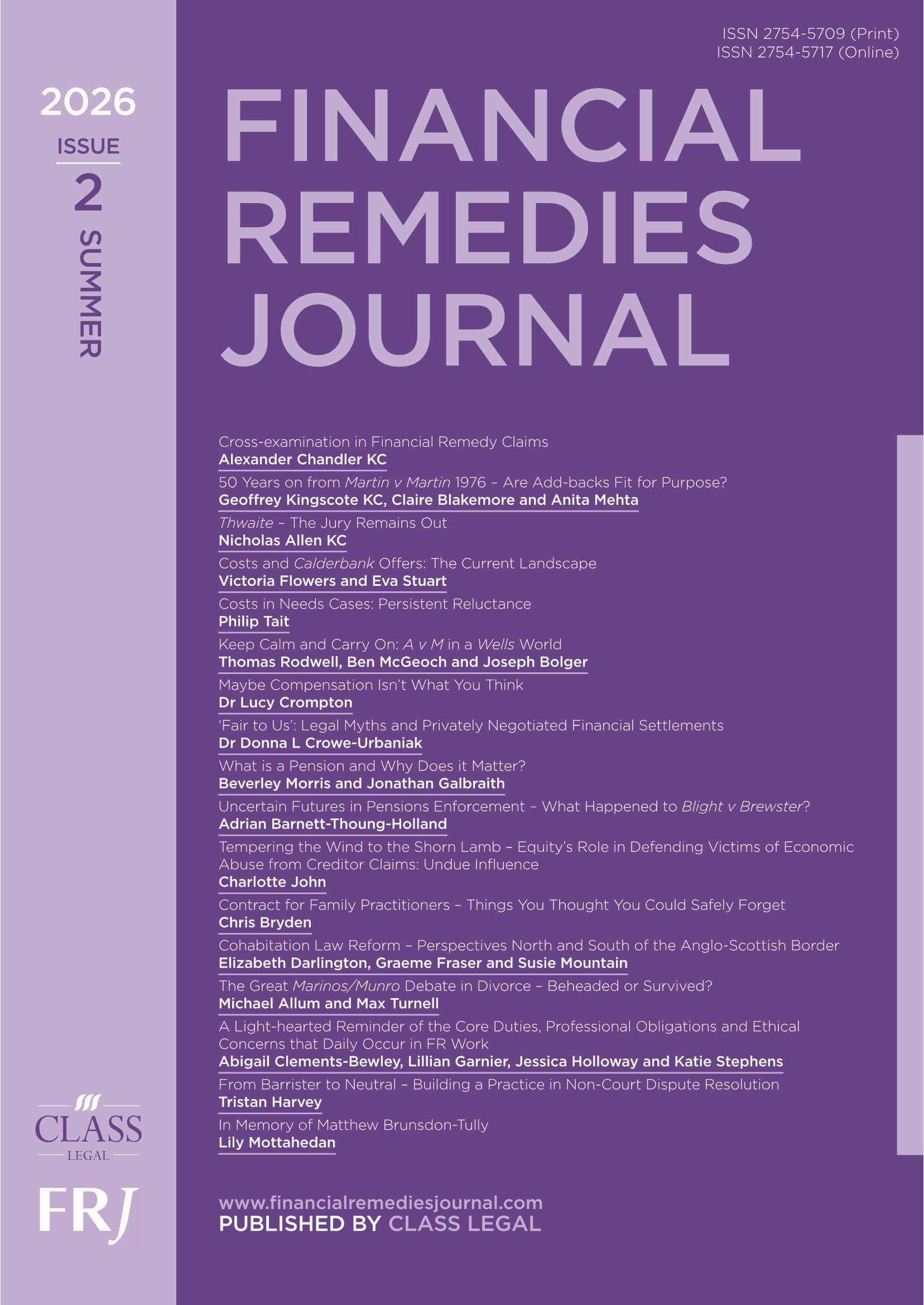
Now out: Financial Remedies Journal 2026 Issue 2 (Summer 2026)

The Right Side of History: Protection Against Domestic Abuse as a Key Theme of the Government Consultation into Financial Remedies