
BC v BC [2025] EWFC 236
https://caselaw.nationalarchives.gov.uk/ewfc/2025/236?court=ewhc%2Ffam&court=ewfc
Peel J
Related
BC v BC [2025] EWFC 236
Peel J. Save for four specific matters, parties cannot refer to what happened at the pFDR. The Financial Remedies Court – Primary Principles paragraph 8 issued by Mostyn J and HHJ Hess goes too far by saying that the court should be told that offers were made and that an was indication given.
Financial Remedy Reform – ‘Fairness’ – Do Divorcing Parties Get Any Say – Time for Some Soul Searching for Family Law Professionals
The Law Commission Scoping Report
The Law Commission’s 373-page scoping report on Financial Remedies on Divorce and Dissolution, which was published just before Christmas 2024, stated categorically (emboldened emphasis):
‘1.58 In our view, the current law relating to financial remedies on divorce and dissolution does not, to use

DR Corner: Introducing Assent: Combining Arbitration and Private FDRs in a Streamlined Process based on the FPR Directions
Anyone who has tried to arrange a Private Financial Dispute Resolution (pFDR) will be familiar with that sinking feeling when the process is slipping away. It starts with a low-level dispute over the judge, the date or the location of the hearing. Then a seemingly innocuous question about disclosure. A


Related
BC v BC [2025] EWFC 236
Peel J. Save for four specific matters, parties cannot refer to what happened at the pFDR. The Financial Remedies Court – Primary Principles paragraph 8 issued by Mostyn J and HHJ Hess goes too far by saying that the court should be told that offers were made and that an was indication given.
Financial Remedy Reform – ‘Fairness’ – Do Divorcing Parties Get Any Say – Time for Some Soul Searching for Family Law Professionals
The Law Commission Scoping Report
The Law Commission’s 373-page scoping report on Financial Remedies on Divorce and Dissolution, which was published just before Christmas 2024, stated categorically (emboldened emphasis):
‘1.58 In our view, the current law relating to financial remedies on divorce and dissolution does not, to use
DR Corner: Introducing Assent: Combining Arbitration and Private FDRs in a Streamlined Process based on the FPR Directions
Anyone who has tried to arrange a Private Financial Dispute Resolution (pFDR) will be familiar with that sinking feeling when the process is slipping away. It starts with a low-level dispute over the judge, the date or the location of the hearing. Then a seemingly innocuous question about disclosure. A
Latest

The Reluctant Pension Credit Member
[2026] 1 FRJ 39. In the case of AP v TP [2025] EWFC 190 (B) a financial remedy order was made by consent, following an FDR, which included a pension sharing order in W’s favour. Difficulties began when W failed to provide the necessary information to permit the pension share to be implemented.

Housing Particulars: Mind The Gap
What can the court do when there's a significant gap between the bottom of the applicant’s range and the top of the respondent’s range? Can the court take up the invitation made by counsel to ‘conduct its own research on Rightmove if it wishes’?
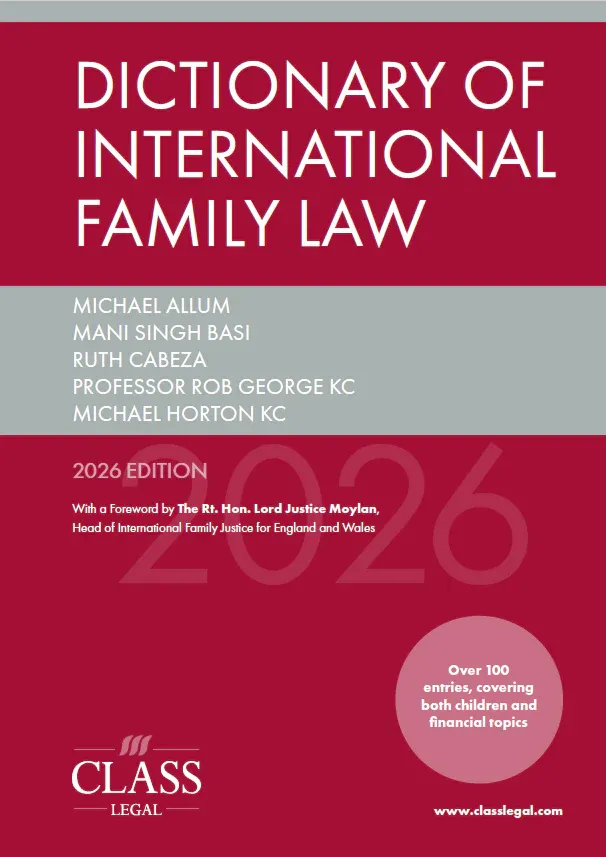
Book Review: Dictionary of International Family Law
The Dictionary of International Family Law is the latest addition to the series of Class Legal Dictionaries. It joins this distinguished family with confidence and purpose.