
Are All Lies Created Equal? The Limits of Without Prejudice Privilege
[2026] 3 FRJ 235. Where someone has admitted a relevant fact in a without prejudice letter and later denies the same fact in court, how can this be right? Fair? Most people assume this would not be protected by the without prejudice rule. This article examines whether that assumption is correct.
Surely they can’t get away with that?
It is a common question that arises, where someone has admitted a relevant fact in a without prejudice letter and later denies the same fact in court. How can this be right? Fair? Just? Most people assume this sort of thing would not be protected by the without prejudice rule. This article examines whether that assumption is indeed correct.
The first part of this article focuses on the law on ‘unambiguous impropriety’ as it stands, with an examination at the end of whether this is inapt to contemporary family law practice, posing the question of whether it is worth reconsidering at appellate level.
First, a reminder of the without prejudice privilege and its objectives.
The privilege attaches to statements or admissions made in the course of a ‘genuine attempt’ to compromise the proceedings. The seminal case is Cutts v Head [1984] Ch 290, with the classic statement at [306]: ‘The public policy justification, in truth, essentially rests on the desirability of preventing statements or offers made in the course of negotiations for settlement being brought before the court of trial as admissions’. The rationale was further explained in Rush & Tompkins Ltd v Greater London Council [1989] AC 1280 so as to encourage free and frank negotiation and make the settling of disputes outside the court arena more likely. This aim is so fiercely guarded by the appeal courts that the consequences of it can sometimes appear surprising. The rationale is that it is generally not considered to be an abuse of the privilege to tell the truth in without prejudice discussions, even if outside them you do not.
Unless both parties agree to waive the privilege then it remains privileged unless an exception applies: Woolwich Plc v Le Foe and Le Foe [2001] 2 FLR 970. In this sense the privilege is different to legal privilege. There are however some exceptions to the rule, which allow without prejudice material to be admitted. These were codified in the leading case on the privilege, a patent dispute called Unilever Plc v The Proctor & Gamble Co [1999] EWCA Civ 3027 (Unilever). This case sets out a list of six exceptions to the rule, which is not exhaustive, and some of them (e.g. disputes about whether a settlement has concluded, vitiation of agreements) are well known to financial remedy practitioners. This article is not focused on those and they are not addressed in detail. It is also worth noting that the rules in respect of the privilege in relation to Private FDRs are more absolute and codified in FPR PD 9A (para 6.2) as stringently applied recently by Peel J in BC v BC [2025] EWFC 236. So the forgoing applies outside the pFDR situation.
Of those exceptions ‘fraud … perjury, blackmail or other “unambiguous impropriety”’ is the route most travelled to meet the argument that an admission made on a without prejudice basis cannot be relied on, and it is this upon which this article will now focus.
The ‘unambiguous impropriety’ exception in Unilever essentially operates to prevent a party being able to deny a fact or statement they made under cover of without prejudice if it effectively acts as a cloak for fraud, perjury, blackmail or other ‘unambiguous impropriety’ applicable in only the ‘clearest cases of abuse of a privileged occasion’.
In the family law context Unilever also recognises the exception in Re D (Minors) (Conciliation: Privilege) [1993] 1 FLR 932: that statements made between parties in a ‘conciliation meeting’ prior to the proceedings would not be admissible except in the very unusual case where the statement clearly indicated that the maker had in the past caused, or was likely in the future to cause, serious harm to the well-being of a child; and the discretion afforded in that event would only be exercised in circumstances where the interest of the child outweighed the public policy interest in maintaining the privilege.
‘Unambiguous impropriety’
The classic situation is where a party has admitted a fact under cover of a without prejudice letter, perhaps it was a resource they had not disclosed or an acceptance that they intend to move to place X rather than place Y, for example. Subsequently, they deny the same fact, or assert a contradictory set of facts, in the proceedings on an open basis. It may seem surprising that the ‘liar’ has the law’s support to conceal their lie.
However, this is an admissibility question, and in that sense is different to legal professional privilege or confidentiality. Another difference is that partial waiver (i.e. putting information in with redactions) is not usually permitted as the documents have to be considered as a whole to give context.
Isn’t lying to the court always perjury? Well, no.
Perjury is a specific criminal offence, namely making a knowingly false statement under oath to mislead the court (Perjury Act 1911). For ‘risk of perjury’ to successfully lift the privilege, there must be a clear, incontrovertible contradiction showing that a party is abusing the rule to actively mislead the court, rather than just shifting their negotiating position.
The leading case on unambiguous impropriety is Savings & Investment Bank Ltd v Fincken [2003] EWCA Civ 1630 (Fincken). That case considered the question of the risk or possibility of a lie amounting to perjury and Rix LJ said at [58]:
‘It may be said … that even if the mere possibility of future perjury does not suffice to destroy the privilege, the admission which demonstrates that perjury has been committed in the past, by reference to an existing affidavit, is or should be different and that no authority suggests otherwise … There is indeed a substantial case to be made that the courts should not pass by such proof of perjury with indifference. There is a clear public interest in the discouragement of perjury. Nevertheless, on balance I do not think that the courts should adopt such a position. If they did, the very serious and criminal charge of perjury would fall to be debated, without the protection which should be available to the accused party, on an interlocutory outing (as here) or even at trial, with the potential of derailing the trial by the exposure of without prejudice material to the trial judge. Essentially the same problem would arise in connection with statements of truth, which now apply under the CPR to all particulars of claim or defence: although they cannot give rise to the offence of perjury, they can give rise to the only relatively less serious matter of contempt of court.’
He continued at [62]:
‘It is of course distasteful for this or any court to avert its eyes from an admission which, subject to any point about value, appears to incriminate Mr Fincken in lying in a sworn document. However, in the tension between two powerful public interests, it seems to me that that in favour of the protection of the privilege of without prejudice discussions holds sway – unless the privilege is itself abused on the occasion of its exercise.’
At [57] Rix LJ emphasised it is not just the mere inconsistency between an admission and a pleaded case or statement, with the possibility that such a case, if persisted in, might lead to perjury, that is enough. Rather, it is the fact that the privilege is abused that provides sufficient grounds. He went on to say:
‘It is not an abuse of the privilege to tell the truth, even where the truth is contrary to one’s case. That, after all, is what the without prejudice rule is all about, to encourage parties to speak frankly to one another in aid of reaching a settlement; and the public interest in that rule is very great and not to be sacrificed save in truly exceptional and needy circumstances.’
Lies and damn lies
So an inconsistency with an open position will not be enough to satisfy the ‘unambiguous impropriety’ exception, lies are not enough. It must be more than a lie, more than just dishonesty or inconsistency. There must be a clear, outright abuse of the privileged occasion itself (such as explicit threats, blackmail or criminality) rather than just discovering an admission that a party was dishonest or inconsistent. Indeed, Fincken says explicitly that if lies/admissions alone were sufficient to displace the privilege, it would undermine the purpose of the rule and make it impossible for any court action involving claims of dishonesty to settle. Less scrupulous people who would not admit to their wrongdoing would be in a better position than those who do.
The particular lie in Fincken was an initial admission in a without prejudice meeting that the appellant did hold assets he had not disclosed in a previous affidavit of means. In particular, that a company he said he didn’t own or have an interest in was, in fact, held by someone else as a nominee for him. The other party wanted to rely on this admission to show the appellant had perjured or fraudulently misrepresented himself in an affidavit and that he did have ownership of the assets that had been denied. That was held not sufficient to meet the test.
Factual examples of unambiguous impropriety
So if a lie by itself isn’t enough, what does qualify as unambiguous impropriety? The answer to the question requires the court to balance the public policy interest in protecting the privilege against the interests of justice itself. As such, the answer is not straightforward and is fact-specific.
The conduct has to be so clearly and obviously wrong that the protection is being abused. The exception will only be allowed in narrow and ‘exceptional’ circumstances and where there is no ambiguity about the facts asserted/what was said or, indeed, the meaning of both. If what was uttered could be subject to different interpretations, then it will not pass the test. Certainty about what was said can be more difficult to establish if the statements were made orally rather than in a document and not recorded on a tape/video.
In the court below, Patten J did find Fincken’s admission to come within the exception but this was overturned on appeal. He felt (at [30]) that it didn’t or shouldn’t just apply to:
‘instances where the without prejudice occasion is abused by the making of threats but also to cases where there is an equally unambiguous admission of facts which is intended to be followed by an equally unambiguous denial of those facts by the same party. Circumstances of that kind amount to an abuse and the exclusion of such evidence by virtue of the rule would act as a cloak for perjury.’
The appeal court did not agree.
If you are grappling with this issue in practice, Fincken is required reading as it helps to give a sense of the different factual scenarios that could or could not amount to unambiguous impropriety. Rix LJ scrutinised a number of scenarios in the preceding case law.
As Rix LJ identified, the issue with an alleged blackmail is usually whether objectively the threat made actually does amount to blackmail or is simply part of aggressive negotiation tactics, for example, ‘accept this offer or I’ll see you in court’. Even with blackmail it seems likely that this will only succeed to lift the privilege where it goes to the heart of the legitimacy of the litigation itself.
For example, where a party stated that unless the claim against him was withdrawn, he would give perjured evidence and bribe other witnesses to perjure themselves, that was unambiguous impropriety. However, where a party said they felt honour bound by an agreement but would deny they had any legal obligation in the litigation, this was ‘very far from blackmail’ and so did not meet the test.
Where (in Hawick v Caplan, unreported) a party was secretly recorded admitting that he had brought a dishonest case against the other party for a £10,000 debt which he knew did not exist and was doing so in order to blackmail the other party to settling other matters, that was held to be unambiguous impropriety. It was of significance that the tapes were agreed to be accurate and there was no doubt as to what was said. However, secret recordings can be problematic for the same reasons they are in the Family Court and there is judicial comment about the need for scrupulous care when considering evidence obtained by ‘clandestine’ methods.
Intimidation may also amount to unambiguous impropriety. While negotiations can often be heated, overstating the case and asserting that what an employee had done was ‘serious misconduct’ which amounted to a criminal offence or summary dismissal (in a letter making an offer) when there was no basis for that was found on appeal to have ‘sailed very close to the wind’. It was only the very strong public interest in the privilege that tipped the balance against lifting it. Such tactics could be construed as dishonest and amount to blackmail, at the very least they may give rise to arguments from the party on the receiving end of ‘improper pressure’ particularly if an agreement is reached on this basis: Swiss Re Corporate Solutions Ltd v Sommer [2022] EAT 78. It seems, nonetheless, that hard bargaining and unreasonable offers will not of themselves waive the privilege.
It is perhaps unsurprising that fraud would make out the unambiguous impropriety exception, particularly if something was said to try to trick someone into an agreement. However, the cases discussed in Fincken demonstrate it is still not straightforward. Admissions in without prejudice discussions of a party’s involvement in fraudulent securities transfers and their theft were found not to be sufficient to waive privilege (Merrill Lynch Pierce Fenner & Smith v Raffa, unreported) as these did not amount to blackmail-type threats. However, there was judicial comment that this would not be so if that person mounted a defence in the subsequent litigation asserting that they did not do these things, because the defence would be ‘fundamentally dishonest’ as it was cloaking admitted fraud. There was no evidence from the party who made the admission to indicate whether or not the admission was challenged and potentially therefore ‘ambiguous’, which was highlighted in Fincken as another reason to be cautious about this statement.
The problematic admission in Fincken was him admitting to perjury in a past affidavit. A distinction was drawn at [57] (above) between that and a ‘blackmailing threat of perjury’, i.e. ‘if you don’t do X I will perjure myself in the future litigation’. There was no accompanying threat in the securities case, the party just admitted that they had been involved in the fraud: that by itself was not enough. Neither was it enough in Fincken to admit in without prejudice discussions that a previous affidavit had not set out the full picture.
Evidential ambiguity
The other takeaway from Fincken is that it is not just the conduct that has to be unambiguously bad, there must not be any evidential ambiguity either. In effect, if there is a dispute about what might have been said or asserted or if what was said or asserted was open to another innocent explanation then it does not meet the test of ‘unambiguous’. This was most recently applied in FW Aviation (Holdings) 1 Ltd v VietJet Aviation Joint Stock Company [2024] EWHC 1823 (Comm). VietJet’s vice chairman was recorded in a contemporaneous attendance note to have said at a without prejudice meeting:
‘You can wait till you go to court and get an English judgement and then go to Singapore too and Vietnam and get another judgement. I cannot speak for the Vietnamese Government but my sense is they are not going to collaborate with anyone from the UK or Singapore or anywhere else, and this could go on for years, but that’s not a threat, that’s just an observation, a Donal Boylan observation.’
The court did not accept this was an effective threat to collude with the government of Vietnam to frustrate the enforcement of any English judgment, but rather a ‘warning’ as to the difficulties of enforcement in Vietnam. Additionally, Mr Boylan asserted the note was not accurate so there was ambiguity about what was said. It may be that a lack of agreement about what was said would act as a knockout blow before any conduct was qualitatively examined.
It is unambiguous impropriety … what then?
Unilateral action should not be taken; do not proceed to lay out what has happened in open correspondence thereby revealing the offending assertion. Without prejudice privilege is a joint privilege and one party cannot waive it without the other’s agreement. So if a dispute arises and cannot be resolved then there must be an application to the court. That application can outline the issue but should not, at that stage, disclose the offending communication to the court.
However, there may be a few cards to play prior to this. Asking a question to elicit the response on an open basis may force the other side to commit to what they have said in open correspondence. If the admission could be evidenced by underlying documents, then disclosure of those documents could be sought, pursuant to the ongoing duty of full and frank disclosure in financial remedy cases. FPR 22.15 could be deployed with a formal notice to admit facts, though care will have to be taken not to allude to the fact that this fact had already been admitted in without prejudice communications.
If an application is still necessary then Cardiff City Football Club Ltd v McKay [2025] EWHC 1439 (Comm) confirms it must be made without providing the material at that stage. It will usually necessitate a separate hearing before a different judge (who would not hear the final hearing).
Does this legal framework sit well within the family law arena?
Unambiguous impropriety is narrowly drawn and it is plain that ‘robust’, some might say bullying, negotiating tactics, quasi threats and dishonesty may not be enough to satisfy it and enable waiver of the privilege. How does this sit within the operation of financial remedy?
It is notable that the law in this area has been almost exclusively developed in the civil commercial sphere. The Re D exception is explained, in Unilever, as based on ‘public interest in the stability of marriage’. This is odd because the case arises from a marriage that had come to its end, and many children disputes arise in non-marital relationships. The exception in Re D is actually based on welfare principles. Re D, like the civil cases, emphasised the public policy interest justification. In fact, it goes a bit further, highlighting the particularly harmful impact of litigation on family relationships to make this justification even more potent in family law.
Re D has been interpreted subsequently at High Court level to suggest that in cases concerning child arrangements where there is a mediation or conciliation, only this exception applies and none of the other Unilever exceptions would apply (see [30]–[31] of Re E (A Child) (Mediation Privilege) (Rev 1) [2020] EWHC 3379 (Fam), Leslie Samuels KC (sitting as a Deputy High Court Judge) endorsing comments from Williams J in an earlier case). So, there is a suggestion arising out of those cases that it is even harder to lift the privilege in a family conciliation setting than it would be in a civil law dispute.
Re D itself also suggests that the application of these rules to family law may be more stringent than the civil sphere. In it Sir Thomas Bingham MR said:
‘Again, even if Kitcat v Sharp (1882) 48 LT 64 is authority for the proposition that a “without prejudice” marking does not protect evidence of a threat as to what will happen if an offer is not accepted, it does not in our view follow that evidence can be given of threats, even credible threats, made by parties in the course of attempted conciliation. Where deep human emotions are engaged, as they often are in disputes concerning children, such threats are commonplace. To override the privilege in such an event would be to emasculate the privilege and so undermine the whole process of conciliation’.
Although this passage focuses on communications during a conciliation meeting, the judgment later confirms the same would applying to statements in the course of meetings held or communications made for the purpose of conciliation.
However, Unilever itself seems to recognise that familial relationships or dynamics may justify exceptions of their own as distinct from general civil law exceptions, despite the family courts tightening the screws on the lid of the privilege as applied to children cases. So in one sense the more restrictive approach taken by the family courts seems perverse.
Surely the increased connectiveness between litigants in family law, the absence of ‘arm’s length’ bargaining between spouses or partners who have had intimate relationships, provides more scope for a dominant party to abuse the privilege? Where the court is considering vitiation of agreements by undue influence, the heightened impact an intimate relationship can have on consent or autonomy was re-emphasised recently by Cobb J in PN v SA [2025] EWFC 141. At [41] he cited a 2006 judgment of Baron J in NA v MA [2006] EWHC 2900 (Fam) at [18]:
‘… in a case involving a husband and wife where it is clear that interdependence and mutual influence are the basis of the relationship, I consider that the court has to take special care when assessing the manner in which each party’s conduct affected the other. For example, if a wife has been accustomed to placing reliance upon her husband’s decisions, she might be much more easily influenced than an individual in a commercial transaction’.
Wouldn’t that be equally as applicable when considering hardball negotiation tactics, threats, and lies (or a significant factual variance from the openly asserted position) where no agreement was reached? Do the intimate relationships between the litigants in family law make a rule which protects some forms of dishonesty more ripe for abuse and shield greater imbalances of power? Should a domestic abuse survivor be ‘strongarmed’ in negotiations with an abuser, even where a solicitor is on record? Should that abuser be allowed to use litigation to contest admitted facts with a risk that, in itself, turns the court into an instrument of abuse?
Re D is now 33 years old. Today, there is increasing recognition within the court system of domestic abuse, coercive control and other more subtle and pernicious forms of abuse. These problems of abusive dynamics apply in financial remedy negotiations and non-court dispute resolution (NCDR) as much as they would in child arrangements negotiations and NCDR.
Although there is a suggestion that Unilever exceptions might be excluded from children’s cases, in LS v PS [2021] EWFC 108 Roberts J does not seem to proceed on the basis they are excluded from application in financial remedy (other than at a pFDR). This is implicit from various paragraphs (e.g. [23]–[25], [80], [83]) and Roberts J’s citation of the well-known paragraph in Prest to emphasise that the ‘Family Division exercises its jurisdiction in terms of established legal principles in accordance with established law across the jurisdictions’.
Other reasons for less stringency?
There is then a question as to whether there is enough room within existing authorities to allow for the impact of an abusive relationship to be considered when assessing how words/threats/lies or admissions may be interpreted.
Most of the cases which have developed the high bar of unambiguous impropriety are commercial disputes between corporations, banks or wealthy individuals who can afford to litigate. In the family sphere, many litigants are forced to court to resolve their basic financial needs having no commercial or legal experience and no money. In financial remedy disputes, often one party holds the bulk of the assets and income while the other party is struggling to fund basic costs. A rule that shields aggressive negotiation tactics and dishonesty seems oddly out of sync with those realities.
In money cases, the primary guiding principle is ‘fairness’, not so in civil disputes. Fundamentally, doesn’t achieving fairness as between two parties mean one not being able to gain an advantage in subsequent litigation on the basis of a lie?
There is the ongoing duty of full and frank disclosure, civil disputes tend to have one disclosure event, and if disclosure is mandated to be full and frank should this privilege protect admissions about the existence of or presence of assets that are then later denied on an open basis, for example?
It is also difficult to reconcile how the rule sits with the oft cited ‘quasi-inquisitorial nature’ of family proceedings, enunciated by Baroness Hale’s observation, at [36] of her judgment in Re A (A Child) (Family Proceedings: Disclosure of Information) [2012] UKSC 60, [2013] 2 AC 66 that, ‘The court’s only concern in family proceedings is to get at the truth’. Re E (above) suggests an answer to that question but not one the author finds particularly convincing.
Has the law got to a point where the balance of the competing interests of justice and public policy interest is tipping off-kilter, having swung too far in favour of the latter? One might understand the hard-nosed commercial approach of the courts in the civil sphere, but does this sit as well when it comes to family matters?
Rather than redoubling ever more restrictive interpretations of it, is it fairer or more just to recognise that different Divisions have different guiding principles and priorities and so require a divergence in approach? Re D recognises the need to incorporate welfare paramountcy within the exceptions, so shouldn’t there be some recognition of the particular aims and principles of financial remedy law?
Lord Byron wrote about a lie, ‘’Tis but the truth in masquerade’ and to an extent there seems to be recognition of that within authorities and their defence of a litigant’s right to ‘masquerade’ the truth. More recent High Court authorities seem to suggest a divergence of approach to the privilege as between children and money cases. If a money case on this point ever gets beyond High Court level, it will be interesting to see whether there will be a rebalancing in line with our unique guiding principles. But for now it appears that all lies are not created equal and many will continue to be protected by the privilege to varying degrees and in varying contexts.


Latest
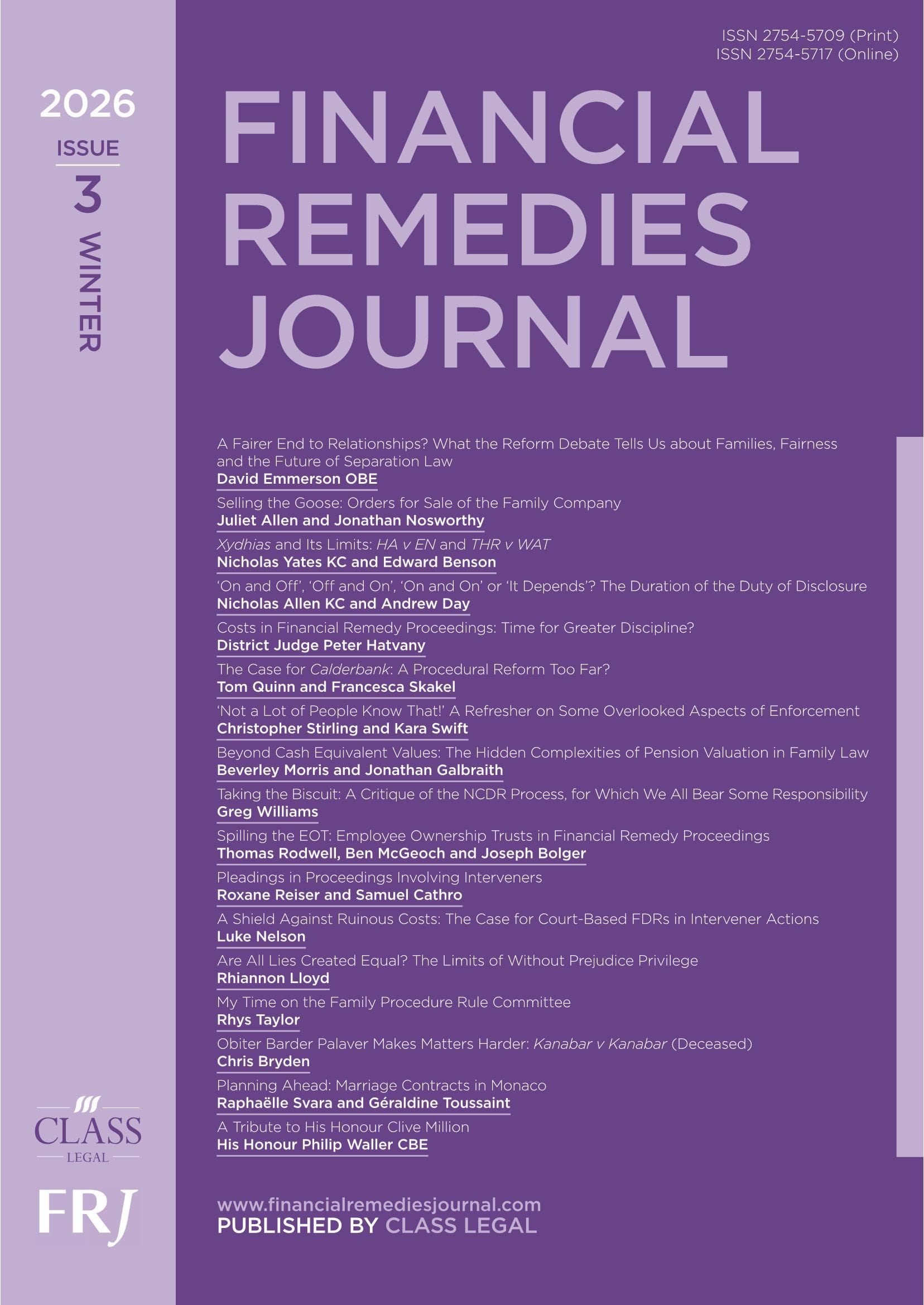
Now out: Financial Remedies Journal 2026 Issue 3 (Winter 2026)
The Case for Calderbank: A Procedural Reform Too Far?