
Y v Y [2012] EWHC 2063 (Fam)
Judgment date: 27 June 2012
Related
Armstrong v Armstrong & Anor (Re Remedy) [2025] EWHC 2054 (Ch)
Mr Andrew Sutcliffe KC sitting as a High Court judge. Judgment considering the appropriate remedy for a claimant who had proved his proprietary estoppel claim and his alternative claim for entitlement under the Inheritance (Provision for Family and Dependants) 1975 Act.

Partnering Up: Partnership Law and Financial Remedy Proceedings
The Department for Business & Trade’s most recent Business Population Estimates suggested that there are approximately 356,000 ordinary partnerships currently trading within the United Kingdom, generating a turnover of just under £1 billion. The majority of these are small enterprises involving either no or fewer than ten employees.


Related
Armstrong v Armstrong & Anor (Re Remedy) [2025] EWHC 2054 (Ch)
Mr Andrew Sutcliffe KC sitting as a High Court judge. Judgment considering the appropriate remedy for a claimant who had proved his proprietary estoppel claim and his alternative claim for entitlement under the Inheritance (Provision for Family and Dependants) 1975 Act.
Partnering Up: Partnership Law and Financial Remedy Proceedings
The Department for Business & Trade’s most recent Business Population Estimates suggested that there are approximately 356,000 ordinary partnerships currently trading within the United Kingdom, generating a turnover of just under £1 billion. The majority of these are small enterprises involving either no or fewer than ten employees.
Latest

The Reluctant Pension Credit Member
[2026] 1 FRJ 39. In the case of AP v TP [2025] EWFC 190 (B) a financial remedy order was made by consent, following an FDR, which included a pension sharing order in W’s favour. Difficulties began when W failed to provide the necessary information to permit the pension share to be implemented.

Housing Particulars: Mind The Gap
What can the court do when there's a significant gap between the bottom of the applicant’s range and the top of the respondent’s range? Can the court take up the invitation made by counsel to ‘conduct its own research on Rightmove if it wishes’?
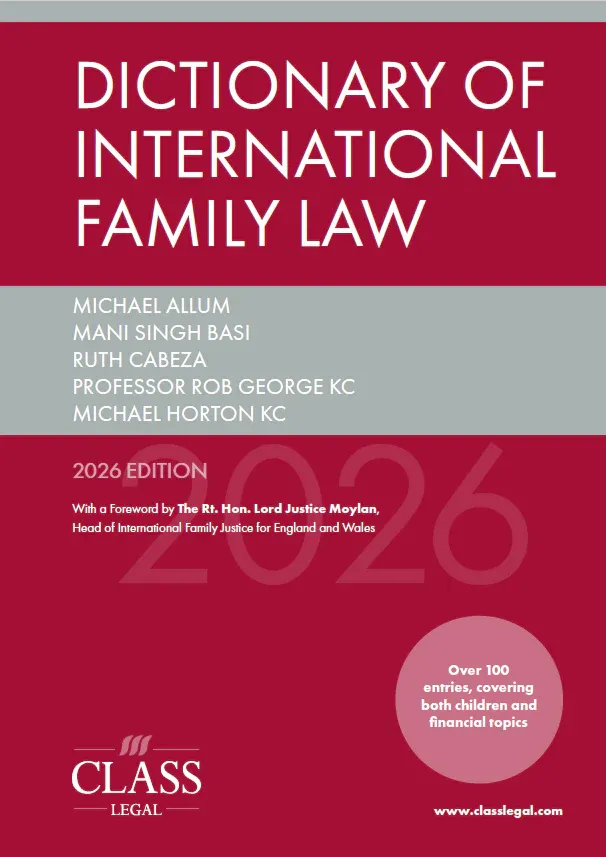
Book Review: Dictionary of International Family Law
The Dictionary of International Family Law is the latest addition to the series of Class Legal Dictionaries. It joins this distinguished family with confidence and purpose.