
Welch v Welch [2017] EWFC B32
Judgment date: 19 June 2017
Related
Transactions Defrauding Creditors: Recent Cases
[2026] 1 FRJ 23. This article examines the nature of the Insolvency Act 1986 s 423 jurisdiction, its parameters and its practical application, as seen in the judgment of Harrison J in the Schedule 1 case of Re P (A Child) (Financial Provision: s 423 Insolvency Act 1986) [2025] EWHC 1460 (Fam).

Piercing Trust Structures in Switzerland in Aid of Financial Claims in England
[2026] 1 FRJ 26. Swiss courts possess domestic tools to pierce through foreign trust structures and make orders in respect of their underlying assets. This article examines what those tools are and how they may be deployed in aid of financial remedies proceedings in England.
Collardeau v Fuchs (Contempt of Court: Sentencing) [2026] EWFC 44
Poole J. Ms Collardeau’s application seeking the committal of Mr Fuchs, for contempt of court. No separate penalty for contempt was ordered, but a costs order was made against Mr Fuchs, summarily assessed at £100,000 inclusive of VAT.


Related
Transactions Defrauding Creditors: Recent Cases
[2026] 1 FRJ 23. This article examines the nature of the Insolvency Act 1986 s 423 jurisdiction, its parameters and its practical application, as seen in the judgment of Harrison J in the Schedule 1 case of Re P (A Child) (Financial Provision: s 423 Insolvency Act 1986) [2025] EWHC 1460 (Fam).
Piercing Trust Structures in Switzerland in Aid of Financial Claims in England
[2026] 1 FRJ 26. Swiss courts possess domestic tools to pierce through foreign trust structures and make orders in respect of their underlying assets. This article examines what those tools are and how they may be deployed in aid of financial remedies proceedings in England.
Collardeau v Fuchs (Contempt of Court: Sentencing) [2026] EWFC 44
Poole J. Ms Collardeau’s application seeking the committal of Mr Fuchs, for contempt of court. No separate penalty for contempt was ordered, but a costs order was made against Mr Fuchs, summarily assessed at £100,000 inclusive of VAT.
Latest

The Reluctant Pension Credit Member
[2026] 1 FRJ 39. In the case of AP v TP [2025] EWFC 190 (B) a financial remedy order was made by consent, following an FDR, which included a pension sharing order in W’s favour. Difficulties began when W failed to provide the necessary information to permit the pension share to be implemented.

Housing Particulars: Mind The Gap
What can the court do when there's a significant gap between the bottom of the applicant’s range and the top of the respondent’s range? Can the court take up the invitation made by counsel to ‘conduct its own research on Rightmove if it wishes’?
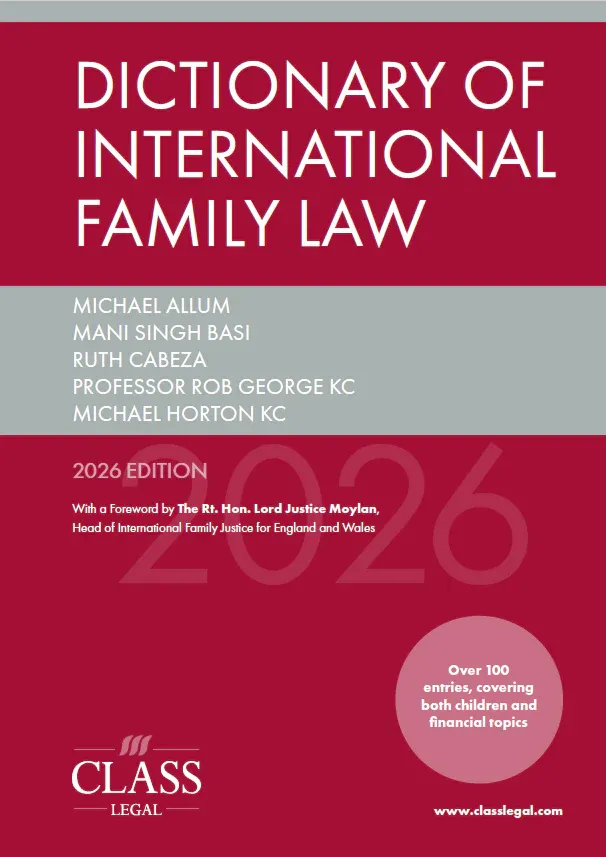
Book Review: Dictionary of International Family Law
The Dictionary of International Family Law is the latest addition to the series of Class Legal Dictionaries. It joins this distinguished family with confidence and purpose.