
Re A and Z: Service Out; MPS; LSPO [2026] EWFC 64
McKendrick J. Interim hearing addressing an application to set aside a previous order permitting alternative service of the divorce petition out of jurisdiction by email in the US, alongside MPS and LSPO applications.
Judgment date: 18 March 2026
https://caselaw.nationalarchives.gov.uk/ewfc/2026/64
McKendrick J. Interim hearing addressing an application to set aside a previous order permitting alternative service of the divorce petition out of jurisdiction by email in the US, alongside MPS and LSPO applications.
Background
A was a European national living in England and Wales, and Z was a US citizen living in the US. A was granted permission for alternative service of the divorce application on Z out of jurisdiction by email in the US, albeit Z was given no opportunity to respond before the order was made, and then only given 7 days to apply to vary or revoke the order. Z was served by email.
Z then filed for divorce in the US shortly thereafter, and A was personally served with that application. Z subsequently filed their answer to the divorce petition and applied for a set aside of the alternative service order.
A also filed applications for MPS and an LSPO, and so the interim hearing was listed to deal with:
- permission for Z to apply out of time to set aside the alternative service order, and the substantive application to set that order aside;
- A’s MPS/LSPO applications;
- Z’s application for a US Part 25 expert; and
- further directions to a forum conveniens hearing.
Judgment
a. Permission to apply out of time/application to set aside
A argued service by email was required because Z would try to evade service to ‘obtain an unfair advantage by progressing rival litigation elsewhere’ (the parties had a US prenup and A expected Z to prefer a US divorce). Z filed a witness statement stating they were attending a silent retreat when the petition was served, and filed evidence to the effect that under US law service by email was not permitted in Z’s state until personal service had been attempted and failed. Z also argued they had acted expeditiously once aware of the application to take English legal advice and respond.
McKendrick J, applying general case management powers under FPR 4.1(3)(a), allowed permission to apply out of time. Amongst other reasons, the extension caused no prejudice to A, and Z had provided good enough reasons for the delay.
McKendrick J was satisfied that Z was not seeking to evade service, but only wished for the rules to be complied with as they had done when serving A with the US petition. The alternative service order was set aside.
b. MPS
In KV v KV [2024] EWFC 165 Peel J had summarised the principles in MPS cases where there was a jurisdiction dispute – the fact of the dispute did not prevent an order, but ‘the court will be appropriately cautious when considering (i) whether such an award should be made and (ii) the quantification thereof’.
Applying BN v MA [2013] EWHC 420 (Fam), the existence of the prenup was also a relevant factor, albeit McKendrick J again suggested caution was required:
‘I should consider what evidence I have of each parties’ resource, their lifestyle and the PNA but the unvarnished rules of the 1973 Act are my guide – reasonableness.’
A sought £29k per month/£348k per annum, and for their rent to continue to be paid by Z in addition to this. A argued that the prenup was signed under duress, and that they had lived a luxurious international lifestyle during the marriage, with Z’s wealth having grown to the hundreds of millions since the prenup was signed. Conversely, Z contended that the prenup was freely entered into and played down the standard of living, although failed to file significant evidence as to their wealth until a third witness statement on the day of the hearing. Z counter-proposed MPS at £6.1k per month and rent on a less expensive property than that A lived in.
MPS was ordered at £13.8k per month/£166.1k per annum, with £100k in rent in addition to this. McKendrick J viewed with scepticism Z’s evidence as to insufficient liquid assets, and found no good reason for the late witness statement.
c. LSPO
A sought £2.1m to pFDR, whilst Z’s position was that the total cost for the same period should be £165k.
As with MPS, caution was required. A’s six lawyers (and their hourly rates) were excessive, and the amount of work proposed in the budget was both excessive and unreasonable. However, the budget only needed to be determined until the forum hearing in the circumstances.
Applying KV v KV, historic costs were included in the LSPO on the basis that they were part of the broad discretion available when determining a LSPO award, and that A would not reasonably be able to obtain appropriate legal services for the proceedings.
Both parties were criticised for taking unrealistic approaches to the LSPO sum. A sum of £700k was ordered, to permit A to settle historic costs, deal with costs of the contested LSPO/MPS application, and permit a budget to fully litigate the jurisdiction/forum issues.
d. Part 25 expert/forum hearing
Z’s application for a Part 25 expert in the law of the relevant US state was granted in order to permit resolution of the forum dispute.
Parties were asked to agree directions to the forum hearing.


Latest
Housing Particulars: Mind The Gap
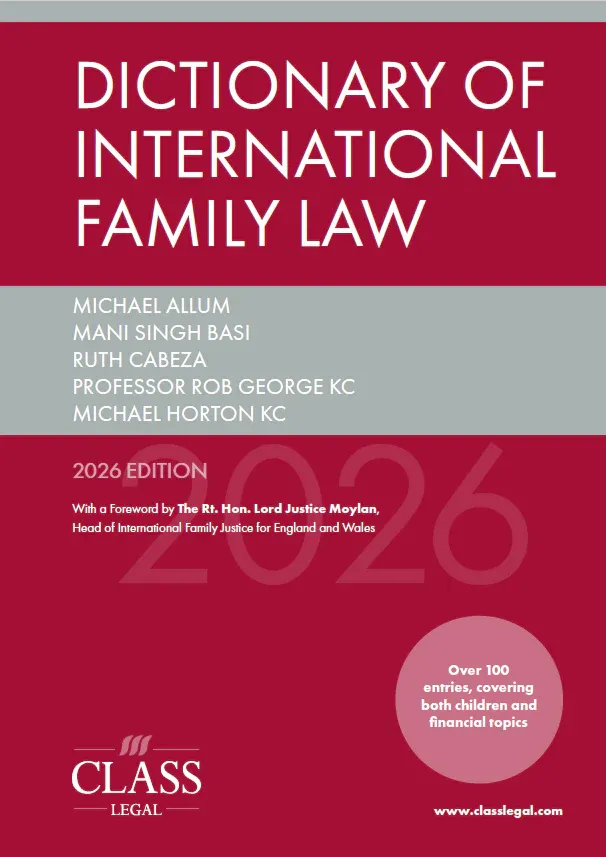
Book Review: Dictionary of International Family Law