
Pleadings in Proceedings Involving Interveners
[2026] 3 FRJ 226. This article aims to assist financial remedy practitioners faced with directions for formal pleadings in proceedings involving interveners. It encourages the practice of disciplined pleading to ensure that the issues in dispute are properly delineated.
Introduction
This article aims to assist financial remedy practitioners faced with directions for formal pleadings in proceedings involving interveners. It encourages the practice of disciplined pleading to ensure that the issues in dispute are properly delineated. It also highlights common issues, such as late amendments and pleading fraud, and offers practical solutions.
When will pleadings be required?
In this article, we use the term ‘pleadings’ to refer to the types of pleadings most commonly directed in financial remedy disputes involving interveners, namely points of claim, points of defence and a reply to a defence.
The FPR are silent on the question of when pleadings should be required in financial remedy proceedings. As we go on to explain, in practice, pleadings are typically ordered in many such disputes where third parties are joined.
The key cases are TL v ML [2005] EWHC 2860 (Fam), [2006] 1 FLR 1263 at [33]–[36]; Goldstone v Goldstone [2011] EWCA Civ 39, [2011] 1 FLR 1926 at [66]; and Edgerton v Edgerton [2012] EWCA Civ 181, [2012] 2 FLR 273 at [52]. These authorities were recently applied in the decision of MacDonald J dated 8 September 2026 in MF v NF [2026] EWFC 243 (which, although beyond the scope of this article, also addresses the higher and more nuanced approach the court takes to strike out applications in financial remedy proceedings).
The authorities provide some useful pointers.
First, a dispute with a third party heard in financial remedy proceedings must be approached on exactly the same legal basis as if it were being determined in the Chancery Division (TL v ML at [34], per Mostyn J).
Second, although not all cases involving a third-party issue will require the joinder of the third party (Behbehani v Behbehani [2019] EWCA Civ 2301 at [69]), where the third party is joined, pleadings will ordinarily be directed where the third-party issue would otherwise be tried as a free-standing civil claim.
Third, pleadings will typically be directed in the following types of intervener disputes:
(1) Disputes concerning the beneficial ownership of property between a spouse and a third party (e.g. TL v ML). This may include:
(a) A claim that property legally owned by a spouse is held on trust for a third party (e.g. Bloom v Bloom (Kontipaylova intervening) [2017] WL 08223847; A v N (R intervening) [2025] EWFC 371 (B).
(b) A claim that property legally owned by a third party is beneficially owned by a spouse (e.g. Sloutsker v Sloutsker [2025] EWFC 369).
(c) A claim that a trust is a sham and/or is illusory (e.g. Michael v Michael [2024] EWFC 463).
(2) Disputes concerning the existence of a loan said to be owed to a third party (e.g. TP v OP [2026] EWHC 1179 (Fam)).
(3) Applications to set aside a disposition under s 37 Matrimonial Causes Act 1973, s 23 Matrimonial and Family Proceedings Act 1984 or s 423 Insolvency Act 1986, in particular where repayment is sought from the third party (e.g. AC v DC & Ors (Financial Remedy: Effect of s 37 Avoidance Order) [2013] 2 FLR 1483 (FD)).
(4) Enforcement proceedings where orders are being sought against assets in respect of which a third party asserts an interest (e.g. Behbehani v Behbehani [2019] EWCA Civ 2301).
(5) Although such disputes are less common, disputes as to whether a gift made by a third party to a spouse is subject to conditions and/or should be set aside for mistake (e.g. Perez de la Sala v Copinger-Symes & Ors [2026] EWCA Civ 282).
This is not to say that pleadings will invariably be ordered in intervener claims. The court retains a discretion in its case management powers, bearing in mind costs and proportionality. Nonetheless, we consider that it is usually appropriate for such an order to be made to ensure that the nature and precise scope of the issues in dispute are clearly identified as early as possible and that rights of the third party are not unfairly prejudiced.
While some may initially be reluctant to seek a direction for pleadings due to the costs involved, we respectfully suggest that such reluctance often leads to a false economy. As Munby J remarked in A v A [2007] EWHC 99 (Fam), [2007] 2 FLR 467 at [24]:
‘In the present case the muddle confusion and ambiguities in the wife’s case would have been more pitilessly exposed, and at a much earlier stage in the proceedings, had the presentation of her case been exposed to the intellectual discipline which is one of the advantages of any system of pleading. Moreover, if the wife had been required to plead her case everyone would have had a much clearer idea, and at a much earlier stage, as to exactly what she was or was not asserting and as to exactly what the husband and the interveners were or were not saying by way of defence. As it was, matters were wholly unclear even as late as the first day of the final hearing.’
Pleadings should be sequential (points of claim, followed by points of defence, and if appropriate, a reply to the defence). Witness statements should be filed after pleadings. As the editors of the Family Court Practice 2026 (the Red Book) note (at procedural guide A4):
‘It is bad practice for the court to be invited to order the parties to exchange simultaneously a statement of case with witness statements “exhibiting all statements upon which they intend to rely.” This telescoping of pleadings, disclosure and evidence misunderstands the requirement for the pleadings to set out the claim, for disclosure to ensure “all cards are on the table”; and for witness statements to be exchanged once respective cases have been understood by each side and all relevant documents are in play.’
What procedural rules apply?
In the absence of any rules on pleadings in the FPR, the court may turn to the CPR for guidance. There are at least two recent authorities in support of that proposition: Re P, HL (Children) (Mobile Phone Extraction) [2023] EWCA Civ 206, [2023] 2 FLR 528 at [54] and SM v BA & Anor (No 3: Amendments to Statement of Case) [2026] EWFC 9 at [28].
However, absent a specific direction, reference may be made to the CPR (and any relevant authority pertaining to them) for guidance only. Financial remedy proceedings (whether under the Matrimonial Causes Act 1973, Sch 1 Children Act 1989 or Part III Matrimonial and Family Proceedings Act 1984) remain family business to which the FPR apply (see FPR 2.1, s 32 MFPA 1984 and s 61 Senior Courts Act 1981), irrespective of the involvement of an intervener. The court may apply the CPR by analogy, with or without modification where appropriate, but it is not bound to do so.
In practice, partitioners are likely to find useful guidance in CPR Part 16, which concerns statements of case (meaning a claim form, particulars of claim where these are not included in the claim form, defence, Part 20 claim or a reply to a defence (CPR 2.3(1)) and CPR Part 17, which concerns amendments to a statement of case.
Important provisions of both parts are discussed in further detail below. Chapter 4 of the Business and Property Courts Chancery Guide on Statements of Case[[1]] also contains a useful summary of key CPR provisions and relevant case law.
What should statements of case contain?
Statements of case must be concise and plead the relevant facts. As the Court of Appeal explained in BB v Khayyat [2023] EWCA Civ 253:
- A statement of case must set out the facts on which the claimant relies to establish the essential elements of the cause of action, so the defendant knows the case they have to meet (at [37]).
- Statements of case ‘must be concise’, and plead ‘only material facts, meaning those necessary for the purpose of formulating a cause of action or defence, and not background facts or evidence’. Still less should they ‘contain arguments, reasons or rhetoric’. This reflects the matters which each party will need to prove by evidence at trial (at [38]).
- Irrelevant statements may be ‘embarrassing’ and the statement of case may be struck out in whole or in part if irrelevant matters are included (at [37]).
Although it may be tempting to plead (for example) details of the marital history or the other party’s conduct, the pleader should ask of every averment: is this a material fact necessary to establish the cause of action, defence or relief sought? If it is background, evidence, commentary or advocacy, it does not belong in the statement of case.
A recurring practical question is whether a pleading may properly be left open-ended to accommodate information that has not yet emerged. There is a tension here. A pleading must give the other side sufficient notice of the case to be met. An entirely open-ended pleading that provides no particulars and amounts to bare assertion is liable to be struck out. However, at the time of pleading, a party may only have an incomplete picture – and it is permissible to plead a case by inference, so long as the facts which are said to give rise to the inference are clearly set out.
Special rules in the CPR apply to the requirements for defences and replies, and may be applied in family proceedings by analogy.
A defence (CPR 16.5) must deal with every allegation in the particulars of claim and make clear which are admitted, which are denied and which the claimant is required to prove. If an allegation is denied, the defendant must state their reasons for doing so and state their own version of events if different to that alleged by the claimant. If a defence fails to deal with an allegation in the particulars of claim, the defendant is taken to have admitted it (unless the defence otherwise sets out the defendant’s case in relation to the issue to which that allegation is relevant). It is therefore important to carefully consider each of the specific allegations in the particulars (or points) of claim when drafting a defence, and ensure that they have all been dealt with, to avoid inadvertent admissions.
There is no requirement to file a reply. If a claimant does not file a reply, the defendant is required to prove the matters raised in the defence; and if a reply does not deal with a matter in the defence, the defendant is required to prove that matter (CPR 16.7). However, if the claimant wishes to rely on positive matters not alleged in the particulars (or points) of claim in response to those raised in the defence, those matters should be set out in a reply.
CPR Part 16 and PD 16 also contain a number of detailed rules which must be followed in proceedings in the Chancery Division relating to certain specific claims, including where the statement of case pleads interest; exemplary, aggravated or provisional damages; oral or written agreements; or fraud, undue influence, etc. To the extent that the CPR have been applied by analogy, the drafter should (re)familiarise themselves with CPR Part 16 and PD 16 before finalising the pleading to ensure these detailed provisions are complied with.
All statements of case must be verified by a statement of truth (CPR 22.1).
When can a party amend a statement of case?
Rules on when a party may amend a statement of case (as defined in CPR 2.3(1), see above) are contained in CPR Part 17. Most disputes in this area concern amendments to statements of case after they have been served. A party may only amend a statement of case after it has been served if: (1) the other parties consent; or (2) with the permission of the court (CPR 17.1(2)).
When considering whether permission to amend should be granted, the court will have regard not only to the proposed amendment itself, but also to its timing.
Two recent financial remedy decisions shed some useful light on the issue of late amendments in financial remedy proceedings involving interveners: SM v BA & Anor (No 3: Amendments to Statement of Case) [2026] EWFC 9 and Michael v Michael [2024] EWFC 463.
In SM v BA, Nicholas Allen KC (sitting as a deputy High Court Judge) reviewed the relevant civil authorities on CPR 17.1(2) at length ([30]–[37]). His judgment is essential reading for any practitioner seeking a late amendment to pleadings. Of particular note are the dicta adopted from Coulson J’s judgment (as he then was) in CIP Properties (AIPT) Ltd v Galliford Try Infrastructure Ltd (No 3) [2015] EWHC 1345 (TCC) at [19]. In summary:
(1) The lateness by which an amendment is produced is a relative concept. An amendment is late if it could have been advanced earlier, or involves the duplication of cost and effort.
(2) An amendment can be regarded as ‘very late’ if permission to amend threatens the trial date.
(3) There must be a good reason for the delay.
(4) The court will consider the particularity and/or clarity of the proposed amendment.
(5) Prejudice to resisting parties if the amendments are allowed may involve the simple fact of being ‘mucked around’, disruption in the run-up to trial, or the duplication of cost and effort. If allowing the amendments would necessitate the adjournment of the trial, that may be an overwhelming reason to refuse the amendments.
(6) Prejudice to the amending party if the amendments are not allowed will, obviously, include its inability to advance its amended case, but if that prejudice is caused by the amending party’s own conduct, then it is a much less important element of the balancing exercise.
In SM v BA, the court refused to grant the wife permission to amend her points of claim. The application to amend was made over 8 months after her points of claim had been filed and served. The amendments were lengthy and significantly expanded the scope of the wife’s claims. It was argued on the wife’s behalf that the amendment was necessary to fill a legal lacuna in the points of claim which could lead the court to reach a conclusion which was unsustainable in law. Nicholas Allen KC found that there was no such lacuna. The amendments, if allowed, would also have jeopardised the trial date. It is important to stress, however, that even late amendments which would not result in the trial being adjourned may be refused (see SM v BA at [32]).
Exceptionally, amendments may nonetheless be allowed as late as the trial itself. We say ‘exceptionally’ because such cases are rare. For instance, in Michael v Michael, HHJ Hess (sitting as a deputy High Court Judge) permitted the wife to amend her points of claim during the course of the trial, accepting the submission (at [95]) that: ‘for the wife trying from the darkness to work out what the husband has been doing, this has been a developing picture and she should not be penalised for wishing to hone her case in the light of developing evidence …’.
We suggest that it is important not to read the decision of HHJ Hess to allow the wife’s late amendment in Michael v Michael as providing broad licence to make very late amendments. The court in that case made significant findings of non-disclosure and dishonesty against the husband. Cases inevitably develop in the lead up to trial, whereas the prejudice to a respondent caused by a very late amendment may be significant.
Consequences of not pleading, or not pleading properly
Perhaps surprisingly, failure to plead a claim relied on at trial is not necessarily fatal. As Lord Denning MR observed in In Re Vandervell’s Trusts (No 2) [1974] Ch 269 (CA) at 321–322:
‘It is sufficient for the pleader to state the material facts. He need not state the legal result. If, for convenience, he does so, he is not bound by, or limited to, what he has stated. He can present, in argument, any legal consequence of which the facts permit. The pleadings in this case contained all the material facts. It does appear that [counsel] put the case before us differently from the way in which it was put before the judge: but this did not entail any difference in the facts, only a difference in stating the legal consequences. So it was quite open to him.’
However, Lord Denning’s observations would not absolve a party who fails to plead the relevant facts required to establish a cause of action (such as the relevant contractual provision relied on, or the relevant mental state of the counterparty). It therefore remains very important at the time of pleading to identify every cause of action which will be relied on at trial and to ensure that each of the elements of that claim have been pleaded and are squarely put in issue.
Even if new arguments sought to be raised at trial are strictly matters of legal characterisation of pleaded facts, courts may nevertheless be wary of allowing a party to raise them, when they could and should have been raised earlier. To give a recent example, in TP v OP [2026] EWHC 1179 (Fam) at [59]–[60], Trowell J observed that the exercise of his duty under the FPR to manage the case would be ‘thwarted’ if ‘parties spring issues on the court at the very last minute’. The judge considered that response from the defendant’s counsel that:
‘one can take fresh points of law all the way up to the Supreme Court – is an inadequate response. Litigation is not a game in which cards can be held back to be played at critical moments. Litigation is a matter of significance in the parties’ lives which requires each side to have fair notice of what is in issue and be able to prepare for it.’
The safest course is therefore to seek to plead all relevant causes of action at the earliest stage.
Pleading fraud
Lastly, it is worth briefly considering the special requirements for pleading fraud. The requirements are exacting and it is easy to inadvertently slip into error.
Any allegation amounting to fraud or dishonesty must be pleaded distinctly and with particulars, and it is impermissible to advance a case that is, in substance, an allegation of fraud without expressly pleading it: Three Rivers District Council v Bank of England (No 3) [2001] UKHL 16, [2003] 2 AC 1 (see [51] and [184]–[186]). The claimant must plead the facts, matters and circumstances relied on to show that the defendant was dishonest and not merely negligent. A claim in fraud is not sufficiently particularised if the facts pleaded are consistent with innocence (at [184]). The court also gave useful guidance regarding the correct approach to pleading fraud by inference (at [186]) – a party is not permitted to seek to draw an inference of fraud at trial from facts which have not been pleaded.
What amounts to an allegation of fraud for these purposes may be wider than the label suggests. To give just one example, undue influence has been described as ‘a species of fraud’: CIBC Mortgages Ltd v Pitt [1994] 1 AC 200 at 209, per Lord Browne-Wilkinson.
In the financial remedy context, where allegations of concealment of assets, sham transactions and pressure or overreaching in relation to nuptial agreements are relatively common, the pleader must consider carefully whether the case being advanced is, in substance, one of fraud or dishonesty, and if so must plead it distinctly and with particulars. Allegations of fraud cannot be deployed as a rhetorical flourish or a tactical makeweight.
Further, under the Bar Standards Board Handbook,[[2]] rC9(2) provides that a barrister ‘must not draft any statement of case, witness statement, affidavit or other document containing: … (c) any allegation of fraud, unless you have clear instructions to allege fraud and you have reasonably credible material which establishes an arguable case of fraud’. It may therefore be necessary to ask for further supporting documentation or interrogate the reasons why one is being asked to plead fraud and whether there is a proper basis for doing so.
Conclusion
Pleadings often introduce helpful procedural and intellectual rigor into disputes involving third parties. With that, however, comes important formal requirements which must be followed – otherwise, the consequences for non-compliance can be significant.


Latest
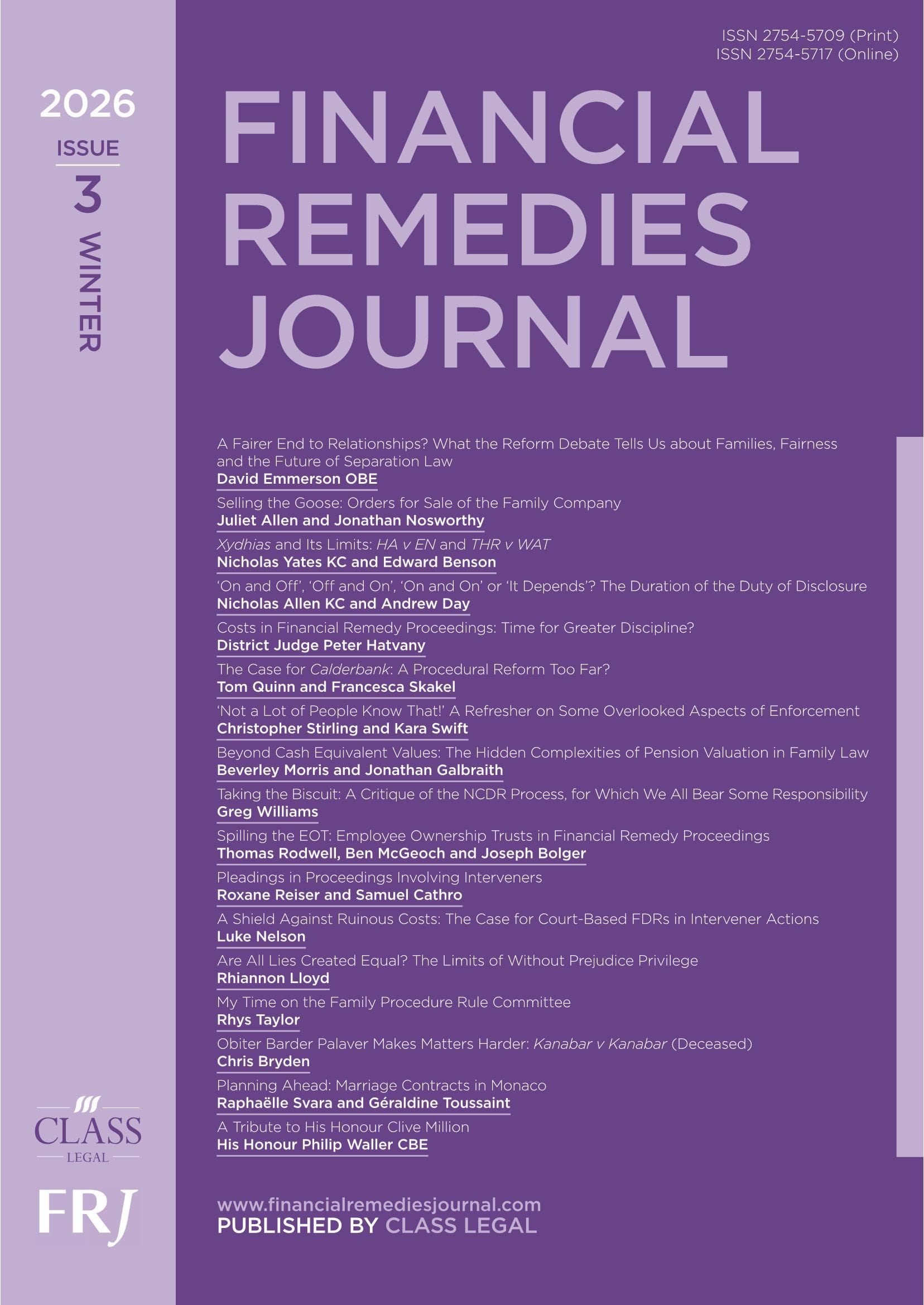
Now out: Financial Remedies Journal 2026 Issue 3 (Winter 2026)
The Case for Calderbank: A Procedural Reform Too Far?