
Planning Ahead: Marriage Contracts in Monaco
[2026] 3 FRJ 246. This article aims to provide English legal practitioners with a comprehensive overview of the Monegasque approach to marriage contracts and to draw clear distinctions between these instruments and the prenuptial agreements familiar to common law jurisdictions.
Introduction
The Principality of Monaco, by virtue of its favourable tax environment, its geographical appeal and the concentration of ultra-high-net-worth individuals within its borders, has long been a jurisdiction of particular significance in the realm of international family law. A substantial proportion of marriages celebrated or domiciled in Monaco involve spouses of different nationalities, with assets spread across multiple jurisdictions.
This article aims to provide English legal practitioners with a comprehensive overview of the Monegasque approach to marriage contracts and to draw clear distinctions between these instruments and the prenuptial agreements familiar to common law jurisdictions.
Defining the key concepts: marriage contract vs prenuptial agreement
At the outset, it is imperative to dispel a common misconception: a Monegasque marriage contract and an English prenuptial agreement are fundamentally different legal instruments. They arise from distinct legal traditions, serve different purposes and operate within different conceptual frameworks. They must not be conflated.
Marriage contract
Under Monegasque law, a marriage contract is a notarial deed which determines the matrimonial property regime applicable to the spouses. It is, in essence, an agreement governing the ownership, management and division of assets within the marriage. The marriage contract is concluded before the celebration of the marriage and must comply with the formal requirements of Monegasque notarial law.
The marriage contract does not, strictly speaking, regulate the financial consequences of divorce in the manner that an English prenuptial agreement does. Its primary function is to define the property regime the couple are signing up to: which assets are owned jointly, which are separate, how they are managed and how they are to be divided upon dissolution of the regime (whether by divorce, death or otherwise). As such, a marriage contract cannot be challenged by the court, which must enforce it without being able to amend it.
Prenuptial agreement
By contrast, our understanding is that a prenuptial agreement in the English and broader common law tradition is a private agreement between prospective spouses that seeks to regulate the financial consequences of the breakdown of their marriage. Our English colleagues have mentioned that since the landmark decision of the Supreme Court in Radmacher v Granatino [2010] UKSC 42, English courts have accorded significant weight to prenuptial agreements, provided that certain safeguards are met – principally, that both parties entered into the agreement freely, with a full appreciation of its implications, and that it would not be unfair to hold the parties to the agreement in the circumstances prevailing at the time of divorce.
It is thus our understanding that a prenuptial agreement in the common law sense typically addresses matters such as lump sum payments, spousal maintenance, the capping or potential waiver of financial claims, and the ring-fencing of non-marital assets. These are matters that go well beyond the scope of a matrimonial property regime.
The fundamental distinction
The distinction is therefore clear: a marriage contract governs the matrimonial property regime; the prenuptial agreement serves primarily to govern the financial outcome upon divorce. These are two separate legal categories. A marriage contract may have consequences upon divorce (insofar as the property regime determines what each spouse owns at the point of separation), but it does not purport to determine matters such as spousal maintenance, how capital needs will be met, or the exercise of judicial discretion in dividing assets. Consequently, Monegasque law does not require disclosure of assets, separate legal representation for each spouse, or a minimum period between signing and marriage in connection with the execution of a marriage contract. English practitioners must bear this distinction firmly in mind when advising clients with connections to Monaco.
Marriage contracts: scope, utility and strategic value
Under Monegasque law, the default matrimonial property regime – that is, the regime that applies in the absence of a marriage contract – is the regime of separation of property. This means that, unless the spouses agree otherwise, each spouse retains ownership of the assets acquired in his or her own name before or after the marriage, and there is no community of property.
English practitioners may reasonably ask: if the default regime is already one of separation, what is the purpose of entering into a marriage contract?
The answer is multifaceted.
First, although the default regime is separation of property, a marriage contract allows the spouses to tailor the regime to their specific needs. They may, for example, wish to establish a limited community of property for certain categories of assets (such as the family home), while maintaining separation for all other assets. They may wish to include specific provisions regarding the management and administration of assets, the contribution of each spouse to household expenses, or the fate of particular assets upon dissolution. A marriage contract may also include donations between spouses of existing assets or future assets.
Nevertheless, while spouses are generally permitted to organise their matrimonial property regime by agreement, Art 1236 Civil Code restricts certain arrangements that would otherwise contravene public policy. In particular, that Article prohibits clauses that would derogate from the rights and duties arising from marriage, alter the legal order of succession, or include stipulations incompatible with the principles governing matrimonial regimes under Monegasque law. Accordingly, any provision that exceeds those bounds may be deemed null and void.
Second, and of critical importance in an international context, a marriage contract provides the vehicle through which the spouses may exercise their choice of applicable law for the matrimonial property regime and the divorce, as permitted by the Code of Private International Law (PIL Code). Without a marriage contract, the applicable laws are determined by the default rules of the PIL Code, which may not produce the result that the spouses desire.
Thus, Art 36 PIL Code provides that the matrimonial property regime is governed by the law chosen by the spouses. The available options are: (1) the law of the state in which the spouses establish their domicile after the celebration of the marriage; (2) the law of a state of which either spouse holds nationality at the time of the choice of law; (3) the law of the state in which either spouse is domiciled at the time of that choice; or (4) the law of the state in which the marriage is celebrated. This is a relatively broad palette, reflecting the international character of marriages in Monaco.
Where no choice is made, Art 38 provides default connecting factors: the law of the state where the spouses establish their first common domicile after marriage; failing that, the law of their common nationality; and, as a last resort, Monegasque law.
Article 41 PIL Code addresses the law applicable to divorces. The default position is that Monegasque law applies, unless both spouses request the application of the law of their common nationality. However – and this is of particular importance – Art 41 further provides that the spouses may agree, even before the celebration of the marriage, to apply the law of a state of which either of them has nationality, or the law of the state in which they share a common domicile.
This means that the marriage contract can serve as the instrument through which the spouses designate not only the law applicable to their matrimonial property regime (under Art 36), but also the law applicable to their divorce (under Art 41). The marriage contract thus becomes a dual-purpose instrument of considerable strategic value.
Third – and this is a development of particular practical significance – we have developed a practice of including declarations made by the spouses within a marriage contract that go beyond the strict scope of the matrimonial property regime.
As the Monegasque marriage contract is, by its nature, an instrument governing the matrimonial property regime, it does not, in itself, allow spouses to regulate in advance the broader financial consequences of a potential divorce in the manner of a common law prenuptial agreement.
To address this structural limitation, we have developed a practice of including within the marriage contract ‘declarations’ which sit alongside the contractual clauses governing the regime but do not share their binding legal force under Monegasque law. These declarations typically refer to the foreign law relevant to our client’s situation and incorporate provisions addressing the financial consequences of the divorce that would be recognised as valid and enforceable in that jurisdiction. Their purpose is to create a formal, notarised record of the spouses’ agreement on matters that fall outside the scope of the Monegasque marriage contract proper, but that are of critical importance to internationally exposed clients.
It would be wrong to suggest that those ‘declarations’ provide an absolute guarantee of protection. The uncertainty is not, however, general. Where the declarations merely seek to ensure the validity of the marriage contract in a foreign jurisdiction, little difficulty arises. Where they concern spousal maintenance (pension alimentaire), there is no doubt that the Monegasque courts will consider them contrary to public policy and refuse to apply them. However, where the ‘declarations’ concern the prestation compensatoire – the compensatory allowance that may be awarded to a spouse upon divorce – the position becomes considerably more complex and uncertain.
The enforceability of the declarations by the court will depend on the characterisation of the prestation compensatoire under Monegasque law. The relevant distinction is whether the payment is intended primarily to meet the financial needs of the former spouse or to compensate for the economic consequences of the breakdown of the marriage. If it is regarded as serving a maintenance-related purpose, it would constitute a matter of public policy, and any declaration purporting to waive or limit it would be unenforceable as contravening a mandatory rule of Monegasque law. If, on the other hand, the prestation compensatoire is regarded as being intended primarily to compensate for the economic consequences of the divorce, rather than to meet the former spouse’s financial needs, it would not fall within the scope of public policy and the declarations should, in principle, be enforceable.
It is our considered view that the prestation compensatoire has a predominantly compensatory character, as it is intended to redress the economic imbalance resulting from the dissolution of the marriage rather than to meet the former spouse’s continuing financial needs. On this basis, we consider that a declaration addressing the prestation compensatoire should not be regarded as contrary to the public policy of Monaco.
We stress, though, that there is, at present, no Monegasque case law directly on this point. The question remains open. What we can say with confidence is that, at a minimum, such declarations demonstrate the spouses’ common intention and may serve as a guide to a judge in exercising his or her discretion. They are not without value – but their enforceability cannot, as matters stand, be guaranteed.
In practice, we frequently complement the Monegasque marriage contract with a shadow agreement – a separate contract governed by the relevant foreign law, which restates the key financial provisions of the marriage contract in a form and with the formalities required by that jurisdiction. This dual approach maximises the likelihood that the spouses’ intentions will be given effect, whether proceedings are brought in Monaco or elsewhere.
A marriage contract cannot, however, address all the uncertainties that may arise in an international divorce. In particular, the lack of enforceability of jurisdiction clauses in divorce matters means that the parties may remain exposed to forum shopping and lis pendens issues.
Jurisdiction uncertainty in divorce matters
A further difficulty arises from the uncertainty as to which court will have jurisdiction to hear divorce proceedings.
Invalidity of jurisdiction clauses in divorce matters
Forum shopping – the practice whereby a spouse initiates divorce proceedings in the jurisdiction perceived as most favourable to his or her interests – is a matter of acute concern in international family law, and particularly so in Monaco, where the concentration of wealth and the international character of the population make it an especially fertile ground for jurisdictional disputes.
Under Monegasque law, jurisdiction clauses (clauses attributives de compétence) are not valid in divorce matters. Article 8 PIL Code permits jurisdiction clauses only in matters where the parties may freely dispose of their rights under Monegasque law. Divorce is not such a matter.
The consequence is that spouses cannot, by agreement, confer exclusive jurisdiction on any particular court for the purpose of divorce proceedings. This leaves open the possibility of a race to the courthouse – a scenario in which each spouse seeks to file first in the jurisdiction most favourable to his or her financial interests. In practice, this race is a recurrent feature of high-value international divorces involving Monaco.
Lis pendens: Art 12 PIL Code
The PIL Code addresses the problem of parallel proceedings through its rules on lis pendens. Article 12 provides that where an action having the same object is pending between the same parties before a foreign court, the Monegasque court seized second may stay proceedings until the foreign decision is rendered. Moreover, the Monegasque court shall decline jurisdiction if the foreign decision is capable of being recognised in Monaco under the PIL Code.
This mechanism offers a degree of protection against the costs and uncertainties of parallel proceedings, but it is not a complete solution. In practice, the question of which court was seized first, and whether the proceedings are truly identical in object, can itself become a contested issue.
For practitioners, the practical lesson is clear: where a client is at risk of divorce proceedings in multiple jurisdictions, the timing of the filing is of critical strategic importance. The absence of valid jurisdiction clauses in Monegasque divorce law means that pre-emptive filing may be the only effective means of securing the desired forum.
Considering all of the foregoing and depending on the particulars of their situation, the parties may also consider a marriage contract governed directly by a foreign law capable of addressing the financial consequences of the divorce.
Marriage contracts governed by foreign law
Spouses may also choose to enter into a marriage contract governed by foreign law – that is, to exercise the choice of law permitted by Art 36 PIL Code in favour of a foreign legal system which permits the marriage contract to include provisions addressing the financial consequences of divorce (as is the case under many continental European legal systems).
Such an agreement may be entered into in two different ways. The spouses may either execute a marriage contract before a Monegasque notary, while expressly choosing a foreign law to govern the agreement, or they may enter directly into prenuptial agreements in the form prescribed by the foreign law concerned. Provided that the relevant requirements of the applicable foreign law are satisfied, the use of such a foreign law agreement is permitted by the PIL Code.
The public policy exception
Where the matrimonial agreement is governed by foreign law, the relevant limitation is not the ordinary domestic public policy of Monaco but the more narrowly construed concept of Monegasque international public policy. In matters involving a situation validly created abroad, this reflects the attenuated effect of public policy: rights validly acquired abroad should, in principle, be recognised in Monaco unless their recognition would manifestly offend the fundamental principles of the Monegasque legal order.
This distinction has practical consequences. Indeed, if spousal maintenance (pension alimentaire) should fall within Monegasque international public policy, as should the protection of the family home – which is subject to mandatory rules under Art 35 PIL Code where the home is situated in Monaco – it is our opinion that any amount negotiated by the spouses in a foreign prenuptial agreement to deal with the financial consequences of their divorce should not be considered contrary to Monegasque international public policy.
Prenuptial agreements before Monegasque courts: the judgment of 27 March 2014
The question of how Monegasque courts treat foreign prenuptial agreements was addressed in the only judgment rendered on the subject by the Tribunal de première instance on 27 March 2014 (SC-VA c/ CO). In that case, the court was seized of divorce proceedings between German nationals domiciled in Monaco who had entered into a German marriage contract (Ehevertrag) in Munich. The court applied German law to the divorce and assessed the validity and enforceability of the German marriage contract under the applicable German law, including the provisions of the German Civil Code (Bürgerliches Gesetzbuch) on maintenance (Unterhaltsrecht). The court upheld the application of the foreign marriage contract, examined and rejected the wife’s claim of invalidity (based on her pregnancy at the time of signing) and gave effect to the contractual provisions.
Although this judgment concerned a German rather than an English marriage contract and did not address the question of the prestation compensatoire, it is of considerable significance. It demonstrates that the Monegasque courts are willing to apply foreign marriage contracts in divorce proceedings, provided that the contract is valid under the applicable foreign law and that its provisions are not manifestly contrary to Monegasque international public policy. By extension, there is a reasonable basis for concluding that an English law prenuptial agreement, if properly executed and valid under English law, should also be applied by a Monegasque court, subject to the same international public policy reservation.
The traditional Monegasque marriage contract, as it currently exists, is no longer suited to today’s circumstances. Monaco is responding by pursuing concrete reform to better meet the demands and expectations of spouses, particularly in international high-net-worth contexts.
Looking ahead: proposed legislative reform
The legislative landscape in Monaco is evolving. Where Monegasque law previously offered only marriage contracts, a new bill proposes to introduce the accord nuptial, echoing the Anglo-Saxon prenuptial agreement. This agreement would allow spouses to organise the financial and patrimonial consequences of a dissolution, could be concluded before or during the marriage, or in the course of dissolution proceedings, and could take the form of a simple private document.
As in Radmacher v Granatino, validity would require free consent with full financial disclosure, independent counsel and adequate negotiation time; compliance with public order and children’s best interests is also mandatory. The court could ratify the agreement to render it enforceable but would not be able to modify its terms. This convergence of civil law rigour and common law flexibility would be particularly valuable for Monaco’s internationally mobile families.
Whether or not the proposition de loi is enacted in its current form, the direction of travel is clear: Monaco is moving towards a legal framework that bridges the continental tradition of the marriage contract with the pragmatism of the English prenup, thereby simplifying the ability of couples residing in Monaco to put in place the equivalent of a prenup within the Monegasque legal order.


Latest
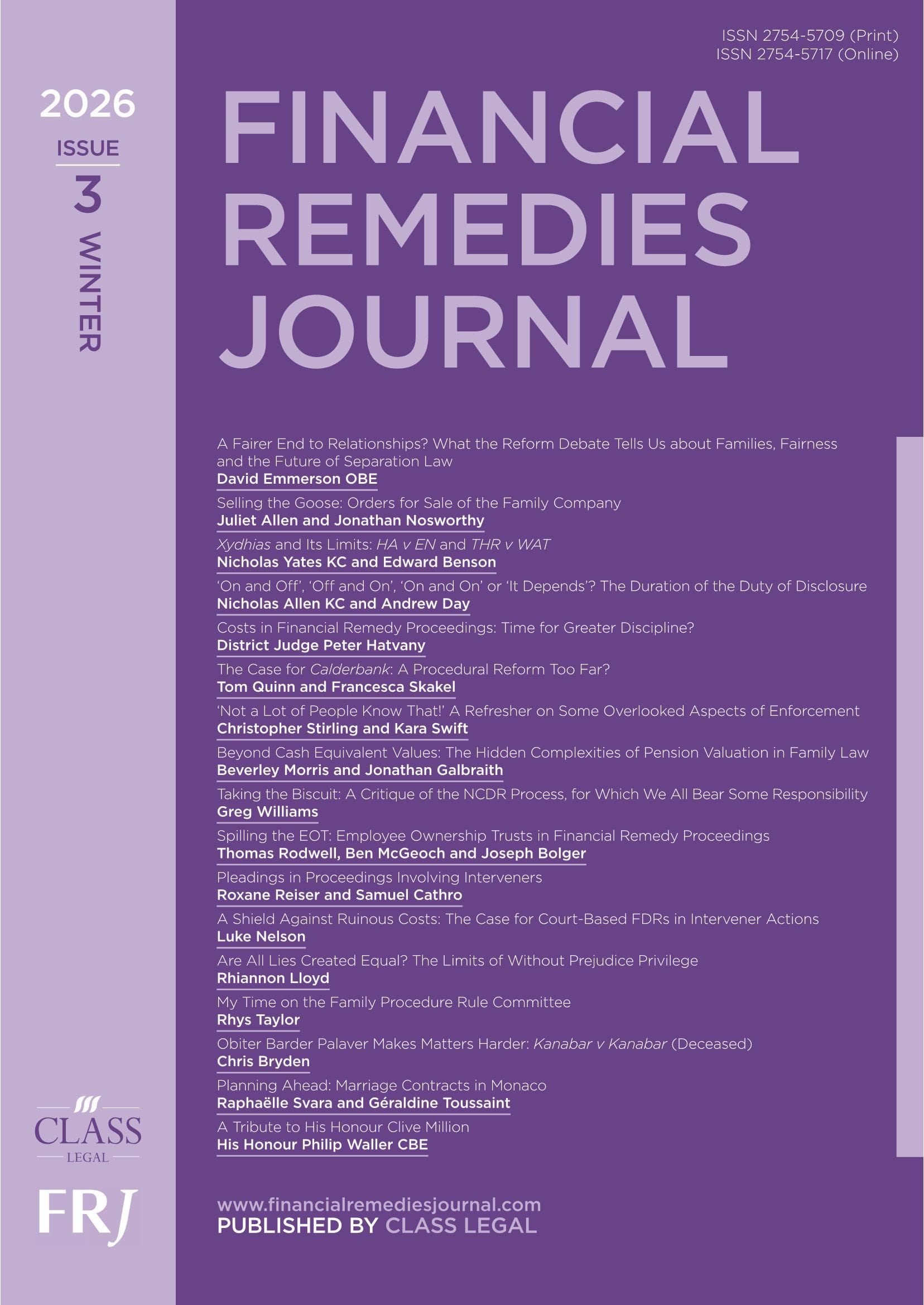
Now out: Financial Remedies Journal 2026 Issue 3 (Winter 2026)
The Case for Calderbank: A Procedural Reform Too Far?