
Moore v Moore [2007] EWCA Civ 361
Judgment date: 20 April 2007
Related

Delaying Departure? Domicile in Divorce Cases
[2026] 1 FRJ 16. In Ramana v Kist Ramana [2025] EWCA Civ 1022, [2025] 4 WLR 120 the Court of Appeal was concerned with the question of how a domicile of choice may be lost. This article explores the arguments made at the hearing, the court’s decision and reasoning, and the likely implications.
AO v EO [2026] EWFC 30 (B)
HHJ Edward Hess. Judgment in financial remedy proceedings, addressing habitual residence and forum conveniens where the parties had competing connections to England and Nigeria.
Collardeau v Fuchs: Contempt of Court [2025] EWFC 413
Poole J. An application for committal to prison for contempt of court following alleged breaches of an order made varying a final financial order.


Related
Delaying Departure? Domicile in Divorce Cases
[2026] 1 FRJ 16. In Ramana v Kist Ramana [2025] EWCA Civ 1022, [2025] 4 WLR 120 the Court of Appeal was concerned with the question of how a domicile of choice may be lost. This article explores the arguments made at the hearing, the court’s decision and reasoning, and the likely implications.
AO v EO [2026] EWFC 30 (B)
HHJ Edward Hess. Judgment in financial remedy proceedings, addressing habitual residence and forum conveniens where the parties had competing connections to England and Nigeria.
Collardeau v Fuchs: Contempt of Court [2025] EWFC 413
Poole J. An application for committal to prison for contempt of court following alleged breaches of an order made varying a final financial order.
Latest

The Reluctant Pension Credit Member
[2026] 1 FRJ 39. In the case of AP v TP [2025] EWFC 190 (B) a financial remedy order was made by consent, following an FDR, which included a pension sharing order in W’s favour. Difficulties began when W failed to provide the necessary information to permit the pension share to be implemented.

Housing Particulars: Mind The Gap
What can the court do when there's a significant gap between the bottom of the applicant’s range and the top of the respondent’s range? Can the court take up the invitation made by counsel to ‘conduct its own research on Rightmove if it wishes’?
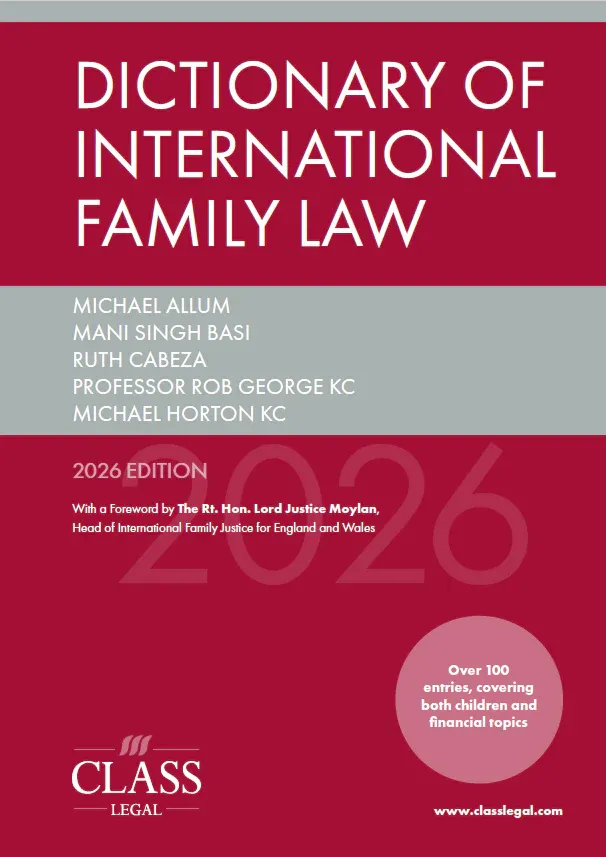
Book Review: Dictionary of International Family Law
The Dictionary of International Family Law is the latest addition to the series of Class Legal Dictionaries. It joins this distinguished family with confidence and purpose.