
Interview with His Honour Judge Stuart Farquhar
[2026] 3 FRJ 273. What makes a persuasive advocate? What irritating things would judges like solicitors and barristers to stop doing? What causes most of the money appeals? HHJ Farquhar answers these questions and more.
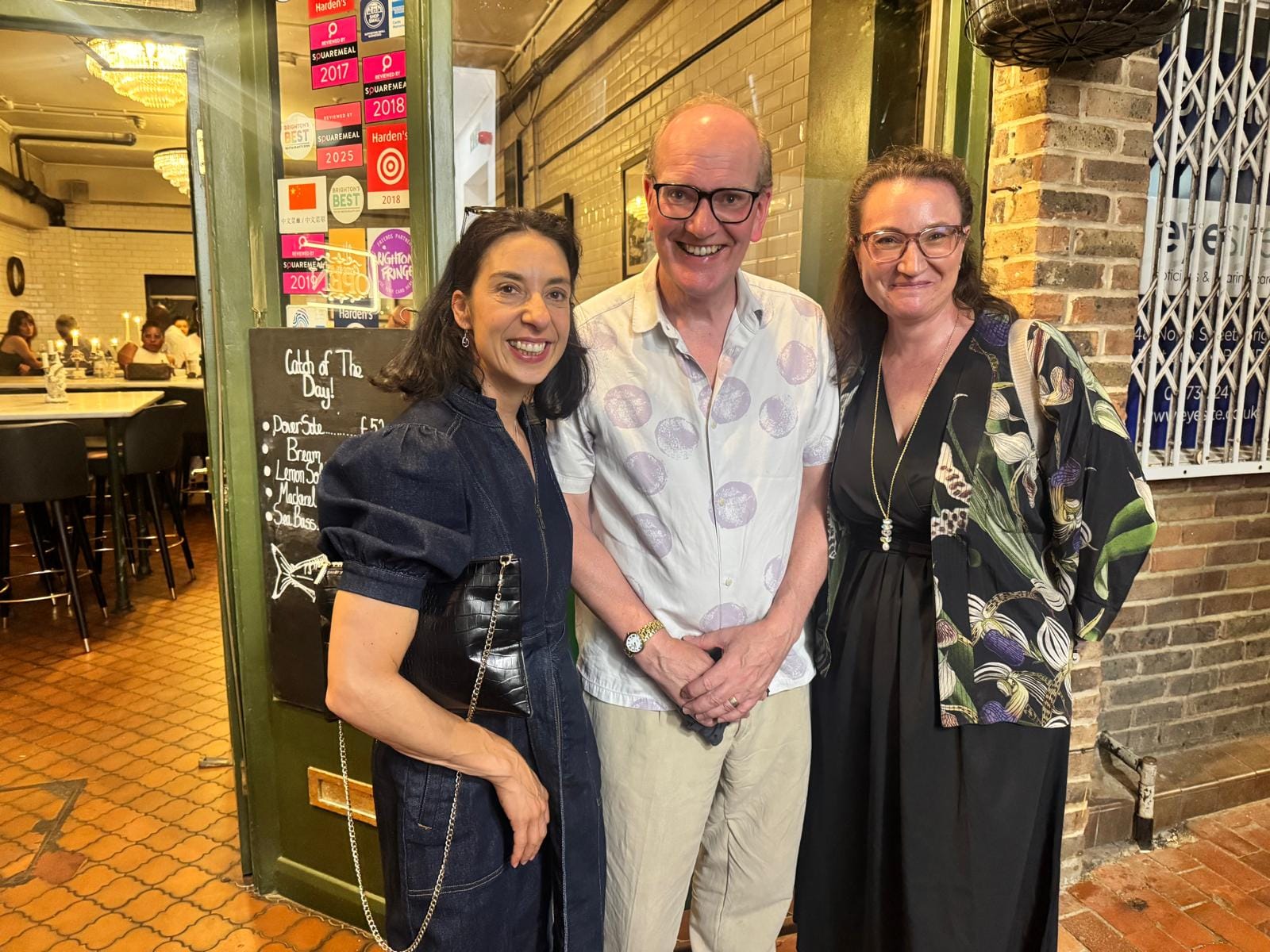
Financial remedy practice in the South-East is not going to be the same
His Honour Judge Farquhar was the dynamic lead Judge for financial remedy work in Kent, Sussex and Surrey from 2019 to June 2026. His Honour was called in 1985 and practised from what is now St Mary’s Chambers in Nottingham. He began life with a mixed practice but was drawn to family work, and the ‘simplicity’ of numbers.
His Honour was interviewed by Charlotte John and Anita Mehta in July 2026, who said that what our audience really want to know from the judiciary is what they can do better to assist their client and the court.
Stuart Farquhar is now offering Private FDR evaluation as an associate member of 1KBW. Please contact clerks@1kbw.co.uk.
What makes a persuasive advocate?
It is a cliché, but there is no substitute for preparation. Knowledge of all of the case is vital, both the points in your favour and even more importantly your weak points. It is always impressive if the advocate has full command of where things are in the bundle and makes reference to page numbers whenever any point is made (it speeds things up when considering our judgments).
An argumentative, bombastic presentation is rarely helpful, and it is generally the more understated approach that is more persuasive. Your client’s unfiltered arguments should not simply be put forward, and over-pitching your case starts to undermine your credibility.
It is staggering how often the advocates appear to fall out with each other in FRC cases (it rarely happens in other fields) and there seems to be little understanding among advocates about how incredibly annoying and unimpressive it is when this occurs.
When I started in practice, we were specialist advocates rather than specialists in a particular field and it really did help to have greater experience of cross-examination that you obtained in the criminal courts, for example. There was a good article on it recently.[[1]] That is not to say that there are not good young advocates these days, some of them are absolutely brilliant, but I do think that it is a shame with fully specialised sets that advocates do not have early exposure to a wider range of cases.
What irritating things would judges like solicitors and barristers to stop doing?
Where to start?! The simple answer is to be reasonable at all times and follow the rules. That is a simple statement but it appears to be very hard to follow.
It would take too long to set out all issues today (Do I feel an article coming on?[[2]]) but I would set out the following to start:
(1) Only put something in correspondence if you would be happy to hear it being read out in court at a hearing. Always read what has been written, especially if you have written it when you are not necessarily feeling at your best!
(2) Stick to the page limits on documents. You may think just four or five pages extra cannot do any harm and it will enable you to get more information into your document, but think of your audience. If a District Judge/Deputy District Judge is in an FDR/first appointment list then they will have five cases. If each document is five pages longer than permitted then that would amount to an extra 50 pages to be read. They will simply not have the time.
(3) Follow the rules on witness statements – it is so annoying to be reading a document that contains legal arguments or evidence on conduct when it had been agreed (or ordered) that conduct is not to be pursued. The whole purpose of instructing a lawyer is to put your case in the best possible light and not to annoy the judge. I appreciate that clients might want such things to be included in their statements, but tell them that it would annoy the judge and ensure it is excluded.
(4) Make realistic offers. I appreciate it is an adversarial process, but that does not mean that all legal principles can be ignored when making offers. This is especially true at final hearings, where parties appear to have abandoned their more reasoned approaches at FDR and simply gone for broke, however unrealistic that may be. It weakens the case overall.
The most important thing that lawyers can do is give their client realistic advice at an early stage so that the case, and the costs, are not driven by a client with unrealistic ambitions. It means an early conference to consider the merits. Not least because there are cases where everyone can re-house and manage if they reach an early settlement, but that becomes much harder once costs have eaten up their assets.
It surprises me that there are still final hearings being run by lawyers where they are seeking an award that is outside the spectrum of outcomes. I ask them whether the High Court would uphold my judgment if I made an order in line with their proposals.
[INSERT IMAGE 29]
What causes most of the money appeals that you have been dealing with?
The majority of appeals are from litigants in person who are simply disgruntled with the outcome. These applications rarely receive permission to appeal but they consume a lot of the judicial time. I was probably dealing with around 40 appeals a year. One point that did occur when only one side was represented was for judges to simply follow the order that was sought by the represented party with little thought being given to the impact upon the unrepresented party. There were a number of appeals when the order was unfair to the self-representing party and no net effect calculation had been performed to highlight the situation. It may be seen as a ‘good result’ for the client, but it left them open to it being overturned on appeal with a risk of costs orders being made. It is vital to ensure the order you seek is reasonable.
And what about when lawyers are involved?
One regular problem is simply a mistake as to the numbers by the judge at first instance. This is nearly always due to a shortage of time as the time estimate did not provide a sufficient period for the judge to give full consideration to the issues in the case, which leads to rushed judgments. This is particularly so when the assets are held in complex structures that require time to understand and consider. It is easier as a Circuit Judge as you can ensure there is time to be able to deliver a written judgment. The District Bench need to deliver the judgment immediately and avoid reserved judgments because of the pressure of their workload. This would be improved if there were more sitting days and the judges could have some thinking time.
There seem to be even greater problems and increasing issues with enforcing financial remedy orders and compliance with orders. What can lawyers and judges do about that?
This is a real problem. A judge considers their job is done once they reach a decision and it is not overturned on appeal, but that is only half the story in many cases.
The problem with enforcement is really one of listing. When I was a District Judge, I was always able to list such matters at short notice. Enforcement requires the ability to hear the applications swiftly as well as judicial continuity. It is almost impossible for this to occur now due to the overwhelming amount of work faced by the District Bench. In Kent, Surrey and Sussex, we set up two remote Application Courts per month but they too soon became fully listed. The answer is there needs to be more listing available for such applications, but there is simply no appetite for this to occur. I do not think I have ever heard anyone from outside the FRC world advocating for greater time being devoted to such work, yet we all know the real anguish that is caused by a failure to implement orders.
Judicial career
What advice would you give anyone thinking about whether a judicial role is right for them?
The answer is to give it a go. It is extraordinarily helpful to practitioners to see what it is like ‘on the other side’. Make an application to shadow a judge to see how it differs from your perception. I suggest that most practitioners have their perceptions about life behind ‘that door’ but it rarely fits with the reality. I was genuinely surprised at how much I enjoyed my days sitting as a Deputy District Judge (even hearing small claims) and it certainly helped me in my work as a barrister. It caused me to shorten my written submissions as well as to focus my cross examination and submissions, as I could instantly see that a lot of what I was doing previously would not have been helpful.

What are your thoughts on the role of AI in judicial decision-making?
As with all other IT, it is a useful tool when used correctly. The Judicial College has provided training on the use of AI in financial remedy cases and it is endorsed by the senior judiciary. I am no expert in the field but I have found it incredibly helpful in preparing judgments. One of the most time-consuming elements of judgment preparation is simply finding the relevant parts of the evidence that deal with specific points. If AI has the bundle, my notes and the position statements then it usually is able to pinpoint the relevant passages fairly swiftly and this enables the judge to spend more time on the truly discretionary considerations. I would add that the version of AI provided to the judiciary is ‘closed’, meaning that any information that is provided cannot leak onto the internet. It is also vital to double check the information with which you are provided.
Having used AI for some legal research, I would agree with others that it is certainly not reliable, although it is a reasonable first step. The big concern would be one of over-reliance upon AI. It is important to remind oneself that it is no more than a tool to assist and can never take the place of the true judgement of the judge in assessing witnesses and considering whether any point is proved or not.
Do we need more specialist FRC Circuit Judges?
Yes. And they need to be sitting more frequently in FRC work. Prior to my retirement, my understanding is that HHJ Hess and I were the only two Circuit Judges sitting more or less permanently in the FRC (I still sat in the MHT and CoP occasionally). I am of the view that each FRC zone should have a full time CJ to deal with the work. There are some zones which would not be large enough to provide full-time work, but I consider the zones should be enlarged to ensure that there is sufficient work available. This would create a structure whereby it was known that there was an experienced specialist judge to deal with all FRC cases and appeals. It would be helpful if such judges all received section 9 authorisation so that, like me and HHJ Hess and some others, they could also hear cases at High Court level if appropriate. This enables the larger cases to remain at local level and avoid the need for everyone to travel to the RCJ. There are a number of my former colleagues who were Lead FRC Judges who were extraordinarily able FRC practitioners but still sat the majority of their time in public law. I have no doubt that they are very capable judges in all fields, but a strengthening of the FRC work would be helpful to ensure money practitioners felt more able to apply for appointment in due course.
I always restricted the number of CJs dealing with FRC work in the Kent Surrey and Sussex zone to two. This was to ensure that any judge who heard an appeal was also dealing with sufficient first instance cases and was fully up to speed on all matters FRC. If there were more than two CJs dealing with the work then they would not be doing a sufficient amount to keep abreast of the ever-changing law in this field. This follows the scarring experiences I underwent at the Bar when appeals could be heard by a CJ who had not heard any FRC cases that year which created a lottery in terms of outcome.
What is the highlight from your judicial career?
The highlight of my judicial career – that would probably be chairing the committee (which Nick Mostyn subsequently coined ‘the Farquhar Committee’) looking into remote hearings, practices in the FRC and transparency. I can claim very little credit for the output of the reports as it was genuinely a team effort, but I was careful to ensure that the team members were representative of all levels of practice and all regions, and not just London-centric. They were a hugely impressive team which has provided a significant legacy in terms of remote hearings, the efficiency statement (it is now mind-boggling to think that we used to permit two separate schedules of assets) and improved understanding in relation to transparency, although I accept that there are still some arguments to be resolved on anonymity.
What has been your experience of the greater transparency flowing from the Farquhar Committee recommendations?
I appreciate the concern of judges (especially part-time judges) with transparency and others commenting upon the decisions that you reach, but this is something that comes with the job. Judges make hugely important decisions in people’s lives on behalf of the state (in its widest sense) and it must be right that others can comment upon such decisions. This can be difficult, especially for fee paid members of the judiciary who also have their own practice to consider.
I dealt with a case (JY v KF [2025] EWFC 195) in which one of the issues was how to treat the costs of gender reassignment surgery of the former husband. I decided that it was a ‘need’ and as such the costs should be met from the joint assets rather than from the former husband’s share. This was not the main issue in the case, the costs of the surgery being £160,000 out of total assets of close to £3m. The press picked up on this element only and it would appear that the readers of the Daily Mail were not in full agreement with my decision! There were over 300 comments on the story and nearly all were of the view that I was wrong, with me being referred to as ‘disgraceful’, ‘woke’ as well as ‘the judge should be stacking shelves’ and one even offered to set up a JustFundMe page for the appeal! The article did not set out the real issues in the case or the basis upon which the overall decision was reached, even though the judgment was obviously published in full. The people who really matter are other judges and practitioners as they will consider the judgments as a whole and not be sidetracked by elements which are ‘press worthy’.
I have not met a judge yet who has made a decision which they did not genuinely believe was correct and reasonable. It is our role to make decisions, which by definition will upset some people. The reality is that in factual disputes, it cannot be that both sides are telling the truth. But we cannot stop making such decisions just because there will be some or many who disagree. When there is press attention then the judge cannot make comment, although you can seek support from the secretariat and there are always helpful colleagues who are willing to offer their support – they are just glad it was not them who had to make the decision!
Government consultation
What are your views about the consultation?
It would be difficult to argue that the system did not need change and I am pleased to see that the government is taking the opportunity to look at it all.
Financial remedies – there can be no harm in codification, so long as it is carried out well, but I do not see that it will lead to a significant change in the way that cases are considered. I do not consider it likely that there will be a sea change in the approach of parties simply due to the law as it stands being codified, and therefore the assumptions relating to an increase in early settlement seem to be optimistic.
Nuptial agreements – the suggestions relating to nuptial agreements seem in principle to be sensible, but the direction of travel was already along the lines that are now being set out so, again, I do not see this will cause a substantial alteration to the present position. That is not say I do not welcome the proposals.
Domestic abuse – this seems to be the area where the government is least certain about the way ahead as no settled solution is put forward. In my former role as a Lead Judge, I had serious concerns about the real life consequences of a broadening of this view of conduct. Again, this is not to say that I do not see the strength of the arguments in support, but I fear the impacts. We are all aware that abusers rarely admit their actions and this will be even more so if they think it will result in them being awarded less money and their spouses receiving a greater share. This could also have a knock-on impact on applications for injunctions and Children Act proceedings. There may be less candour on the part of an abusive partner if they were aware that this would ultimately hit them in their pocket at a final financial remedy hearing.
It would undoubtedly cause an increase in the hearing times in the FRC as well as an increase in the emotional pressure on the victim, having to relive their experiences. As I stated previously, I have never heard anyone outside the FRC world support more listing time for the work. The proposals are working on the basis that there will be more settlements so there will be no need for greater sitting days. That is simply unrealistic and I fear that the delays that are presently experienced would only increase substantially.
As ever, it is a balancing exercise. In how many cases will an increased award be made following findings of domestic abuse/coercive control and what would the increase be? That needs to be balanced against the increase in delays for the abuse victims and all other FRC users which seem to be certain to occur. It is an unpalatable decision to be made either way.
The only easy answer would be for there to be a substantial increase in sitting days, but I do not see that occurring. At the time of my retirement, it was taking almost a year to find a listing for a 2-day final hearing in front of a DJ in my FRC zone and that would only get worse. I also note that it is suggested that the reforms will be neutral in terms of sitting days, which does not suggest that further sitting days will be an option.
Cohabitants reform – there are undoubtedly several points that need to be ironed out but, again, in principle, I consider all of the proposals to be moving in the right direction. It is difficult (impossible?) to see how this is not going to cause a huge increase in work levels in the FRC and I see no slack available to take this up. If these applications are not to be bogged down in delay from the start, there will need to be further investment in sitting days.
[[1]]: https://financialremediesjournal.com/cross-examination-in-financial-remedy-claims/
[[2]]: We naturally encouraged this.


Latest
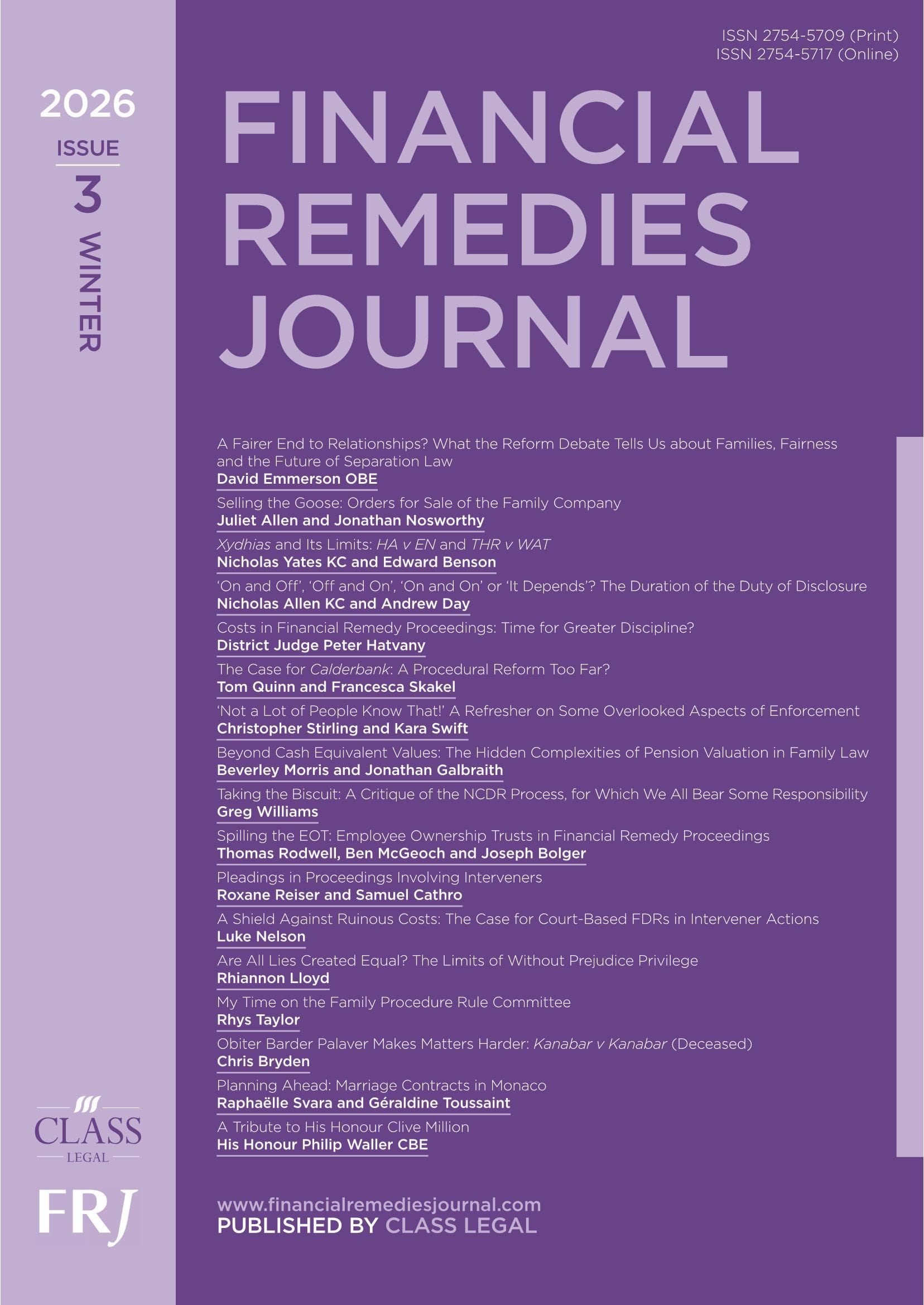
Now out: Financial Remedies Journal 2026 Issue 3 (Winter 2026)
The Case for Calderbank: A Procedural Reform Too Far?