
Important Recent Case Developments (May 2026 to September 2026 inclusive)
[2026] 3 FRJ 268. Noteworthy case law developments since the last issue went to press in the early autumn, including EC v EC [2026] EWFC 275 and Kanabar v Maganal Kanabar (Deceased) & Anor [2026] EWCA Civ 582.
These are the noteworthy case law developments since the last issue went to press in the early autumn. Not all of them are citable as precedent, but they are all useful in some way.
Prenups and preliminary hearings
In EC v EC [2026] EWFC 275, Peel J clarified whether or not the validity of a prenuptial agreement should be addressed at a preliminary hearing or dealt with at a final hearing. His view was that while it is an option to hold a preliminary hearing for this purpose, it will be the exception rather than the rule. It is, he said, it is typically faster, cheaper and more conducive to a holistic assessment of the evidence to consider the agreement alongside all of the section 25 factors at a final hearing. This makes sense given that most successful challenges to prenups are on the basis that they don’t meet needs, rather than that of, for example, insufficient disclosure or undue pressure. In IC v AD [2026] EWFC 224, neither of the counsel appearing before HHJ Hess could identify any case in which there had been a departure from the terms of a valid prenuptial agreement other than to meet need.
Death and financial remedies
I knew a solicitor who moved from practising family law to wills and probate and pronounced it lovely, as everyone was dead. This was, evidently, before the rise in contested probate. Now, one can conveniently combine a practice in financial remedies with death, as the following cases demonstrate.
Kanabar v Maganal Kanabar (Deceased) & Anor [2026] EWCA Civ 582 asked what the court should or could do when an appellant, to whom permission to appeal has been granted, dies intestate with no person willing to apply for letters of administration. The Court of Appeal held that the appeal has to be struck out under FPR 30.10 for want of someone to prosecute it. The court did not deal with the equally interesting issue of whether an appeal survives the death of the appellant anyway, nor what the court might do given the usual rule that financial remedy claims are personal rights which end on death (see Unger & Anor (in substitution for Hasan) v Ul-Hasan (Deceased) & Anor [2023] UKSC 22), and the limited exception Barder v Caluori [1988] AC 20 provides to this.
In KC v CO (Deceased) (Orders for Sale after Death of a Party) [2026] EWFC 165 (B), the family home was subject to a Mesher order. When the wife died, the ex-husband applied for an order of sale, the wife’s death being a trigger event. Deputy District Judge Harrop struck out the claim, holding (again, because of Unger) that it did not survive the death of the wife. The route forward was to bring an application under the Trusts of Land and Appointment of Trustees Act 1996.
Invading non-matrimonial inheritances
P v P (Inheritance at the End of a Long Marriage) [2026] EWFC 209 (B) is a decision of Deputy District Judge Hodson. The parties were of very modest means, having about £330,000 between them plus pensions. There was, therefore, insufficient to rehouse them. Then, 6 months before the parties’ separation, the husband’s father died and, after separation, the husband inherited some £310,000.
The wife’s position was that she should receive all the non-marital pension assets, leaving the husband with his inheritance by way of capital. This was not fair, said the judge. The inheritance was not a marital asset. It formed no part of the parties’ standard of living. The husband was ill and had a shortened life expectancy. His father would have had in mind the husband’s lifelong health needs when deciding to leave him that money. The wife’s needs could be met by working more hours and by half the equity in the family home plus a mortgage. It was therefore unnecessary to invade the inheritance to meet needs, the only justification for that.
However, in this case there was a practical reason for invading the inheritance and that was to give the wife an offsetting lump sum in lieu of a pension share. The husband had drawn his pensions due to his ill health, and argued that he needed this income to supplement his reduced earning capacity. After considering the PAG guidance, Martin-Dye v Martin-Dye [2006] 2 FLR 901 and W v H [2020] EWFC B10, Deputy District Judge Hodson held that while offsetting is not to be adopted casually, it may be justified where fairness demands it. This was one such case.
A primer on Wells sharing
Culligan v Rosemin-Culligan [2026] EWCA Civ 948 is a Court of Appeal decision (Moylan, Coulson and Arnold LJJ) on when Wells sharing is appropriate. It contains a very helpful overview of the relevant law at [54] ff. Moylan LJ, who gives the court’s judgment, holds that, ‘there is no principle that Wells sharing is only to be included as part of an award as “a last resort” nor, indeed, that it should only comprise a minority element’. He continues, ‘there is, equally, no principle that it should be “standard fare” having regard to the well-recognised disadvantages of Wells sharing and to the potential for it to be inconsistent with a clean break … Much will, of course, depend on the facts of the particular case’.
Global orders
In P v M (Appeal: Unfair Hearing: Variation of Periodical Payments: Global Orders) [2026] EWHC 1330 (Fam), a decision of Harrison J, the wife appealed an order reducing her periodical payments award as a result of changes in the husband’s income.
The original order provided for staged decreasing periodical payments to the wife, and separately for child maintenance. Both sets of periodical payments were linked to RPI. Although not child maintenance, the points at which the spousal payments decreased were at key ages for the child – aged 5; aged 11; aged 18; and then the end of tertiary education – and the precise apportionment between wife and child had been given little consideration.
The case reached Harrison J by way of appeal from a subsequent variation order that reduced the periodical payments and removed indexation, meaning a cumulative loss to the wife of some £134,538 over the life of the order; and because of some startling procedural irregularities in the judge’s conduct of the variation hearing. The CMS had somehow also assessed the husband at a modest amount, notwithstanding his admission that his income exceeded their cap.
On appeal, the wife sought a global order to mitigate the effects of the reduction in child maintenance, which was awaiting a child support tribunal hearing. As Harrison J noted, global orders have only ever been used where there is no CMS assessment but the potential for one. They have not been used in circumstances in which there had been a CMS assessment already. There was no reason why they could not be used in this way, said Harrison J, suggesting that:
‘a self-adjusting spousal order could be crafted as follows (with further insertions in accordance with the latest edition of the Standard Orders depending upon, amongst other things, whether it was to be a joint lives or term order):
“The [applicant]/[respondent] shall pay to [applicant]/[respondent] maintenance pending suit until the date of [decree absolute] [the final [divorce] [dissolution] order] and afterwards periodical payments.
Payments shall be at the rate of £[amount] per month annum less the amount of any annual sum which the [applicant]/[respondent] is required to pay to the [applicant]/[respondent] for the benefit of the child[ren] of the family, whether pursuant to an order of the court or an assessment of the Child Maintenance Service. The payments shall be payable [weekly]/[monthly] [in advance]/[in arrears] by standing order.”’
‘Framed in this way’, Harrison J continued, ‘such an order could not offend the scheme of the 1991 Act. It would ensure that there was no double-counting between the elements of spousal and child maintenance which overlap’.
This article draws on the case summaries prepared by the FRJ summariser team. As ever, I am grateful to the team.


Latest
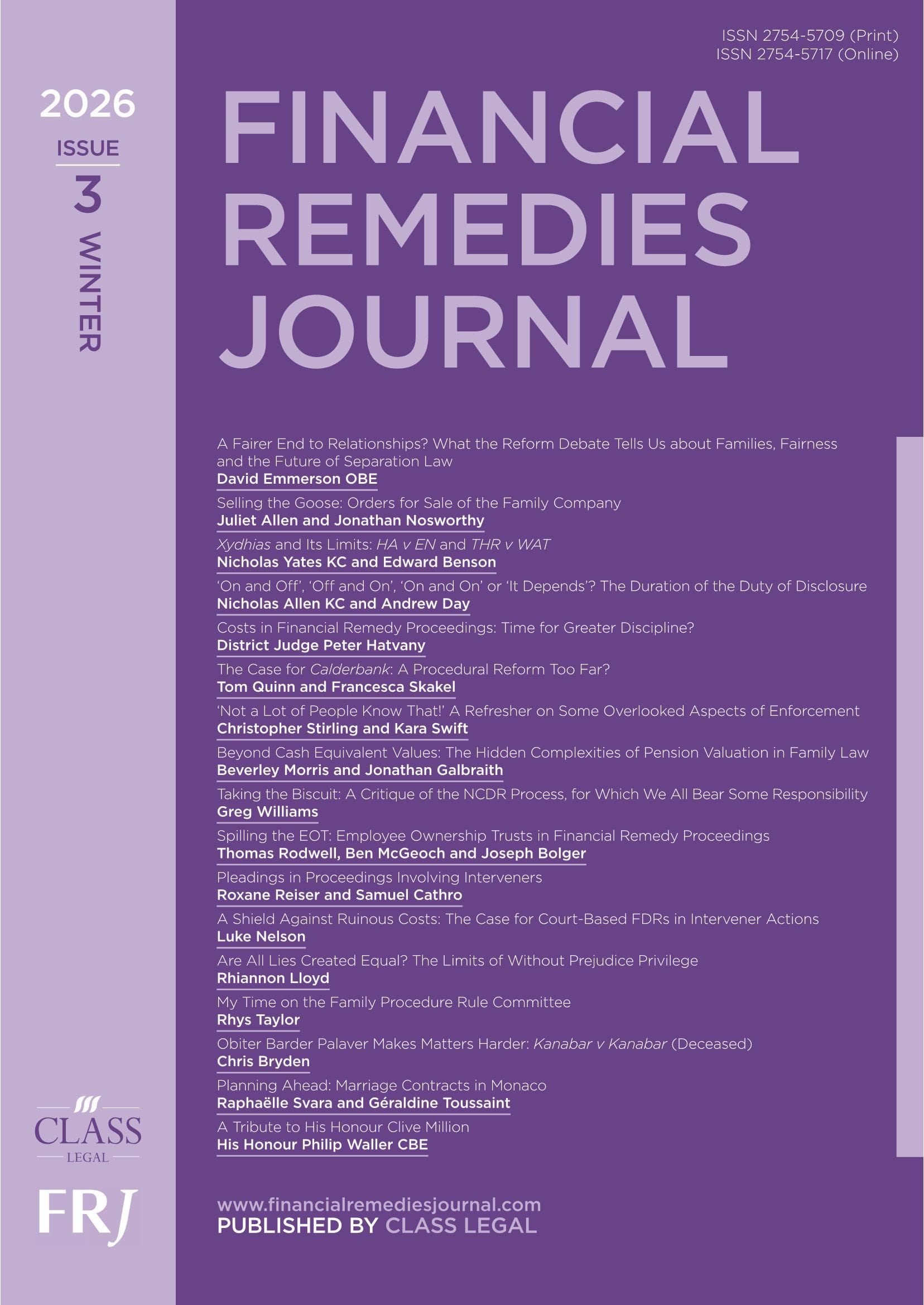
Now out: Financial Remedies Journal 2026 Issue 3 (Winter 2026)
The Case for Calderbank: A Procedural Reform Too Far?