
Book Review: Financial Remedies Handbook 2025
[2026] 1 FRJ 74. Rhys Taylor reviews the 15th edition of Financial Remedies Handbook 2026, by District Judge Sophie Harrison, published by LexisNexis, and says every financial remedy lawyer should have it by their side.
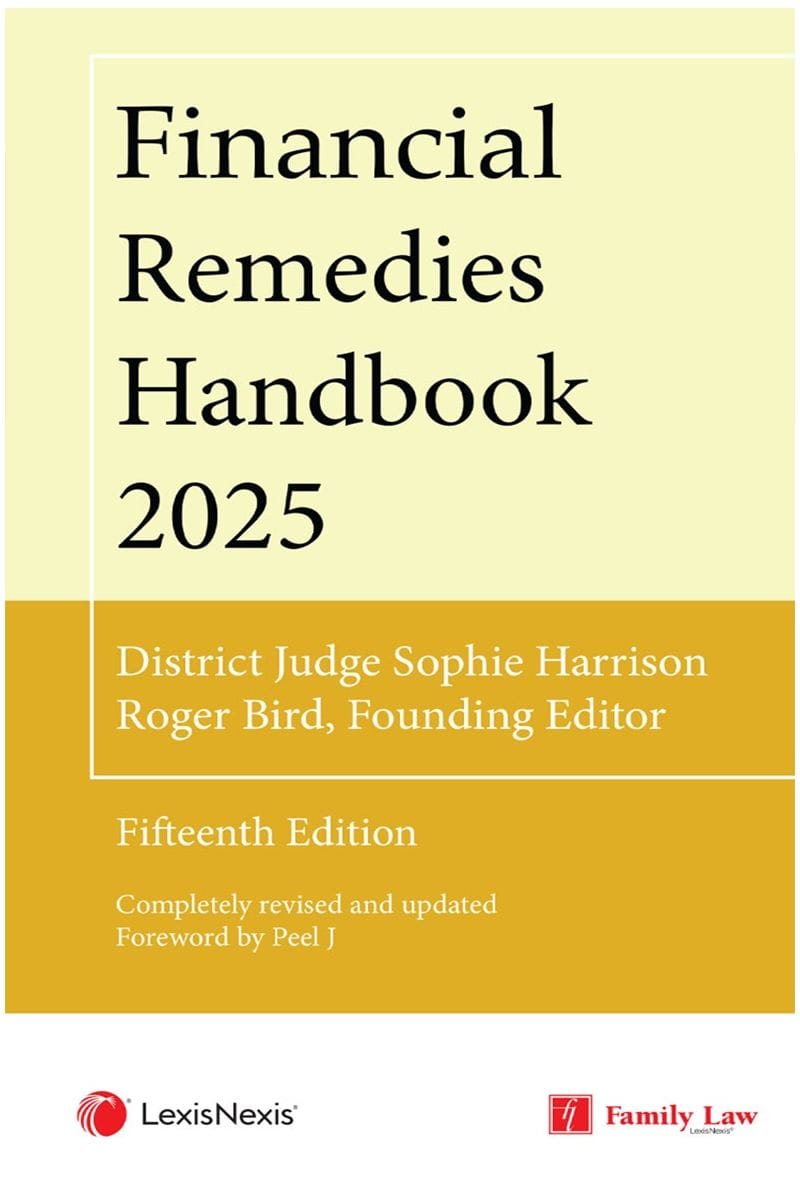
District Judge Sophie Harrison (LexisNexis, 15th edn, 2025)
Every financial remedy lawyer should have the Financial Remedies Handbook, now in its fifteenth edition, by their side. It is on the shelves of the good and the great. It is at once an accessible and authoritative statement of the law in this area.
The current editor is District Judge Sophie Harrison. In her preface she makes reference to the fact that this edition is fully revised and updated. But she then adds something which is quite profound. She states, ‘My aim has been to “simplify and add lightness” (to quote Colin Chapman, designer of Lotus racing cars)’.
If only we could all ‘simplify and add lightness’ in our contributions to family justice. Physician heal thyself.
District Judge Roger Bird’s Ancillary Relief Handbook, as it then was, goes back to the distant days of 1998. I was a baby barrister back then. I am old enough to have actually appeared before District Judge Bird. I recall well its publication.
The Pilot Scheme was underway, but yet to have solidified into the universal procedure now adopted in this area. Notes and schedules were not commonplace, certainly so ‘in the provinces’, where I started out. I recall when an opponent first turned up with a note and thinking that they were a swot and a show off. A schedule of assets, when it was done at all, was more often than not done in a Word table. This was an age pre-White. It was pre the Mostynian age of precision, principle and predictability. The outcome depended on discretion and the length of the judge’s foot. Orders were much shorter. Judges were older and more terrifying, as I recall.
The Handbook was pitched against Rayden & Jackson, Duckworth, Wildblood and Eaton (all looseleaf or eventually looseleaf or semi-looseleaf) and Jackson’s Matrimonial Finance. They were all much grander texts than the Handbook. Their multi-volumes and/or deluxe binding conveyed a sense of weight and authority, just by being placed on a shelf behind a financial remedy lawyer. Or so some of us thought. Being the lightest text in this busy market, I daresay the Handbook was sometimes furtively consigned to the desk drawer rather than proudly displayed. But by my observation, it has always been consulted, even by the most experienced of practitioners. Of course, in our digital age, all of this must sound quite ridiculous to the generations that have followed.
But despite the so-called ‘grandness’ of a text or otherwise, it is instructive to take them on a road test and see how they perform. For instance, compare the Handbook’s treatment of Miller/McFarlane as against, say Jackson’s Matrimonial Finance. Answers on the back of a postcard (remember that) as to which text provides the most helpful exposition.
The Handbook’s chapter on pensions on divorce simplifies the quagmire of issues to a commendable 37 pages. It is one of the most accessible treatments of pensions on divorce that the eponymous ‘busy practitioner’ will find. It has been thoughtfully organised and well considered. Likewise, the chapter on income orders is a model of concise and clear exposition.
District Judge Harrison is still immersed in the law reports. In the chapter on provision for children there is a postscript entitled ‘A good read’ enjoining the study of HHJ Hess’s judgment in Goodman v Walker [2024] EWFC 212 (B) on the basis it ‘… is recommended for the sheer enjoyment of the read’.
Is it too mischievous to observe that the Handbook has always had a former-solicitor-district judge at the helm? The district bench is at the battle-hardened front line of financial remedy justice. The ‘grander’ competitor texts are conventionally staffed by committees of my brethren at the Bar. Dare I suggest that the Handbook has been all the more nimble for it? District Judge Harrison’s experience in this field shines through.
Parts of the grander texts now seem to resemble ancient Byzantine cities, built upon down the generations, without anyone ever making a fresh start from one edition to the next. District Judge Harrison’s spring clean of the text ensures that the reader is taken directly to the key contemporary issues.
But the aim to ‘simplify and add lightness’ should extend beyond the four corners of our textbooks. It should be our mantra. Much has improved in the last 25 years. But have we collectively made something of a meal of sorting out finances on divorce? Is the law of financial remedies accessible to most who would seek out our services? Do some even care? Will the current state of affairs be allowed to persist?
I have seen teams of eminent and well-paid lawyers argue, as if order in the universe itself depended on it, as to whether there should be compliance with a direction of the court by 12 noon or 4 pm. Erudite and expensive submissions, but is the process sometimes eating itself alive with the contention and complexity which is injected into what should otherwise be quite straightforward decisions? Should we be adopting District Judge Harrison’s mantra and be seeking to ‘simplify and add lightness’.
The Handbook was ahead of its time in stating the law in simple but authoritative terms. The Handbook has kept up that fine tradition down the years. The Class Legal Dictionaries have this as their inheritance. The current edition is an exemplar. Sophie Harrision is to be commended for her simplicity and lightness.
I wonder what car she drives at the weekend?
This is an article from the forthcoming Financial Remedies Journal 2026 Issue 1.
Related
Chair’s Column (Spring 2026)

The Reluctant Pension Credit Member
Book Review: Dictionary of International Family Law


Related
Chair’s Column (Spring 2026)
The Reluctant Pension Credit Member
Book Review: Dictionary of International Family Law
Latest
The Reluctant Pension Credit Member

Housing Particulars: Mind The Gap