
Summary of Government’s Consultation on Fairer End to Relationships
Graeme Fraser summarises the Government’s Consultation on Fairer End to Relationships.
1. Consultation opens on 5th June and closes on 14th August 2026
2. Themes in foreword by Rt Hon David Lammy, Deputy PM, Lord Chancellor and Secretary of State for Justice
- Demographic changes; protection against domestic abuse a key theme; financial remedies law to provide clarity and fairness on divorce encouraging agreement and settlement wherever possible; introducing Qualifying Nuptial Agreements (QNAs) to give couples greater autonomy planning their future financial arrangements, so that couples can decide in advance how to arrange finances, with important safeguards to meet needs and protect against coercion; commitment to supporting strong and stable family relationships; providing safeguards for cohabitants protects against destitution.
3. Executive summary
- Financial remedies – codification plus and introducing QNAs; statutory framework of rights and protections for eligible cohabitants, which should be narrower than on divorce; modernise law affecting cohabitants on intestacy and financial provision from a deceased partner’s estate.
- Principles underpinning the consultation – Prioritising fair outcomes for children; protecting the vulnerable; providing a clear and accessible framework; preserving the distinct status of marriage.
- Financial remedies – codifying sharing and needs. On needs, consider child’s welfare first, then individual’s welfare needs, and further discretionary needs where resources permit; introduce binding QNAs supported by safeguards; consulting on whether to give greater weight to impact of domestic abuse, including CCB or economic abuse both on financial remedies on divorce and on cohabitant separation.
- Cohabitation Reform – Eligibility limited to adults in long term committed and interdependent relationships who have lived together for 3 or more years or live together and share a child, with more limited awards for shorter relationships. Starting point is that each person keeps what they legally own departed from only where it is necessary to meet an individual’s defined needs assessed more narrowly than on divorce, excluding discretionary needs so that cohabitants cannot get more favourable outcomes than spouses in comparable circumstances. Children’s welfare to be the first consideration. Clean break should be achieved wherever possible with remedies similar to divorce and maintenance limited to exceptional and time bound circumstances such as long-term health issues.
- Cohabitation Reform on intestacy – Extending intestacy rights to qualifying cohabitants to inherit automatically where their partner dies without a valid will subject to meeting a definition and minimum duration period. Rights of qualifying cohabitants to administer their partner’s estate to be aligned with new inheritance entitlements. Consultation to remove qualifying time periods for cohabitants to apply for financial provision where the surviving partner and the dependant had children together.
- These proposals sit alongside the government’s work to reform weddings law, making it simpler and more flexible for couples to marry in a way that is meaningful to them.
4. Core features of the financial remedies codification plus model are:
- a clear objective for financial remedies on divorce by applying the meeting of needs and sharing assets;
- a coherent and structured framework where matrimonial property should be shared equally as a starting point, unless unequal sharing is required to meet needs;
- a methodical approach to meeting needs;
- definitions of ‘matrimonial property’ and ‘non-matrimonial property’;
- binding nuptial agreements; and
- current remedies under the MCA 1973 will remain unchanged.
5. A three-stage hierarchical approach is proposed for applying the needs objective:
- Stage 1: Children’s needs come first;
- Stage 2: Consider divorcing couple’s capital and income needs, including their housing and pension needs;
- Stage 3: Consider discretionary needs, where resources permit, which are for lifestyle “luxuries”. By contrast, Stage 3 would not be available on cohabitation separation or where a QNA is challenged.
6. Misconduct, including domestic abuse, should be treated consistently by the Family Courts across both financial remedies law and its proposed cohabitation framework.
7. The safeguards required for a QNA are contract validity; execution as a deed; 28 days before the wedding; material financial disclosure; and, independent legal advice.
8. Where a QNA is challenged on the basis it does not meet one party’s needs, those needs should be assessed on a narrower basis similar to those proposed for cohabitants. Discretionary needs would not be considered.
9. The government recommends codification of a pre-marriage cohabiting relationship counting towards the marriage where that relationship moves seamlessly from cohabitation to marriage as counting towards the length of the marriage with cohabitation determined by their definition of cohabitation in the new cohabitation law.
10. The Core Definition of a cohabitant on separation means that the framework should be two people living together as a couple in an enduring relationship. Factors suggested include existence of a joint household; stability of the relationship; financial arrangements; responsibility for children; presence of a sexual relationship; and, public recognition of the relationship.
11. The government proposes a two-year time limit for bringing a financial claim after a cohabiting relationship has ended.
12. The sharing principle should not be applied to cohabitants. The compensation model recommended by the 2007 Law Commission report will not be adopted. The needs-based framework proposes an overarching policy aim for the court when making financial orders; a clear objective of meeting needs; a clear way in which the objective should be applied; and, a list of factors for the court to consider when applying the objective. The Clean Break principle should apply.
13. Core features of the cohabitation reform model are that Children’s needs come first; then consider the individual’s own financial needs, including housing, capital, income and pension needs, taking into account the standard of living during the relationship, with discretionary needs such as luxury items excluded. Ongoing maintenance would only be available exceptionally with needs met in most cases through capital rather than income provision. Hardship would be taken into account.
14. When assessing needs, factors would probably include earning capacity; financial resources of an individual; any physical or mental disability; age and length of relationship; and that a decision made during the relationship which might have affected a person’s financial position such as reducing hours to care for a child would be relevant. Misconduct should be taken into account.
15. The same menu of remedies would be available to cohabitants as to divorcing couples but on a more limited basis with maintenance only available in exceptional circumstances such as serious health issues or disability. Maintenance will be defined and limited and non-extendable.
16. Safeguards for opting out agreements from cohabitation remedies are that contractual validity; execution as a deed; material financial disclosure; and independent legal advice, but no requirement to be made 28 days in advance of commencement of cohabitation
17. TOLATA and contract law will remain where the cohabitants are ineligible or time barred from applying. Opt out agreements should not prevent applications for child maintenance to the CMS nor Schedule 1 claims.
Related

A Fairer End to Relationships? What the Reform Debate Tells Us about Families, Fairness and the Future of Separation Law – A Personal Review of the Responses from a Part-time Judge and Hybrid Mediator
EC v EC [2026] EWFC 275
EC v EC [2026] EWFC 275


Related
A Fairer End to Relationships? What the Reform Debate Tells Us about Families, Fairness and the Future of Separation Law – A Personal Review of the Responses from a Part-time Judge and Hybrid Mediator
EC v EC [2026] EWFC 275
EC v EC [2026] EWFC 275
Latest
A Fairer End to Relationships? What the Reform Debate Tells Us about Families, Fairness and the Future of Separation Law – A Personal Review of the Responses from a Part-time Judge and Hybrid Mediator
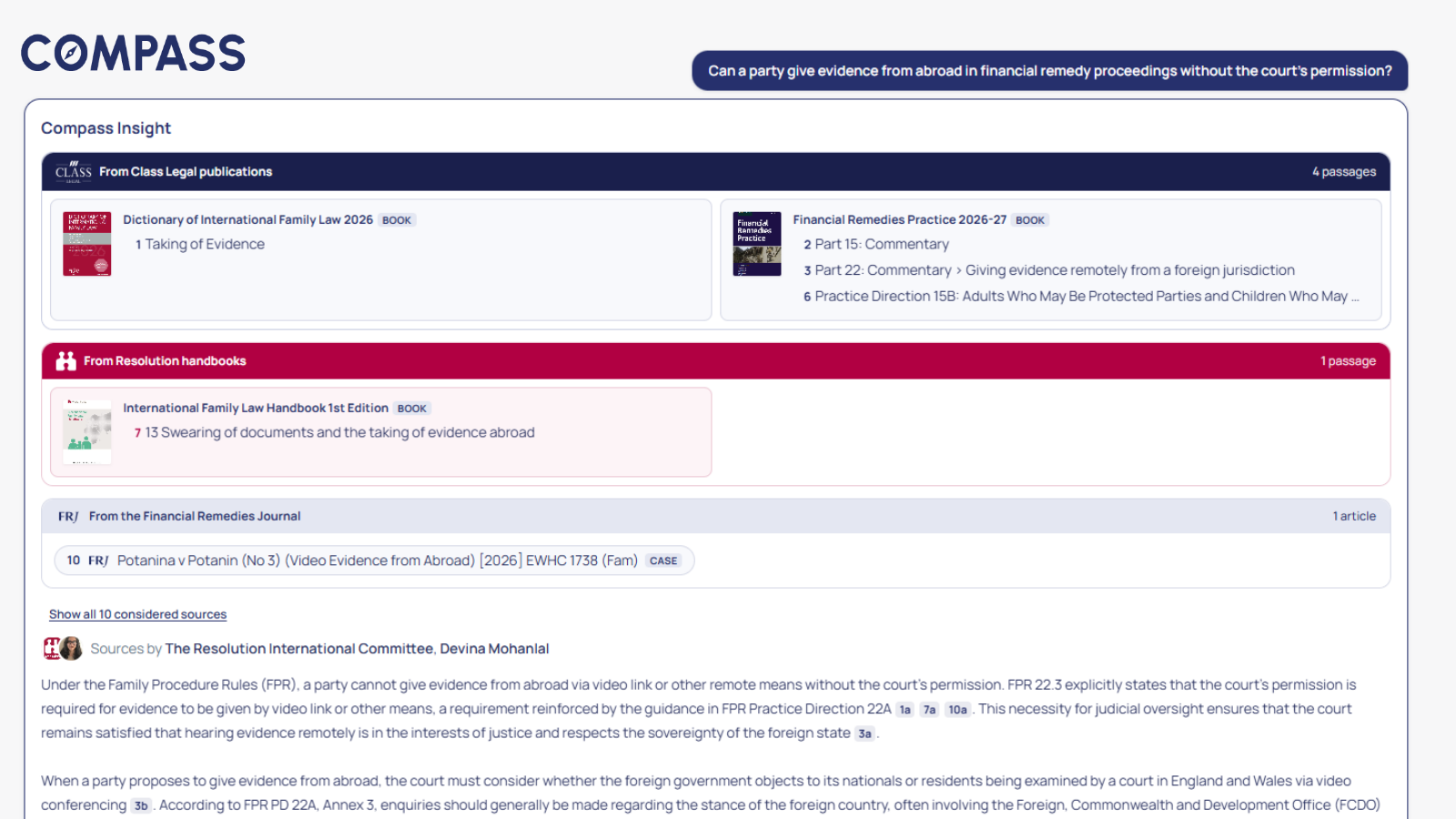
Class Legal partners with Resolution to expand trusted family law resources in Compass