
Section 25(2)(g): Consign It to the Past So Survivors Can Start Their Future
Cusworth J's judgments in LP v MP [2025] EWFC 473 and Wei Lyn Loh and Ardal Loh-Granger [2025] EWFC 483 have dusted off s 25(2)(g) MCA 1973. Limited to use in only the most serious instances, this factor should be consigned to the history books.
The 2026 judgments of Cusworth J reported as LP v MP [2025] EWFC 473 and Wei Lyn Loh and Ardal Loh-Granger [2025] EWFC 483 have dusted off s 25(2)(g) Matrimonial Causes Act 1973. Limited to use in only the most serious instances, this factor should be consigned to the history books rather than being hailed as a path to victim recompense.
On reading the Cusworth J judgments, what is striking is the ‘deplorable’ and ‘egregious’ acts perpetrated by one partner against another in what should be the safe and loving environment of a marriage. It is far from unusual. In my 20 years of practice, I have seen some truly horrid behaviour committed in the confines of an intimate relationship. Those who find their way out of abusive relationships, in whichever form that abuse takes, should be protected by the law, with their personal safety being the court’s prime consideration. This does not mean however that this behaviour should frame the outcome of a financial remedy case.
Moving away from moral judgement
The most significant shift in family law during my years in practice has been the elimination of the need for fault in divorce. The Divorce, Dissolution and Separation Act 2020 removed the need to evidence the reason for one’s separation, with a simple declaration that a marriage had irretrievably broken down sufficiently to progress a divorce. The moralising of the 1960s, when the Matrimonial Causes Act 1973 was drafted, was swept away to reflect modern society.
Section 25(2)(g) is another relic of the past which has been subject to considerable judicial gloss to make it a rare bird. Rather than this factor being confined to a cage, the ability for a judge to exercise a moral judgement should be extinguished once and for all. There are few things worse for a survivor of an abusive relationship to be told that what they have endured is not sufficient to reach the very high standard set by the line of authorities on s 25(2)(g). It nullifies their experience and belittles their trauma.
The delay to moving forward
Findings of fact need to be made about conduct for it to sound in an award, but all this does is elongate the process, delaying the ability to move forward from a destructive relationship. It inhibits the ability to settle a financial remedy claim as conduct is, by its very nature, divisive, all of which adds up to increasing the judicial burden on an already overflowing system, prohibiting a party from moving on with their life.
All survivors should be treated equally
The difficulty with s 25(2)(g) is it cannot be considered in isolation. It forms part of the blend with the other s 25 factors which forms the discretionary judicial exercise. It means that even the most grievous behaviour may not sound in an award if there is not enough money to meet need in the first place.
The wife in LP v MP walked away with a house, a canal boat, various overseas assets and a payment of £750,000. Although less than 50% of the matrimonial assets, it was still a significant settlement, despite her cruel and usual treatment of the husband. Cusworth J did not need to go through a detailed exercise to determine the baseline of need as he was (quite rightly) satisfied that her needs could be met.
The revival of s 25(2)(g) has the ability to treat rich survivors in a different way to those less affluent, reducing the validity of experiences as their mistreatment would never find its way into an award. Abusive behaviour affects all those who survive it, no matter the size of their asset base. No lawyer should have to advise their client that a court would only consider the abuse they suffered if their case had more zeros on the asset schedule.
Flexibility is already there in s 25
The beauty of s 25 is its flexibility. Outcomes are tailored to each individual couple as one size does not fit all. It also means that s 25(2)(g) is otiose given the wide discretionary powers conferred by the other sections. Cusworth J could have reached the same conclusion about the wife’s award in LP v MP if his judgment included only paragraphs 33(a) and (b). The tools are already there to reach fair, nuanced decisions without the need for survivors to endure cross examination about the worst parts of their relationship.
Non-disclosers and bad litigators should still be punished
Some bad behaviour does have place in financial remedy. Not that which takes place during the marriage, requiring survivors to dissect and divulge the most intimate details of years gone by, but that which deliberately attempts to stop someone from moving forward once they have made the decision to separate. Those who are deliberately untruthful with their disclosure, manufacture evidence, like Mr Ardal Loh-Gronager, those who refuse to negotiate openly, those who cause delay should all be penalised but in costs, not as part of the award. Costs is the way to remedy bad litigation, not by tweaking the fundamental award.
Keeping s 25(2)(g) in the statute does not advance survivors’ rights. This section is divisive and potentially damaging to a survivor’s ability to move forward if their case is found wanting. The need to revisit the past in an adversarial setting or simply not being wealthy enough for the perpetrator to meet their needs on a reduced award denies access to a section of the Matrimonial Causes Act 1973 which is so very rarely used anyway.
Section 25(2)(g) is from a bygone time. Superficially, it appears to offer the protection to those mistreated in their relationship but has far greater potential to harm than to heal.
Related

A Fairer End to Relationships? What the Reform Debate Tells Us about Families, Fairness and the Future of Separation Law – A Personal Review of the Responses from a Part-time Judge and Hybrid Mediator

Is It Time for the Conclusions in Waggott to Be Reconsidered?

The Fairer End to Relationships Consultation: The FRJ's Complete Coverage


Related
A Fairer End to Relationships? What the Reform Debate Tells Us about Families, Fairness and the Future of Separation Law – A Personal Review of the Responses from a Part-time Judge and Hybrid Mediator
Is It Time for the Conclusions in Waggott to Be Reconsidered?
The Fairer End to Relationships Consultation: The FRJ's Complete Coverage
Latest
A Fairer End to Relationships? What the Reform Debate Tells Us about Families, Fairness and the Future of Separation Law – A Personal Review of the Responses from a Part-time Judge and Hybrid Mediator
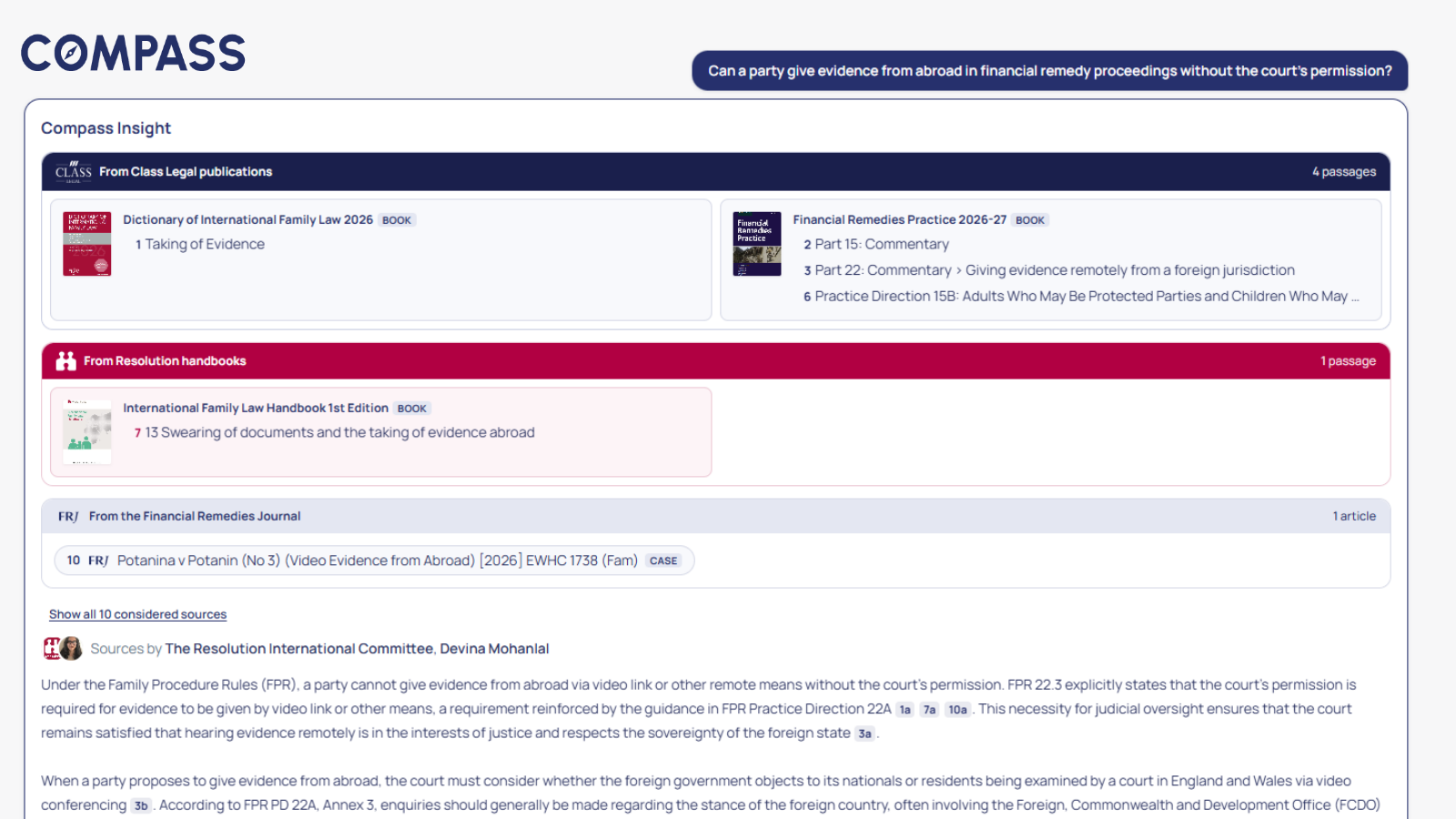
Class Legal partners with Resolution to expand trusted family law resources in Compass